The German installation artist Henrike Naumann died on February 14, at the age of 41, from cancer, her family has confirmed. Naumann was preparing to represent Germany at this year’s 61st Venice Biennale alongside artist Sung Tieu and curator Kathleen Reinhardt.
“With Henrike Naumann’s passing, we have lost not only an important representative of contemporary German art, but also a warm-hearted, alert, and highly committed personality,” read a statement from the Institut für Auslandsbeziehungen (Institute for Foreign Cultural Relations), which commissioned the pavilion. “Her legacy lives on.”
Born in former East Germany, Naumann was celebrated for her highly original approach to examining the country’s history, its influence on today’s geopolitical tensions, and the rise of far-right populism. With a background in scenography, she found visual metaphors for our socio-political reality in the everyday furniture and design objects that articulate our interiors and our lives.
A formative event in development of Naumann’s conceptual approach was the discovery, in 2011, that the National Socialist Underground–a collective of white supremacists later charged with targeting Turkish, Greek, and Kurdish immigrants–had been operating a secret hideout in Naumann’s hometown of Zwickau. This disturbing revelation led her to use the domestic space as a lens through which to consider how the huge political and cultural upheaval experienced by post-reunified East Germany had provided the conditions for extremism.
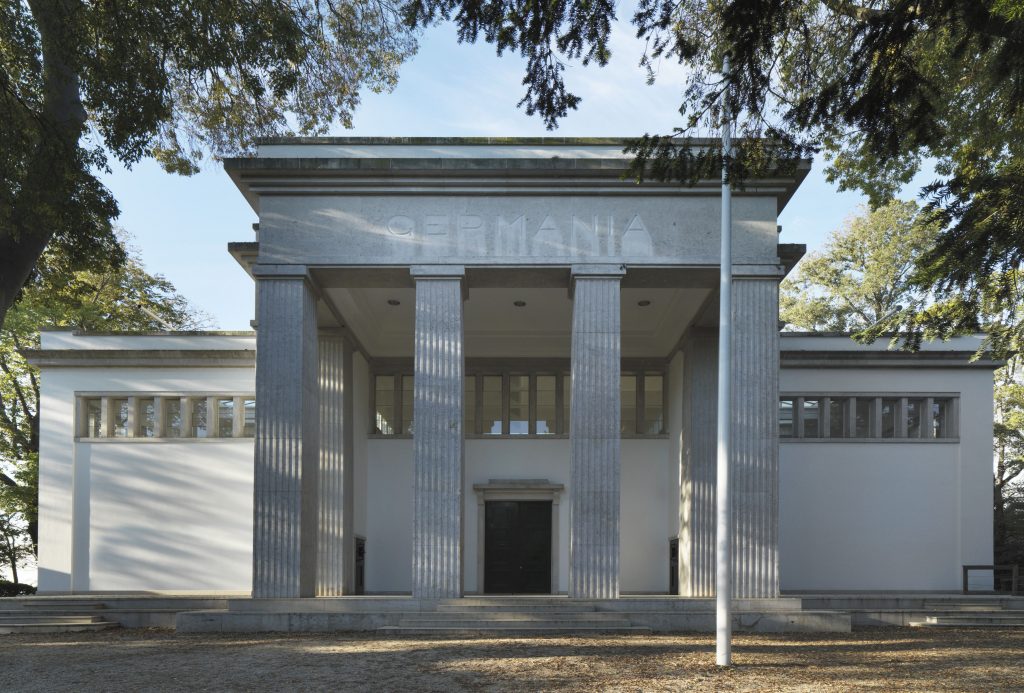
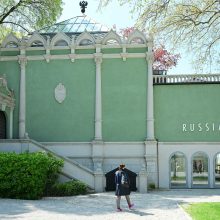
Exterior view of the German Pavilion at the Venice Art Biennale. Photo: Jens Ziehe
Naumann had developed these aims over 15 years, and her work has been shown at a long list of prestigious venues, including Documenta 15 in Kassel, Gropius Bau in Berlin, Haus der Kunst in Munich, Schirn Kunsthalle in Frankfurt, the 2018 Busan Biennale, Belvedere 21 in Vienna, Pinchuk Art Center in Kyiv, and the SculptureCenter in New York. Her inclusion in the 61st Venice Biennale was set to be the crowning achievement of her career, and was described as a “passion project” of Naumann’s in a statement by her family.
The team behind the German pavilion said it was “deeply affected” by news of Naumann’s sudden death. “Over the past months, she developed the work conceptually and finalized it in recent weeks,” it said in a statement, promising to work with Henrike’s studio team “to realize her artistic vision” as planned this May.
Born in 1984 in Zwickau, then part of East Germany, Naumann started out working as a film and television scenographer, having studied stage and costume design at the Dresden Academy of Fine Arts. After reorienting toward fine art in 2011, she began using the cheap, discarded furniture that had become commonplace in East Germany in the 1990s to create stage-like installations.
“After German reunification, mass-produced copies of postmodern designs flooded East German homes,” Naumann explained to Artforum in 2022. “People got rid of their socialist furniture and bought these pyramidal cabinets, a political-aesthetic shift that shocked and excited me as a child.” Even a seemingly innocuous show like the Flintstones, suddenly imported, retroactively applied contemporary American ideals to prehistory, continually re-establishing them as the norm.
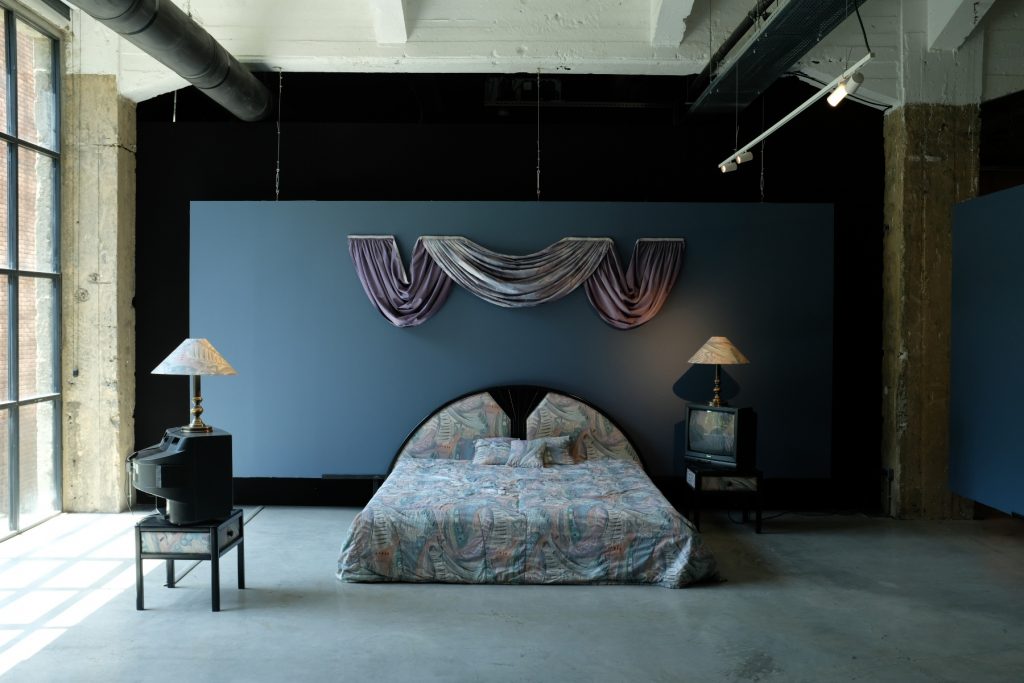
Henrike Naumann, EVROVIZION installed at Tbilisi Photography & Multimedia Museum (TPMM), Tiflis, 2024. Photo: Tbel Abuseridze, courtesy TPMM.
“I want viewers to critically consider the things they’ve grown up with and interrogate aesthetics that might seem funny, weird, or unserious, but that can also be deeply dangerous,” she said.
Her project “Triangular Stories,” initiated in 2012, explored the dual forces of hedonism and radicalization that defined youth culture in 1990s East Germany. In an imagined teenage bedroom, two TVs play what appear to be VHS home videos documenting scenes from the lives of adolescents. In one video, Amnesia, they seek escapism by experimenting with drugs in Ibiza. In the second, Terror, three fictitious youth instead turn to vandalism and violence. Chilling clues from the installation, like a Imperial War Flag, are mixed in with banal domestic details, like a Mickey Mouse toy or a Nintendo Gamebody.
Some of Naumann’s more recent projects had expanded this approach to look at international politics. In 2022, for example, her first U.S. exhibition, “Re-Education” at New York’s SculptureCenter, included new work inspired by the use of furniture to storm the Capitol on January 6, 2021. Large pieces of Federal-style furniture–”a quintessentially American idiom adapted from neoclassicism”–were stacked into towering monuments that almost resembled rioters themselves.
Naumann is survived by her husband Clemens Villinger and their daughter.