Art History
How Hans Holbein’s Paintings Made the Tudors Cultural Icons
A new biography explores how the German painter’s portraits shaped the public image—and enduring legacy—of England’s most famous royal family.

A new biography explores how the German painter’s portraits shaped the public image—and enduring legacy—of England’s most famous royal family.
Jo Lawson-Tancred
 ShareShare This Article
When we think of the Tudors, we think of majestic paintings in which they appear triumphant, ruffed, and dripping in finery. Across Renaissance Europe, portraiture was beginning to play a crucial role in the politics of court life. In England, it was the vision of a German painter, Hans Holbein the Younger, that came to define the era, thanks to his unique ability to confer power with his paintbrush.
Even 500 years later, rulers from the mighty Tudor dynasty are almost instantly recognizable. With T.V. shows like Wolf Hall and popular West End musicals like Six, “it is incredible what a global phenomenon the Tudors have become,” said art historian Elizabeth Goldring. “Holbein is largely responsible for that.”
A new biography by Goldring, Holbein: Renaissance Master, traces Han Holbein the Younger’s astonishing journey from humble beginnings as an artist’s son in the German city of Augsburg to being designated the king’s official painter in Tudor England. Already out in the U.K., it hits bookshops in the U.S. on January 6.
One of Holbein’s greatest accomplishments remains his portrait of Henry VIII, in which the monarch appears feet apart and broad shouldered, with a bulging codpiece. It is the quintessential image of male authority. According to Goldring, one 16th-century eyewitness of the original Whitehall version reported that to stand before the portrait was to feel annihilated by the king’s presence. “I’m sure that’s exactly what Holbein was going for and what Henry wanted,” she said.
Consider too the age-old rivalry between courtiers Thomas More and Thomas Cromwell that lives on at the Frick in New York, where each stares the other down from either side of the fireplace. Outside of England, these men might have been mere footnotes in history, yet Holbein’s portraits have lent them enduring notoriety.

The Living Hall at the Frick Collection, New York. Photo: Joseph Coscia Jr.
Born in the winter of 1497-98, Holbein was in his late teens when he moved with his brother to the Swiss city of Basel to find work designing woodcuts and metalcuts for local printers. In keeping with their traditional training, the pair mainly produced religious art. But after the Reformation, demand for this kind of imagery suddenly disappeared. Holbein was forced to reinvent himself.
Prior to his first trip to England, which lasted two years between 1526 and 1528, Holbein had painted some portraits, including a 1523 image of the Dutch philosopher Erasmus. It was he who recommended the artist to Sir Thomas More, who welcomed Holbein to England. His famous painting of the courtier is from 1527, and during the same stay he did some minor work for the crown by devising ephemeral art and architectural features for court festivals.
By the time that Holbein returned to England in 1532, however, More was falling out of favor with Henry because he would not accept his separation from the Catholic Church and the annulment of his first marriage to Catherine of Aragon. Just a few years later he would be beheaded for treason. Holbein managed not to be tarred by his previous association with the ill-fated courtier.

Hans Holbein the Younger, Sir Thomas More (1527). Photo: Michael Bodycomb.
Instead, the artist worked his way into the king’s orbit, initially as a designer of plate and jewelry, an example of the many strings to his bow. It was his portraits, however, that really caught Henry’s attention, and he was officially appointed the king’s painter in around 1536. Shortly afterwards he produced his iconic Portrait of Henry VIII as part of a larger mural recording the Tudor dynasty at the Palace of Whitehall in London’s Westminster. It was destroyed by a fire in 1698, but remains known through many copies.
“We know that in creating that image, Holbein took some artistic liberties,” said Goldring. Though in the portrait Henry appears, tall, lean, and fit, the king’s health was actually in steep decline. He had had a serious jousting accident at the start of 1536, which left him unconscious for two hours. Accounts of his headaches and mood swings suggest he may have had a brain injury, while permanent damage to his legs made it difficult to walk and the king gained weight quickly. His surviving armor preserves a more accurate impression of his frame.
To what extent Henry may have had a role in the construction of his own image cannot be known. “I suspect Cromwell had some part in the sittings and discussions about what those portraits would look like,” Goldring said, of Henry’s right-hand man. “He was a bit of a control freak and very interested in art.”
Plenty of contemporary eyewitness accounts attest to how startlingly lifelike the Whitehall mural appeared to those high-ranking enough to see it. “Holbein was incredibly innovative and novel,” said Goldring. “It’s easy to forget that today, because so many of his images are familiar to us.” Though the portrait was unprecedented, it is possible that either Holbein or Cromwell were aware of Titian’s similarly lifesize, full-length image of Charles V with his dog from 1533. “If they were aware of it, they certainly wouldn’t have wanted Henry to look less powerful than the Holy Roman Emperor,” said Goldring.

Titian, Emperor Charles V with a Dog (1533). Image: © Museo Nacional del Prado.
Across Europe, the Renaissance saw a renewed interest in producing the kind of realistic likeness that had been commonplace in antiquity. “Holbein was operating on a much more sophisticated level than anyone who came before him in England,” said Goldring. Though the king had previously commissioned likenesses, he tended to make real statements through court festivals. “Once he sees what Holbein can do, the penny drops,” said Goldring. “He realized portraits could communicate a message of magnificence.”
This may well be the reason that Holbein fared well amid treacherous court politics, which saw the demise of some of his former allies. When Henry married Anne Boleyn, Holbein designed jewelry and decorations for the new queen’s coronation. She was later beheaded for treason but, by the time Henry was searching for a fourth wife, he entrusted Holbein with a critical diplomatic mission.
In the late 1530s, Holbein set off across Europe to record likenesses of prospective royal brides, and his image of Anne of Cleves contributed to Henry’s decision to marry her in 1540. The union was a disaster from the start. After a botched first meeting, Henry found himself unable to consummate the marriage and after six months it was annulled. Cromwell had pressured Henry to choose Anne, so this outcome put him in a vulnerable position. He was beheaded that same year. The king also took issue with positive accounts of Anne written by his courtiers but, remarkably, there is no surviving evidence that he ever criticized Holbein’s painting.
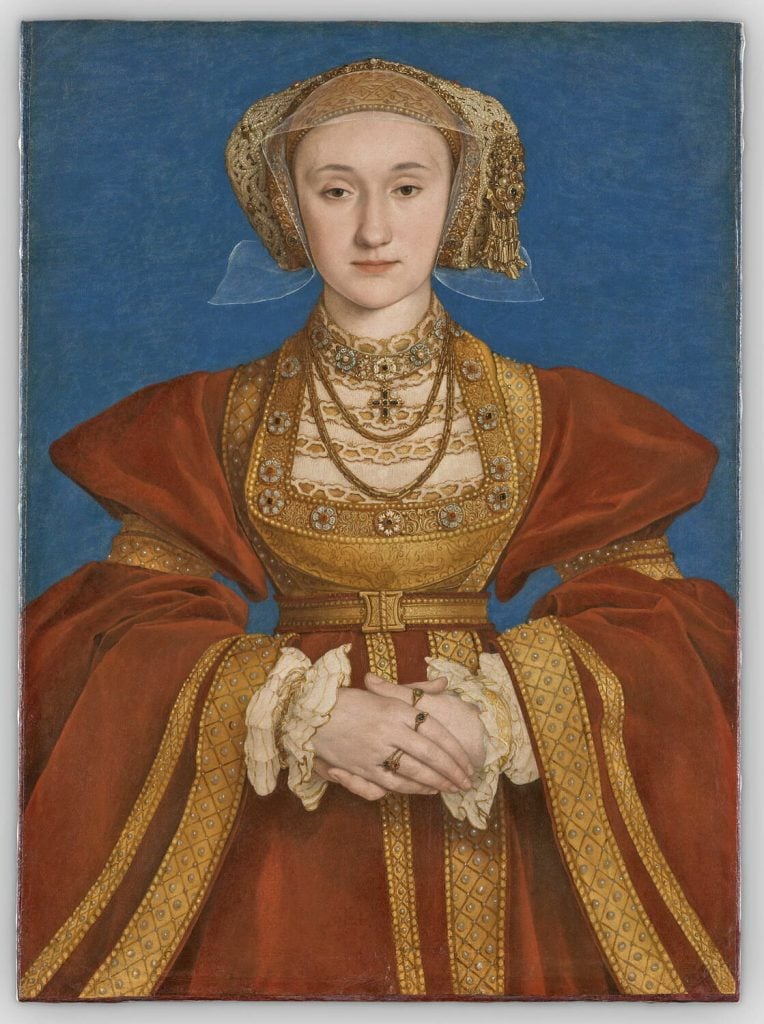
Hans Holbein, Anne of Cleves (ca. 1539). Photo: © 2017 RMN-Grand Palais (musée du Louvre) / Tony Querrec.
“Holbein must have been very shrewd about getting on with people,” Goldring suggested. “He seems to have had a good sense of who was on the up and who was on the way down.” His unique talents also provided some protection.
One story related by Holbein’s first, 16th-century biographer Karel van Mander describes an earl who interrupted Holbein at his studio one day to demand a portrait. When the artist refused, the dispute escalated into a physical confrontation and the earl later asked the king to punish the hotheaded painter. Henry is said to have replied: “I could turn seven peasants into seven earls if it pleased me, but I could never make another Hans Holbein.” Though Goldring suspects the story may have been exaggerated, she suggested that “there is a kernel of truth in there.”
One of the reasons that Holbein’s image of Henry VIII remains so iconic is that he had versions–including more portable half-lengths or headshots–distributed to courtiers across England and to his ambassadors in Europe. “We have to assume that Henry was handing these out as diplomatic gifts,” said Goldring, noting that a new fashion emerged for hanging these images in private homes. Her research into the inventories of important houses shows that, “prior to the mid-1530s, you only very rarely come across evidence of someone displaying a painted portrait of the king.”

Hans Holbein the Younger, Thomas Cromwell (1532-33). Photo: Michael Bodycomb.
In the print medium, Holbein designed a title page for the Coverdale Bible that featured Henry enthroned as God’s representative on earth. This work would have furthered the reach of Holbein’s vision into the hands of everyday people.
Holbein may have masterminded Henry VIII’s legacy, but he also secured his own. In 1899, the art historian Bernard Berenson told American philanthropist Isabella Stewart Gardner that “no master, scarcely Raphael excepted, is harder to get, more in demand, and fetches relatively higher prices than Holbein.”
“It was very clear that Henry Clay Frick felt that he would never be considered one of the great collectors until he had a Holbein,” said Goldring. The two portraits of More and Cromwell that he finally acquired, in 1912 and 1915 respectively, remain trophies of the Frick Collection.
“Holbein: Renaissance Master” by Elizabeth Goldring is published by the Paul Mellon Centre, an imprint of Yale University Press. It is now out in the U.K. and will be published in the U.S. on January 6, 2026. Goldring is an honorary professor at the University of Warwick.