Art & Exhibitions
Giacometti Meets the Gods in the Met’s Temple of Dendur Show
The museum will be installing works by the Swiss sculptor in and around the ancient Egyptian monument.
by
Richard Whiddington
 Share This Article
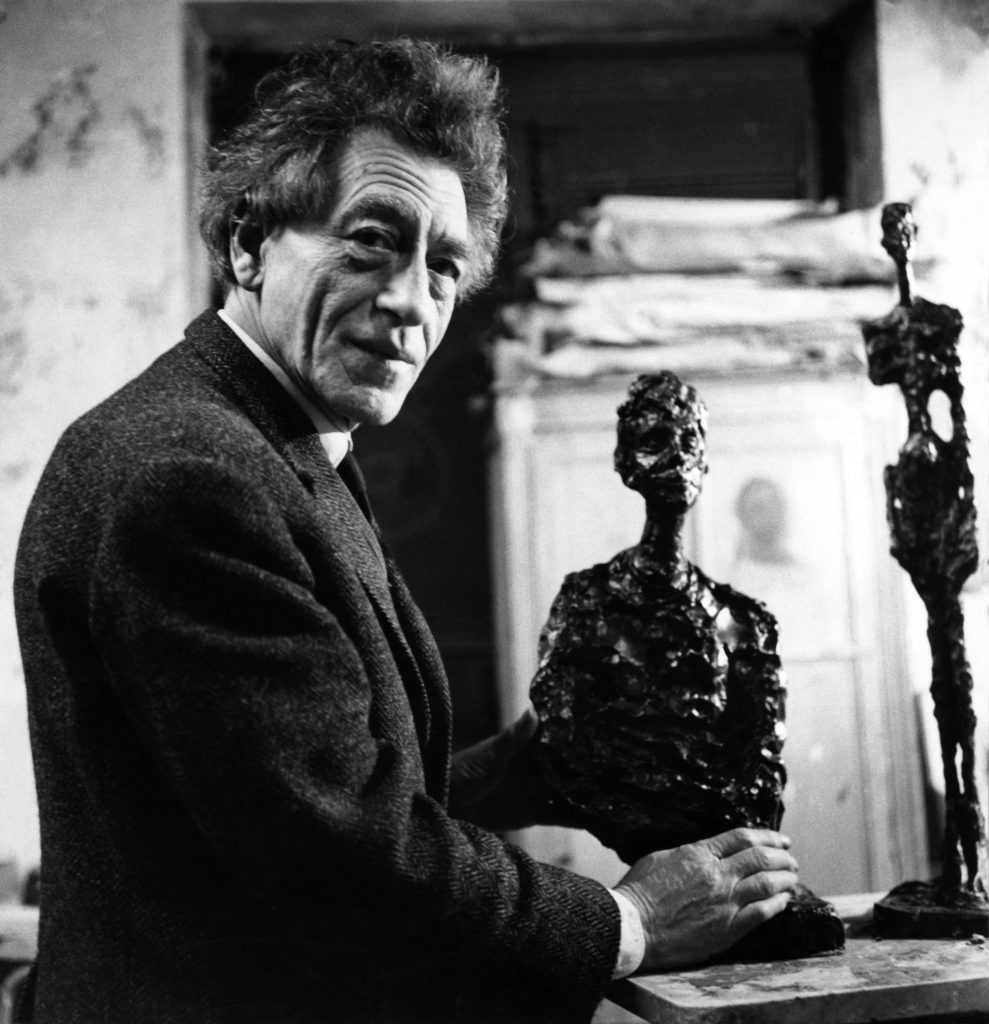
The story goes that as a precocious student at Swiss boarding school, a young Alberto Giacometti lectured his peers on the virtues of Egyptian art. Apocryphal or otherwise, it reflects the sense that the line, gesture, and symbolism of ancient Egyptian statuary took an hold early on Giacometti and lingered. By his early 20s, he had visited the Savoy family’s great hoard of Egyptian treasures in Turin, begun collecting publications on Egyptian art, and spent hours studying its finer details in the Louvre’s Egyptian galleries.
Giacometti may never have set foot in Egypt, but this summer a selection of his sculptures is making the trip—metaphorically at least. The Metropolitan Museum of Art in New York is arranging the sculptor’s work around the Temple of Dendur, the reconstructed 1st-century B.C.E. structure that stands as one of the museum’s leading attractions.
Opening in June, the rare intervention is straightforwardly titled “Giacometti in the Temple of Dendur.” Fourteen sculptures are on loan from the Fondation Giacometti in Paris, which previously explored Giacometti’s relationship to Egyptian art in a 2021 collaboration with the Louvre. Three further works from the Met’s own collection will complete the assembly in a show the museum said presents a “forward-looking approach to presenting modern art.”
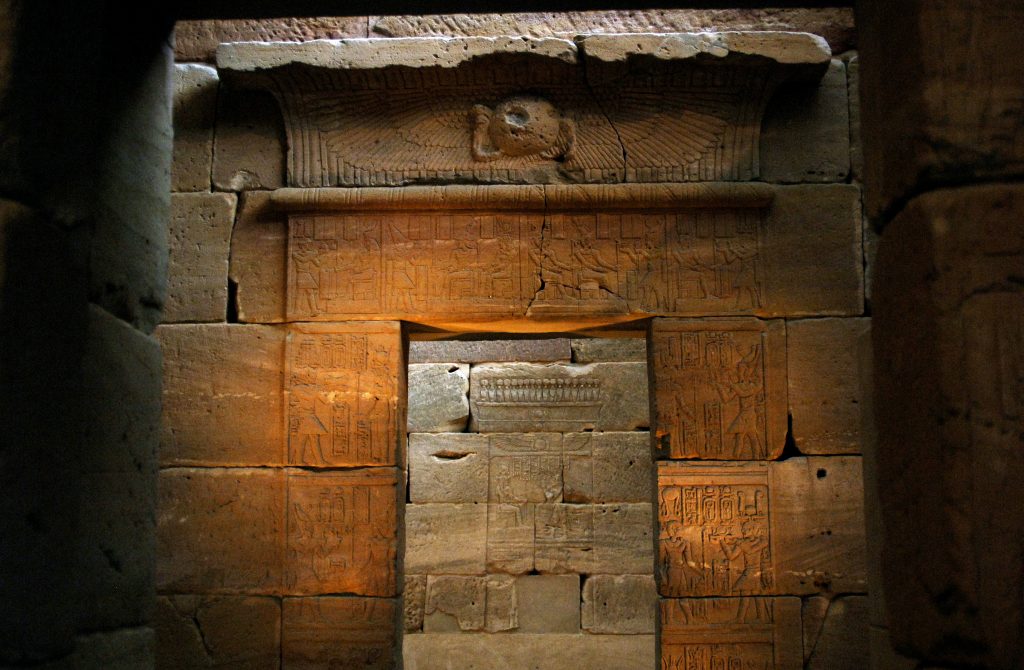
Detail of the Temple of Dendur at the Metropolitan Museum of Art in New York. Photo: Prisma / UIG / Getty Images.
It’s a curatorial juxtaposition that the Met says will guide its vision for the Tang Wing, a $550-million project to revamp and reimagine its collection of Modern and Contemporary art that is currently in the works. “Giacometti in the Temple of Dendur” has brought together curators from across departments, a move preceded by 2024’s “Flight into Egypt: Black Artists and Ancient Egypt, 1876–Now,” which placed 3,500-year-old statuary alongside work by the likes of Julie Mehretu and Sam Gilliam.
The showstopper will be the placement of Giacometti’s serene and slender Walking Woman (I) (1932) inside the temple’s offering hall, thereby occupying the position of cult statues that were placed before worshippers. Ancient Egyptian temples were considered sacred houses for the gods and sites where the public would encounter divine images. Accordingly, the placement of statues across the temple’s terrace, including Women of Venice (1956), are intended to evoke ancient temple processions.
“The Temple of Dendur is a modest-sized version of the temple buildings common during the Ptolemaic and Roman periods,” Aude Semat, an associate curator in the Met’s Egyptian art department said over email. “Egyptologists still debate if it housed cult statues within its sanctuary or if the deity e.g. its statue, rather than inhabiting the temple, would have visited it during religious festivals.”
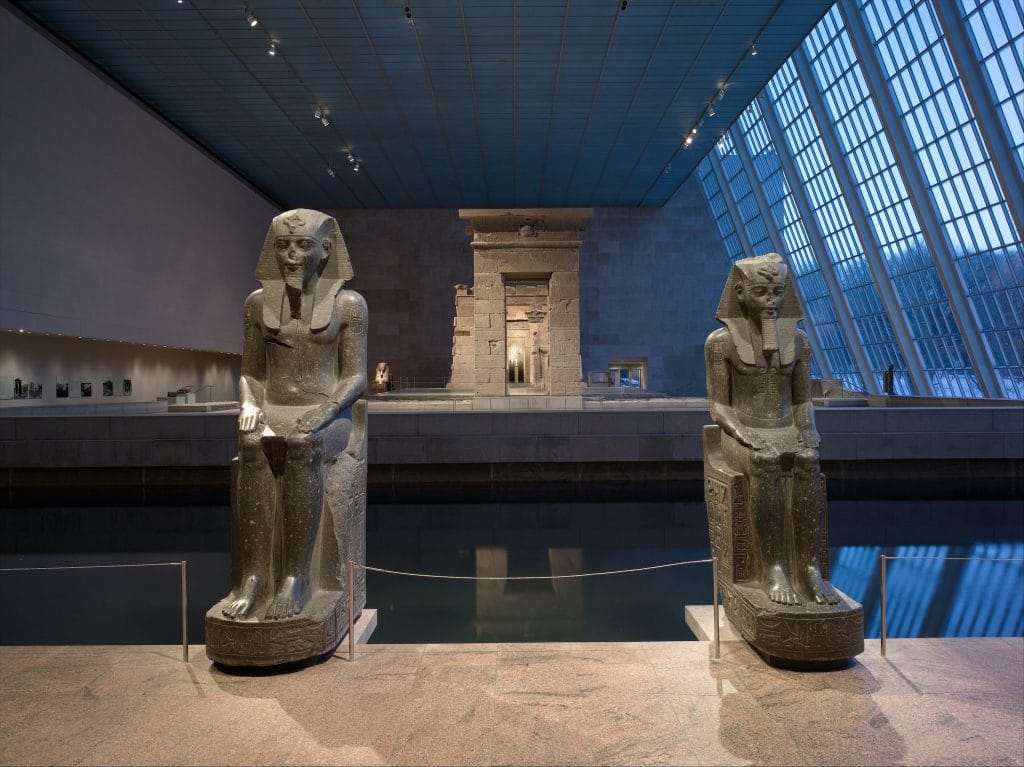
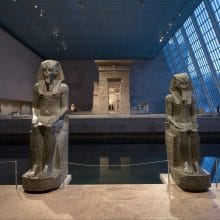
The Temple of Dendur seen between two statues of Amenhotep III. Photo: courtesy the Met.
Built around 10 B.C.E., the Temple of Dendur was dedicated to the goddess Isis and the deified brothers, Pedesi and Pihor. It was one of five Nubian temples that were relocated from Egypt ahead of the completion of the Aswan High Dam and was awarded to the Met in 1967 following skillful lobbying by Thomas Hoving, the museum’s charismatic director. The Temple of Dendur opened to the public in its grand glass-enclosed gallery in 1978.
“The Met has been interested in Giacometti for some time,” Stephanie D’Alessandro, a Met curator of Modern art, said over email. “We had a number of ideas for a presentation of Giacometti in resonance with our rich Egyptian Art collection, but it was the idea of seeing both Giacometti’s figures and the Temple of Dendur together that was most exciting.”
“Giacometti in the Temple of Dendur” is on view at the Metropolitan Museum of Art, 1000 5th Ave, New York, June 12–September 8.

Related Articles
-