People
Frank Gehry, Architect of Innovation and Incredulity, Dies at 96
Gehry produced iconic buildings like the Guggenheim Bilbao, Fondation Louis Vuitton, and Los Angeles’s Walt Disney Concert Hall.
by
Vittoria Benzine
 Share This Article
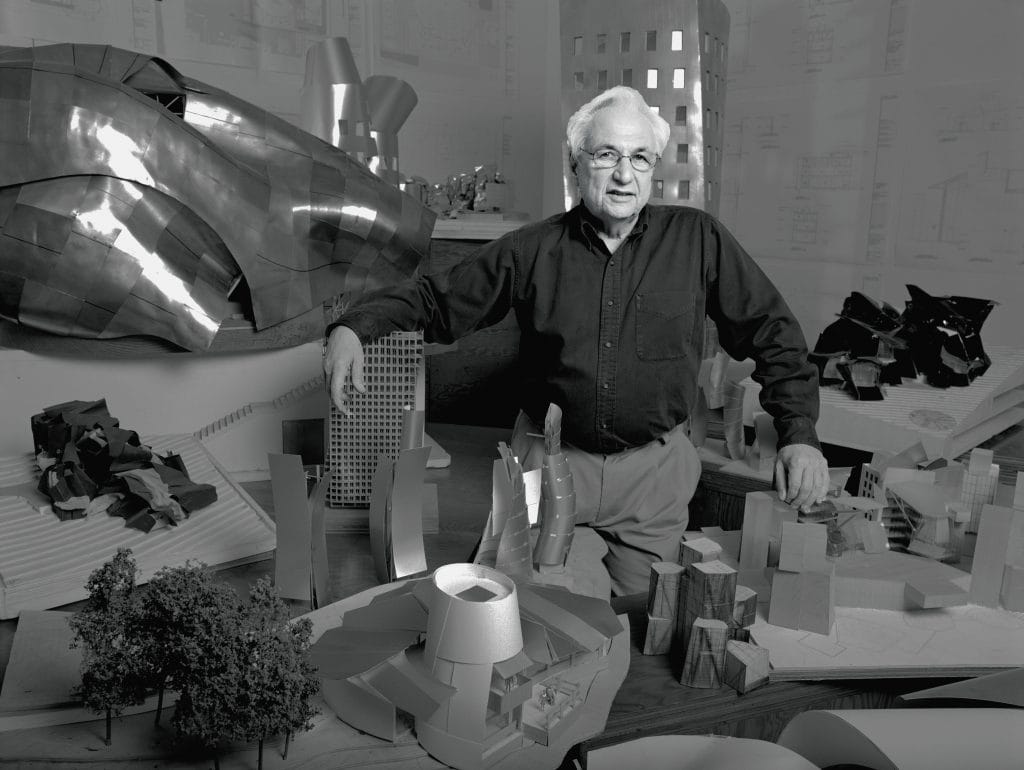
Famed American architect Frank Gehry has died at age 96 in his Santa Monica home after a brief respiratory illness. He is survived by his wife, three children, and an unparalleled portfolio of international monuments, like the Guggenheim Bilbao in Spain and Los Angeles’s Walt Disney Concert Hall, both of which revived a flagging discipline and made Gehry a star. He went on to produce dozens of icons, like the Fondation Louis Vuitton in Paris and the 8 Spruce skyscraper in New York, each with its own twist on his signature vision.
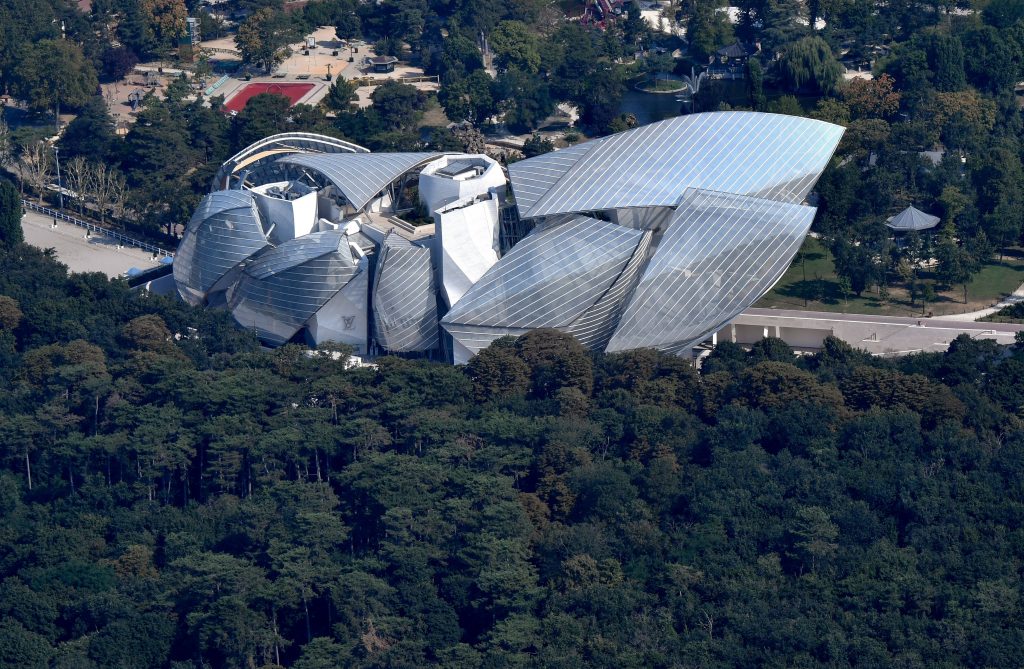
An aerial view of theLouis Vuitton Foundation designed by US architect Frank Gehry, in Paris. Photo: Gerard Julien/AFP via Getty Images.
Gehry was born Frank O. Goldberg on February 28, 1929, in Toronto to a working-class Jewish family. Growing up, he worked in his grandfather’s hardware store once a week, forging his lifelong affinity for metal early on. His grandmother often brought live fish home too, inspiring Gehry’s enduring fish motifs, like the fish lamps he made for the Formica Corporation in 1983 and his 1987 “Fish Dance” sculpture in Kobe, Japan. Gehry moved to Los Angeles after finishing high school in 1947. His father, who’d suffered a heart attack while arguing with him, had been advised to relocate somewhere more temperate. LA was growing rapidly at the time.
The fledgling talent studied art and architecture at L.A. City College, then at the University of Southern California. He met his first wife, Anita Snyder, while delivering furniture at his day job. They married in 1952. In 1954, she convinced him to change his last name to Gehry, in order to sound less Jewish. Gehry relented—he’d experience antisemitism firsthand.
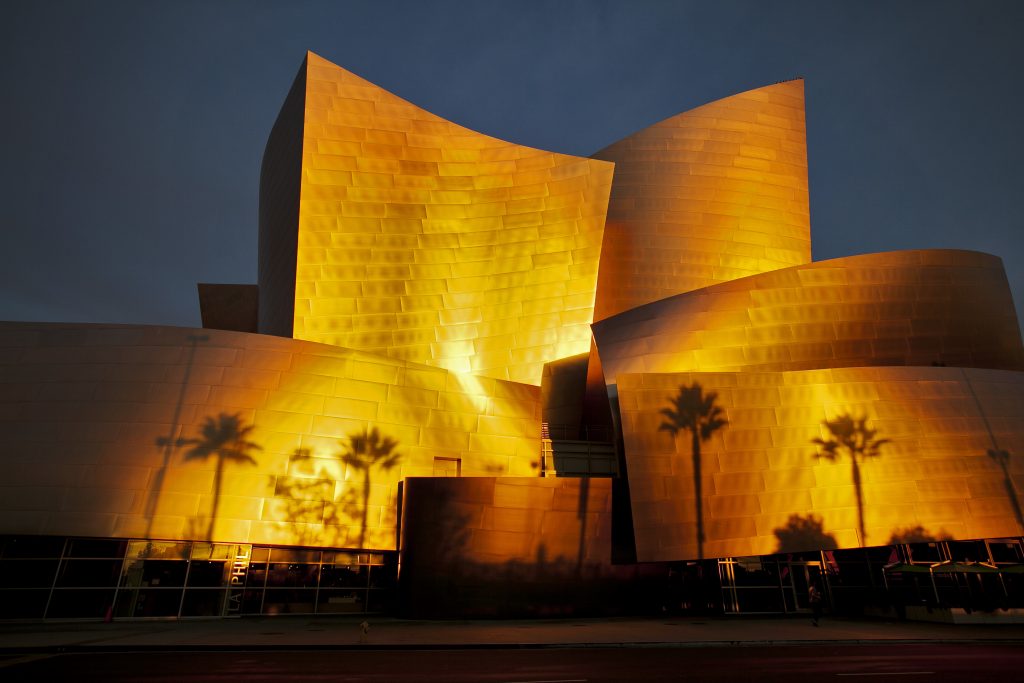
The Walt Disney Concert Hall in early morning light, designed by Frank Gehry. The hall is home to the LA Philharmonic and is located in downtown Los Angeles. Photo by Ted Soqui/Corbis via Getty Images.
He graduated from USC in 1954, served in the U.S. Army for two years, then worked in Los Angeles as a mid-level designer at Gruen Associates, the firm that envisioned the classic American shopping mall. He spent a year studying urban planning at Harvard University, but returned to L.A. in 1957 before finishing, completing his first private residence for one of his wife’s family friends instead. Gehry left again in 1961 to work for French architect Andre Remondet. Upon returning to L.A. permanently in 1962, he founded his current firm.
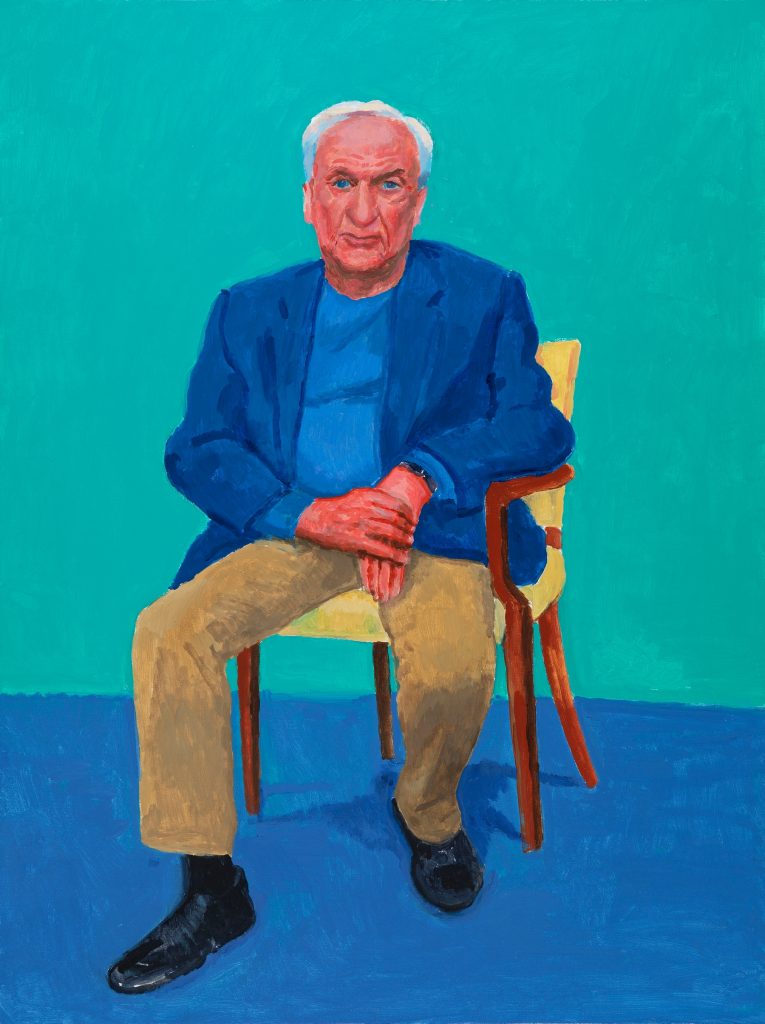
David Hockney, Frank Gehry, 24th, 25th February 2016. Photo: Richard Schmidt, © David Hockney.
At first, Gehry adhered to the Modernist principles dominating architecture in that era. But, L.A.’s freewheeling atmosphere—and the artistic scene Gehry fell into there, befriending installation artist Robert Irwin and sculptor Larry Bell—inspired the architect, who had a humanist bent, to experiment. A trapezoidal, wood-frame studio he made in the 1970s for the colorful geometric abstractionist Ron Davis offered early evidence of such a shift.
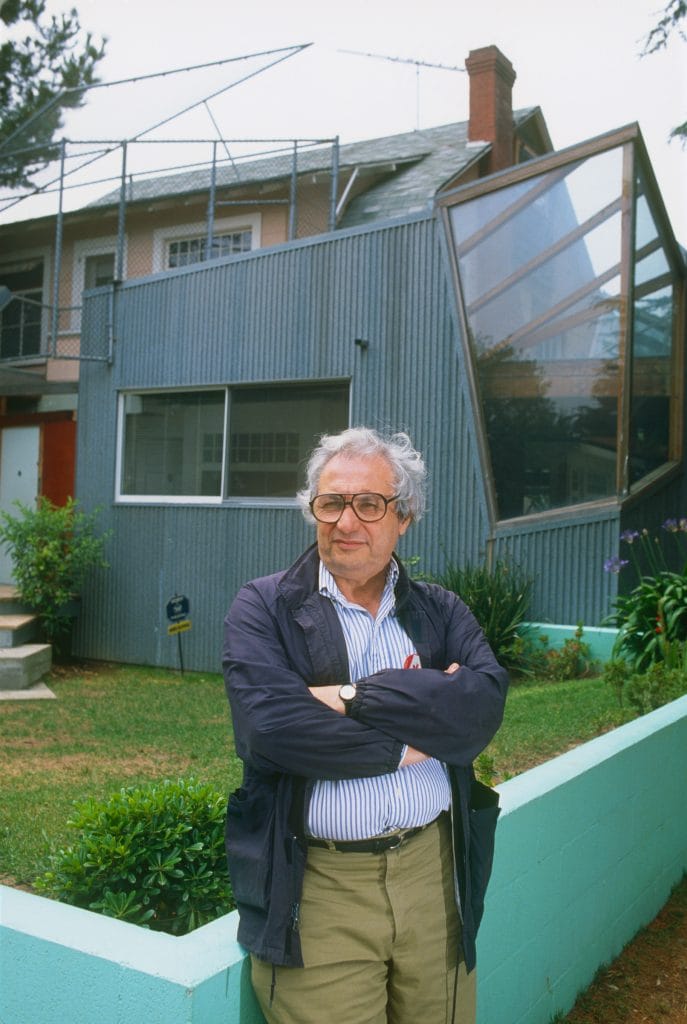
Frank Gehry poses for a 1988 portrait in front of his Santa Monica, California home. Photo by George Rose/Getty Images.
By then, Gehry had divorced Snyder. In 1975, he married Berta Aguilera, now his widow. They bought a two-story pink-stucco home from the 1920s in Santa Monica in 1977. The following year, Gehry started renovating it into a prototypical iteration of his now-famous style, featuring convergent planes of corrugated metal inspired by his upbringing and the neighborhood’s vibe at the time. The home’s immense notoriety transcended Santa Monica, putting Gehry on the map.
In 1988, he finally won his first civic project in L.A.—Downtown’s Walt Disney Concert Hall, home to the city’s Philharmonic. The design made him L.A.’s first Pritzker Prize-winning architect in 1989.
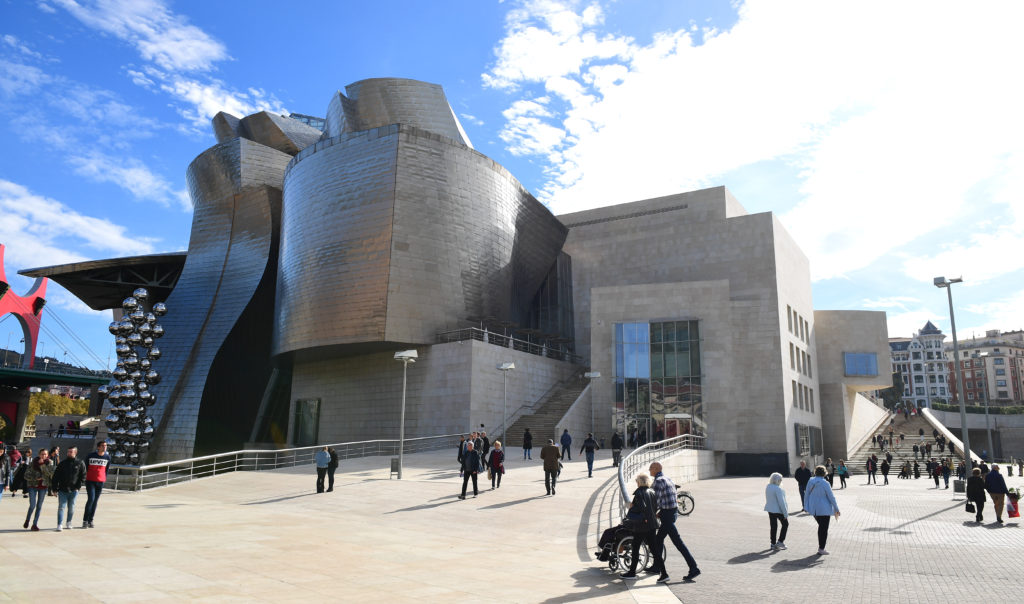
The Guggenheim Museum in Bilbao, Spain. Photo by Ian West/PA, Images via Getty Images.
Before the long-delayed project got built, however, Gehry unveiled the Guggenheim Bilbao. The New York-based museum’s computer-designed outpost instantly became a global sensation. Millions of tourists visited. Critics penned thinkpieces. Cities around the globe sought the kind of rehabilitation that run-down Bilbao had received, clamoring after their own Gehrys. The triumph even inspired L.A. officials to finish building the Walt Disney Concert Hall, at last, in 2003.
As his firm grew, its website stated that “Every project undertaken by Gehry Partners is designed personally and directly by Frank Gehry.” They include dozens of monuments, like the multicolored Museum of Pop Culture, which was unveiled in Seattle in 2000, and the melting Cleveland Clinic Lou Ruvo Center for Brain Health, which opened in Las Vegas in 2010.
Even as minimalism has come to dominate contemporary architecture, Gehry’s designs never lost their whimsy. Buildings are all the more in peril of getting a bit more boring without him. At this publication, Gehry Partners has not yet responded to a request for comment regarding the fate of Gehry’s active projects, like a new Louis Vuitton flagship and a concert hall for the Colburn School of Music, both in L.A.

Related Articles
-