Law & Politics
Epstein Files Reveal Possible Dealings Between Leon Black and Disgraced Dealer Douglas Latchford
A noted Southeast Asian antiquities expert, Latchford was indicted for smuggling before his death.

A noted Southeast Asian antiquities expert, Latchford was indicted for smuggling before his death.
Sarah Cascone
 ShareShare This Article
Did billionaire art collector Leon Black buy Southeast Asian antiquities from the disgraced late British dealer Douglas Latchford? Documents in the roughly three million additional Epstein files from the U.S. Department of Justice suggest a connection between the two.
A spreadsheet in Jeffrey Epstein’s emails titled “Leon Black/ Narrows South East Asian Art Inventory” features a list of bronze and stone statues from the region, including their cost to Black and estimated value. The most expensive work, a $7 million Shiva, is described as 110 centimeters tall (43 inches) and dating to the year 1044. That’s reportedly a perfect match to a shiva statue from a “private collection” that Latchford featured in his 2004 book Adoration and Glory: The Golden Age of Khmer Art, written with American art historian Emma C. Bunker.
The list includes 12 works, pegging their estimated worth at $27.7 million. Black spent $23.85 million to buy them, according to the document, which dates to April 2014.
“While we were previously aware that Mr. Black collected Khmer sculpture, these materials provide substantially greater detail and raise serious questions regarding the scope and provenance of the works,” Bradley Gordon, a lawyer representing Cambodia’s restitution efforts, told Bloomberg, which first reported the possible link between Black and Latchford.
“Mr. Black owns a very small number of Cambodian works of art that were acquired through a well-regarded and highly reputable art dealer,” a spokesperson wrote in an email. “He never met nor acquired anything directly from Latchford. He also provided the Justice Department with all information related to these works nearly five years ago.”
Latchford, who called himself an “adventurer scholar,” was born in India to British parents and lived most of his life in Thailand. He began dealing in antiquities from the region in the early 1970s, and became a respected expert in the field. The Cambodian government even awarded him its highest honor, the Grand Cross of the Royal Order of Monisaraphon, in 2008.
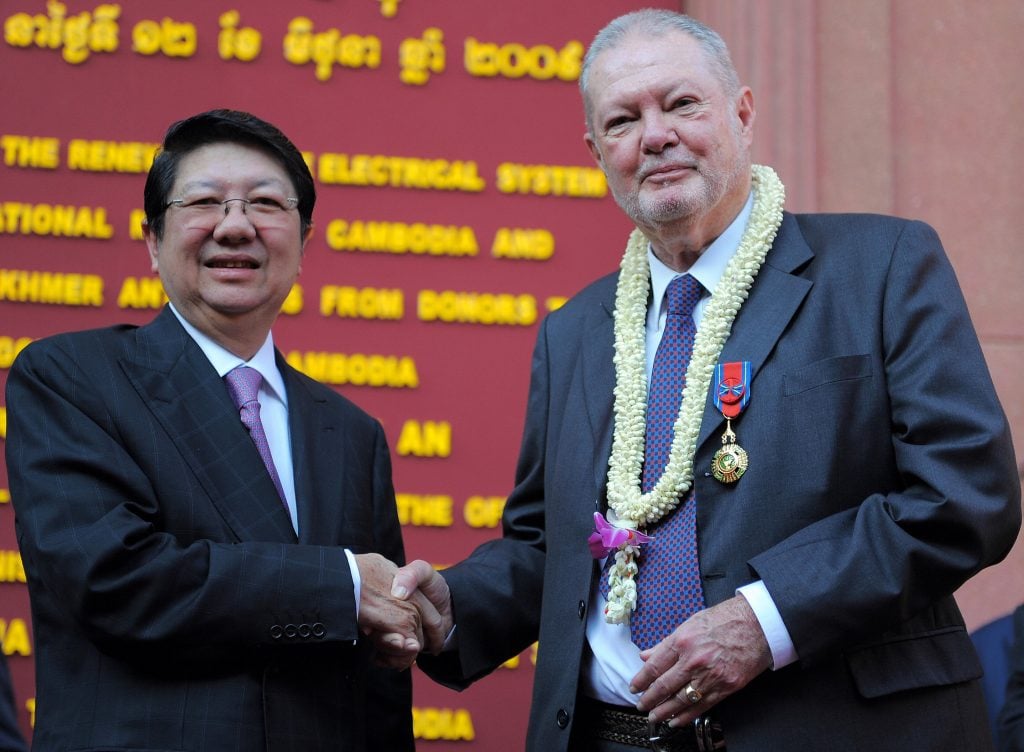
Cambodian deputy Prime Minister Sok An shakes hands with British Khmer art collector Douglas Latchford during a function at the National Museum of Cambodia in Phnom Penh on June 12, 2009. Photo by Tang Chhin Sothy/AFP via Getty Images.
But in 1970, the UNESCO Convention established an international treaty to prevent the illicit trafficking of cultural property. Under Cambodia’s 1996 Law on the Protection of Cultural Heritage, any undocumented antiquities exported after 1970 are considered looted.
Latchford appears to have operated as if there was no such law, taking advantage of civil unrest in Cambodia to smuggle artifacts around the world. He is accused of falsifying provenance documents and invoices to obscure the illicit origins of newly discovered antiquities.
In 2010, he told the Bangkok Post that “most of the pieces I have come across in the past years have been excavated, or dug up… [by] a farmer in the field.” When New York’s Metropolitan Museum of Art restituted a pair of looted statues partially donated by Latchford in 2013, he told the New York Times that “admittedly these things were moonlighted out of Cambodia and wound up somewhere else. But had they not been, they would likely have been shot up for target practice by the Khmer Rouge.”
U.S. authorities charged Latchford with wire fraud, smuggling, and conspiracy in November 2019. The indictment included quotes from emails in which Latchford offered potential buyers newly excavated antiquities, noting that they still needed to be cleaned.

A page from Douglas Latchford’s book Adoration and Glory. This bronze Shiva statue matches the dimensions and age of a $7 million piece listed in an inventory of Leon Black’s collection discovered in the Epstein files.
The dealer died at age 88 the following August before going to trial, and never admitted to any wrongdoing. But further details of Latchford’s smuggling operation, such as the use of offshore accounts, came to light in the October 2021 release of the Pandora Papers, which uncovered the financial machinations of many of the world’s richest people.
In February 2021, Latchford’s daughter, Nawapan Kriangsak (formerly Julia Ellen Latchford Copleston), made a deal to repatriate his $50 million collection of 125 Khmer antiquities to Cambodia. Two years later, she agreed to pay Cambodia $12 million to settle a civil case against the estate.
There have been a number of high-profile restitutions of antiquities purchased through Latchford: 35 from the collection of Netscape creator James H. Clark; 33 from billionaire collector George Lindemann; four from the Denver Art Museum; and 16 more from the Met, including the Khmer gilt-bronze statue known as “Golden Boy.” Toek Tik, a reformed Cambodian antiquities smuggler who was one of Latchford’s suppliers has identified 33 pieces in the Met collection as works he recognized as looted.