
Min Chen
 Share This Article
David Lynch, the artist, filmmaker, and musician who mined the strange and the surreal, has died at age 78. His passing was announced by his family in a Facebook post.
“It is with deep regret that we, his family, announce the passing of the man and the artist, David Lynch,” the post reads. “We would appreciate some privacy at this time. There’s a big hole in the world now that he’s no longer with us. But, as he would say, ‘Keep your eye on the donut and not on the hole.'”
Lynch had been battling emphysema after a lifetime of smoking. In August 2024, he revealed that the diagnosis had severely restricted his movements. Nonetheless, he wrote, “I am filled with happiness, and I will never retire. I want you all to know that I really appreciate your concern.”
“Anybody lucky enough to grow up during the prime Lynch years—the ’80s and ’90s—had the architecture of their brain significantly rebuilt by his genius,” said Marc Glimcher, CEO of Pace, which has represented Lynch since 2022. “What an unbelievable loss of a pure creator. Lynch turned insanity into philosophy.”
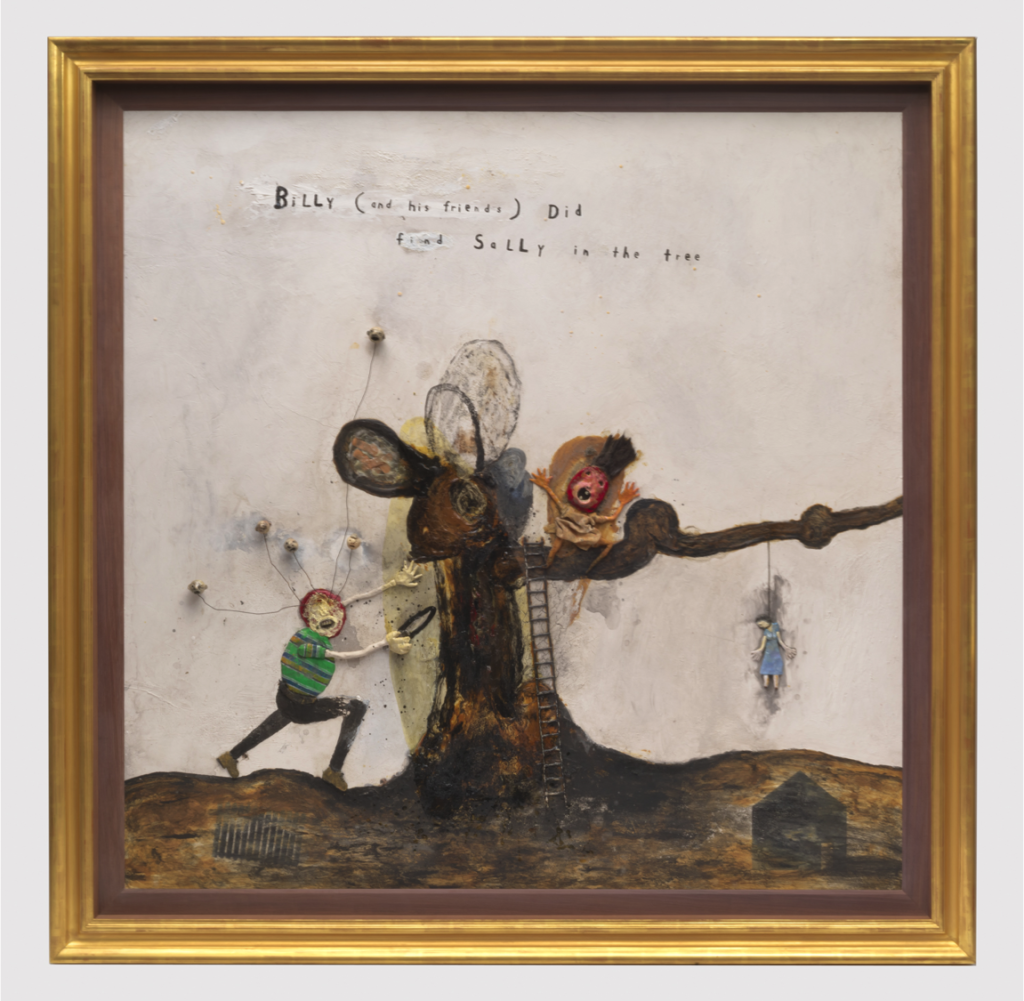
Installation view of “David Lynch: Squeaky Flies in the Mud,” courtesy of Sperone Westwater.
Over a filmography spanning more than four decades, Lynch birthed a creative vision that injected everyday scenarios with sinister, otherworldly elements. That unsettling dreamlike tenor was sustained throughout his name-making movies, from Blue Velvet (1986) to Inland Empire (2006), and the hit TV series he co-created, Twin Peaks (1990–91). So singular was this aesthetic that it called for its own descriptive, “Lynchian”—defined in 1996 by David Foster Wallace as “a particular kind of irony where the very macabre and the very mundane combine in such a way as to reveal the former’s perpetual containment within the latter.”
While Lynch was best recognized for his work in film, he maintained a rich visual art practice throughout, producing figurative paintings, assemblages, and photographs. Francis Bacon was a touchstone for him, as were Edward Hopper and Lucian Freud. Much like his cinematic output, Lynch’s art presented disquieting scenes into which were woven his choice motifs such as home, light and electricity, and dream logic. His spare lines of text offered further layers of meaning or mystification.
“All my paintings,” he said in 2005’s Lynch on Lynch, “are organic, violent comedies.”
Painting was Lynch’s first love. It called to him at age 14, when a friend named Toby Keeler told him that his father Bushnell was a painter. A young Lynch thought he meant a house painter, until Keeler clarified: a fine art painter. “And a bomb went off in my brain. It was like I was one way before he said that and I was completely different after he said it,” Lynch remembered in 2018. “I just thought, that’s what I want to do. All I wanted was to be a painter.”

David Lynch at an exhibition of his works at Griffin L.A., 2009. Photo: Lester Cohen/WireImage.
Lynch was born in 1946 in Missoula, Montana, to a family that was constantly on the move due to his father’s work at the U.S. Department of Agriculture. He grew up between Durham, North Carolina, Boise, Idaho, and Alexandria, Virginia—in a world, he admitted, that was “completely and totally fantastic as a child.” He also became an Eagle Scout.
After graduating from high school, Lynch pursued painting, first enrolling at Washington, D.C.’s Corcoran School of Arts in 1964, then the School of the Museum of Fine Arts, Boston, where he remained for less than a year. Feeling uninspired by both schools, he opted instead to head to Europe with a friend, Jack Fisk, with the vague idea of training with Austrian artist Oskar Kokoschka.
“We went off in a very unorganized way, and we got to Salzburg, where he apparently taught in this castle, and he wasn’t there and there wasn’t really any school set up—I guess he did more of a workshop,” Lynch recalled in 2019. “But Salzburg was way too clean and I really wanted to get out of there. So, we spent most of the 15 days traveling on the Orient Express.”
When he returned to the U.S., Lynch attended the Pennsylvania Academy of the Fine Arts in Philadelphia, a city he cited as his “biggest influence,” it being “filled with fear, insanity, corruption, decay, violence, and a lot of disturbances in the air.” At the school, Lynch made his first short film—what he dubbed a “moving painting”—titled Six Men Getting Sick (1967). The stop-motion work cost so much to make that Lynch thought, “I simply can’t afford to go down this road.” But when an older student commissioned him to create another film, he wrote in his 2006 book Catching the Big Fish, “little by little—or rather leap by leap—I fell in love with this medium.”
Lynch would continue to experiment with animation, before landing at the AFI Conservatory in L.A. in 1970 to study filmmaking. While there, he conceived Eraserhead, a grim picture featuring a bewildered man, a mutant infant, and a chipmunk-toothed lady who lives in a radiator. Once completed in 1977, the film would cement Lynch as an idiosyncratic talent. Mel Brooks famously exited a screening of Eraserhead and effused to the young director: “You’re a madman! I love you!”

Poster for Eraserhead (1977). Photo: LMPC via Getty Images.
Lynch’s follow-up,The Elephant Man (1980), earned him his first Academy Award nomination for Best Director, and paved the way for his 1984 adaptation of Dune (for which he turned down the opportunity to direct Return of the Jedi). Though now a cult film, Dune was a flop on release; its making was a torment for the director, who didn’t get a say on final cut. “I sold out,” he admitted. “It was a slow death… it hurt.”
No surprise, then, that following Dune the director leaned even more toward the arthouse, releasing a run of films that further tightened his darkly psychological and atmospheric hold. Among them were Wild at Heart (1990), which clinched the Palme d’Or at the Cannes Film Festival, and Mulholland Drive (2001), which won him the Best Director prize at the same event. Even his venture into T.V. with Twin Peaks, an ostensible murder mystery, took an esoteric turn, its symbolism providing fodder for endless fan theories. Lynch would revisit the series in 2017 with Twin Peaks: The Return.

Sheryl Lee, David Lynch, and Moira Kelly on the set of Twin Peaks: Fire Walk With Me (1992). Photo: Collection Christophel © Lynch/Frost Productions / Propaganda Films.
All the while, Lynch made art. From the 1980s, he steadily showed his work at venues from Leo Castelli Gallery in New York to the Museum of Contemporary Art Tokyo. In 2007, the Fondation Cartier pour l’art contemporain in Paris staged the major retrospective, “The Air Is on Fire,” which installed his paintings and drawings in spaces designed by Lynch himself. Other surveys at the Bonnefantenmuseum in Maastricht and his alma mater Pennsylvania Academy of the Fine Arts followed.
Post-2000s, Lynch’s musical career, which began when he co-created the Eraserhead soundtrack in 1977, also gained steam. Following his 2001 debut album, BlueBOB, made in collaboration with John Neff, the director released Crazy Clown Time in 2011 and The Big Dream in 2013, both off-kilter blues outings that were warmly received. With his frequent collaborator Dean Hurley, Lynch composed an accompanying ambient-drone soundtrack for his 2007 exhibition.

Installation view of “The Air is on Fire” at the Fondation Cartier pour l’art contemporain, 2007. Photo: Dominique Faget / AFP via Getty Images.
Over the years, Lynch has stopped short of unpacking the roots or meaning of his cryptic paintings and films, conceding only that they are worlds and experiences of their own. His only pursuit, as he wrote in Catching the Big Fish, was honing his own ideas to a fine point. “You just keep working to make it look like that idea looked, feel like it felt, sound like it sounded, and be the way it was,” he said. “At some point, it feels correct to you. And you hope that it feels somewhat correct to others.”
The 2016 documentary, The Art Life, offered a rare peek into Lynch’s studio in the Hollywood Hills. He was captured handling steel, wood, and found objects for his mixed-media assemblages and paint for his canvases. It was the same space where he filmed his quirky weather reports (probably the most surreal entry in his oeuvre), at a desk lined with a small reprint of Bosch’s The Garden of Earthly Delights (1503–15), empty Coke bottles, and singing toy birds.
In the film, Lynch recalled once visiting the studio of Bushnell Keeler, who handed him a book, Robert Henri’s The Art Spirit (1923). He could not recollect its contents, but he remembered loving it and carrying it around as a budding artist.
“The art spirit sort of became the art life. I had this idea that you could drink coffee, you smoke cigarettes, and you paint,” he said. “And that’s it.”


Related Articles
-


