Museums & Institutions
Inside Calder Gardens, Philadelphia’s Lush New Space for the Master of the Mobile
The project realizes a dream of 25 years to create a Philadelphia institution dedicated to the city's most famous artist.

by
Sarah Cascone
 Share This Article
Philadelphia’s newest cultural destination blends art and nature in Calder Gardens, a new institution dedicated to the work of Alexander Calder (1898–1976), the third in a generation of local artists.
Housed in a new 18,000-square-foot Herzog & de Meuron-designed building set into a verdant landscape featuring 250 varieties of flowers and other plants, Calder Gardens is located in the heart of the city, along Benjamin Franklin Parkway. Melding art, architecture, and the natural world, it features a rotating selection of works by the artist, best known for his delicate but often monumental metal sculptures, especially his innovative, suspended mobiles. Perfectly balanced, these kinetic wire works were engineered to move with a subtle grace, responding to air currents.
The Calder Foundation is partnering with the Barnes Foundation—located just across the street—to operate the institution. It’s the latest addition to a cultural corridor that is already home to the Franklin Institute, the Rodin Museum, and the central branch of the Free Library of Philadelphia, and it hopes to draw 100,000 visitors in its first year.
“We’re in an incredible landscape of institutions here, and we’re hoping to add something different,” Juana Berrío, the garden’s senior director of programs, told me during a press visit to the new space, which does not describe itself as a museum.
A Beloved Philadelphia Artist

Calder Gardens in Philadelphia. Photo: by Iwan Baan, ©Calder Gardens. Artwork by Alexander Calder © 2025 Calder Foundation, New York/Artists Rights Society (ARS), New York.
The city hasn’t had an institution dedicated to Calder, one of its most famous citizens, since the closing of Calder Sculpture Garden in 2009, following the expiration of eight years of funding from the Pew Charitable Trusts. The $90 million project—a price tag that ballooned from an initial $40 million estimate—also creates something of an intergenerational Calder trail along the mile-long boulevard, which starts at City Hall and ends at the Philadelphia Art Museum.
Calder’s grandfather Alexander Milne Calder (1846–1923), created the city’s famous statue of namesake founder William Penn that is perched atop City Hall’s central tower. And between the two landmark sites is the Swann Memorial Fountain, a monumental 1924 Art Deco design depicting allegorical figures of the three local rivers by Calder’s father, Alexander Stirling Calder (1870–1945) and architect Wilson Eyre (1858–1944) at Logan Square. As if that wasn’t enough art in one family, the dynasty also includes Calder’s mother, Nanette Lederer Calder (1866–1960), who was a painter.

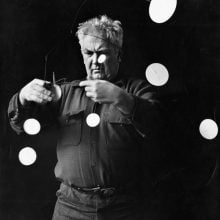
Alexander Calder in his Roxbury studio, 1941. Photo: by Herbert Matter, ©2025 Calder Foundation, New York/Artists Rights Society (ARS), New York.
Developing the 1.8-acre site was a project over a decade in the making. The Calder Foundation, led by Calder’s grandson Alexander “Sandy” Rower, first pursued building a dedicated Calder Museum, ultimately unrealized, at the location some 25 year years ago.
The institution’s funding comes from a coalition of philanthropists including the Neubauer Family Foundation, the Pew Charitable Trusts, and H.F. Lenfest, as well as the Commonwealth of Pennsylvania and the City of Philadelphia, which approved a 99-year lease for just $1.
Art Blending Into the Landscape

Calder Gardens in Philadelphia. Photo: by Iwan Baan, ©Calder Gardens. Artwork by Alexander Calder © 2025 Calder Foundation, New York/Artists Rights Society (ARS), New York.
You can enter Calder Gardens from three different points, and explore pathways through the grounds designed by Dutch landscape architect and horticulturalist Piet Oudolf (b. 1944), who also did the plantings on the High Line in New York.
“On both sides of the garden, there are small woodland areas, ‘garden concepts,’ ideas that make each part of the garden feel unique. So, from some entrances, you don’t see the full garden at once,” Oudolf told Christie’s. “You walk through woodland and then the garden opens up into different types of plantings. There’s a perennial garden we call the ‘robust borders’ and another we refer to as a ‘matrix’ or meadow-type planting, especially around the entrance.”

Calder Gardens in Philadelphia. Photo: by Iwan Baan, ©Calder Gardens. Artwork by Alexander Calder © 2025 Calder Foundation, New York/Artists Rights Society (ARS), New York.
Planted with native and perennial species, the nonprofit’s peaceful meadow is designed as a place of rest and reflection. Nestled in the center is Herzog & de Meuron’s building, with metal cladding that reflects the surrounding landscape. The building is cleverly camouflaged, and most of the space is subterranean, with sunken courtyards on the lower level.
“Calder was really interested in multidisciplinary collaborations, going beyond just sculpture,” Berrío said. “He was interested in learning from musicians, from architects; he was obsessed with the circus.”

Calder Gardens in Philadelphia. Photo: by Iwan Baan, ©Calder Gardens. Artwork by Alexander Calder © 2025 Calder Foundation, New York/Artists Rights Society (ARS), New York.
She also sees a parallel between Calder’s work and the seasonal component of the new Calder Gardens, where the wild plantings will grow and change throughout the year.
“Calder was one of the first artists in the 20th century who included the notion of time in art,” Berrío added.
An Ever-Changing Display, Indoors and Out

Alexander Calder in his Roxbury studio, 1947. Photo: by Herbert Matter, ©2025 Calder Foundation, New York/Artists Rights Society (ARS), New York.
The art on display, many from the foundation collection, will also rotate, with some works on long-term view while others appearing for only a few months. There will be no permanent collection, but the loans secured by the curators include pieces in private collections that have never been on public view, or have only been shown abroad.
The inaugural installation features 30 masterworks such as Black Widow (1948), a large, delicately balanced hanging sculpture on loan from the Instituto de Arquitetos do Brasil–Departamento de São Paulo; and the foundation’s Tripes (1974), a monumental standing “stabile,” as Calder called his stationary pieces, made of sheet metal cut into organic shapes and bolted together.

Alexander Calder, Eucalyptus (1940) on display at Calder Gardens in Philadelphia. Photo: by Tom Powel Imaging, ©Calder Gardens. Artwork by Alexander Calder © 2025 Calder Foundation, New York/Artists Rights Society (ARS), New York.
There are no white cube spaces inside, with spaces that seem to flow into one another. Around one corner, the black mobile Eucalyptus (1940) seems to hover in space, in a pure white nook called the “Apse Gallery” where the wall is sculpted into the floor to illusory effect.
There are no labels or didactic interpretative text, inviting visitors to take the time to really contemplate these artworks, letting them speak for themselves. The effect is that of a sanctuary, offering an almost spiritual experience communing with the art.

Alexander Calder, Jerusalem Stabile II (1976) on view at Calder Gardens in Philadelphia. Photo: by Tom Powel Imaging, ©Calder Gardens. Artwork by Alexander Calder © 2025 Calder Foundation, New York/Artists Rights Society (ARS), New York.
“For Calder, what really made the work was when you see it move,” Berrío said. “I like to say that Calder Gardens is not a place where you come to be taught about something, but where you learn more about yourself.”
Calder Gardens is located at 2100 Benjamin Franklin Parkway, Philadelphia, Pennsylvania.

Related Articles
-