Art & Tech
Boston Hotel Roasted for Using A.I.-Generated ‘Warhol’ Portraits as Decor
The hotel just reopened after five years as a dorm for North Eastern.
by
Sarah Cascone
 Share This Article
There’s a reason that “hotel art” has long been used as a pejorative for generic, blandly inoffensive artwork with corporate appeal. But the genre may have sunk to a new low at the newly renovated Midtown Hotel in Boston, which has come under fire on social media for decorating with A.I.-generated hotel art, mashing up Andy Warhol (1928–1987) and local celebrities.
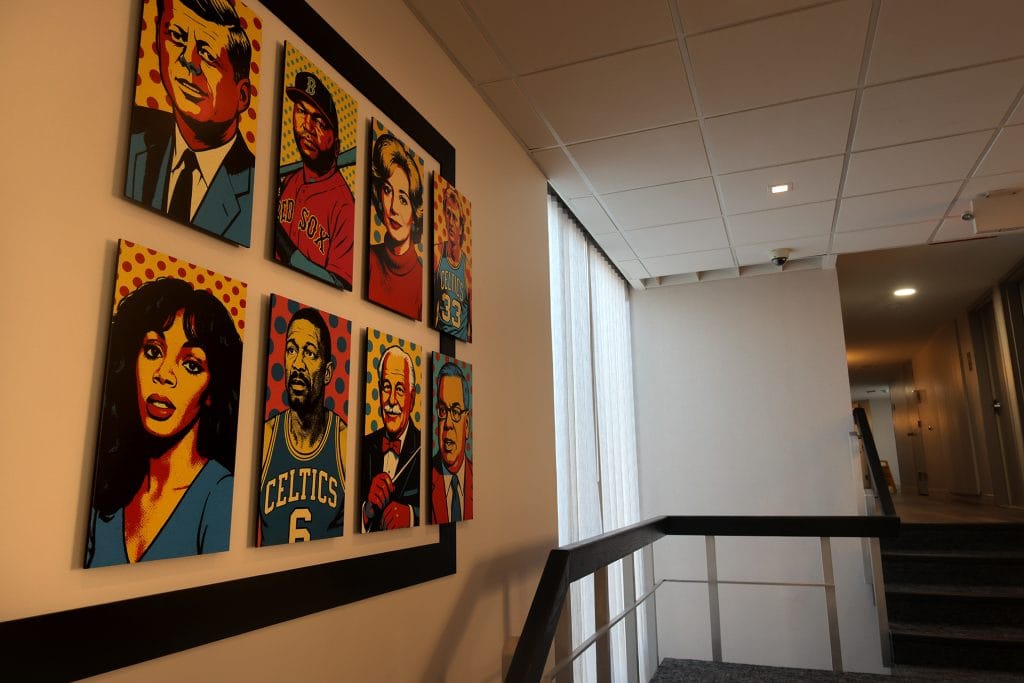
“I know we have bigger fish to fry but this sucks so fucking bad,” hotel guest Alex Steed wrote on social media, sharing a photo of a small placard hanging on a wall reading: “Art throughout this hotel was entirely created by Artificial Intelligence. A.I. was asked, ‘What if Andy Warhol painted Boston luminaries?'”
The post did not include images of the work itself—colorful portraits of Larry Bird, Arthur Fiedler, John F. Kennedy, Thomas Menino, David Ortiz, Bill Russell, Donna Summer, and Barbara Walters: “It looked like a cartoon of Andy Warhol art,” Steed told me, adding that he didn’t even bother to photograph the work because “it’s exactly what you would imagine.”
Indeed, Steed’s complaint quickly struck a chord, with 3,300 views on Threads, close to 2,000 on Instagram, and hundreds of comments decrying the hotel for cutting costs by choosing A.I. slop over the work of real creatives.
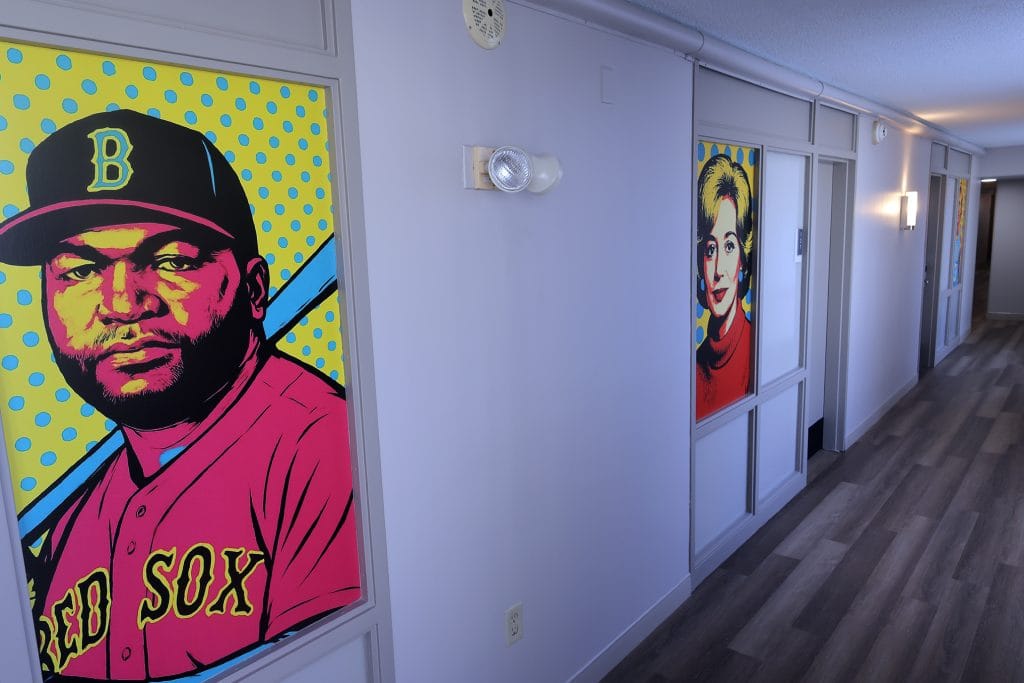
A hallway features AI-generated art of iconic Bostonians like David Ortiz and Barbara Walters at the Midtown Hotel on November 19, 2025. Photo by Lane Turner/the Boston Globe via Getty Images.
“In a city with world-renowned art museums and world famous art schools, someone missed a real opportunity,” read one comment. “Really putting the ‘mid’ in midtown,” said another.
A Disappointed Guest
A Los Angeles photographer, podcast host, and zine publisher who operates a small record label, Steed was in town for the funeral of a friend who was a local artist and musician. Steed chose the Midtown Hotel because his partner had studied at Berklee College of Music years ago, and had stayed at the hotel during her audition. He wasn’t surprised by the outrage generated by the establishment’s embrace of A.I.
“I knew it would speak to an existing frustration a lot of people have,” Steed said, noting that the rise of automation and the outsourcing of art-making to machines and A.I. are major sources of anxiety for many people. “We’ve cut out the artist, and the person who’s ultimately making the money on it is some billionaire who owns the large language model company.”
He didn’t immediately clock that the portraits were A.I.-generated, but when he noticed the sign, he wasn’t surprised.
“It has the kind of slightly uncanny valley feel of something that was mass-produced, not with human intervention,” Steed said. “I had this feeling at the hotel prior to even seeing this plaque. You’re walking on linoleum that’s made to look like a wooden floor. Everything is an imitation of a thing that was real once.”
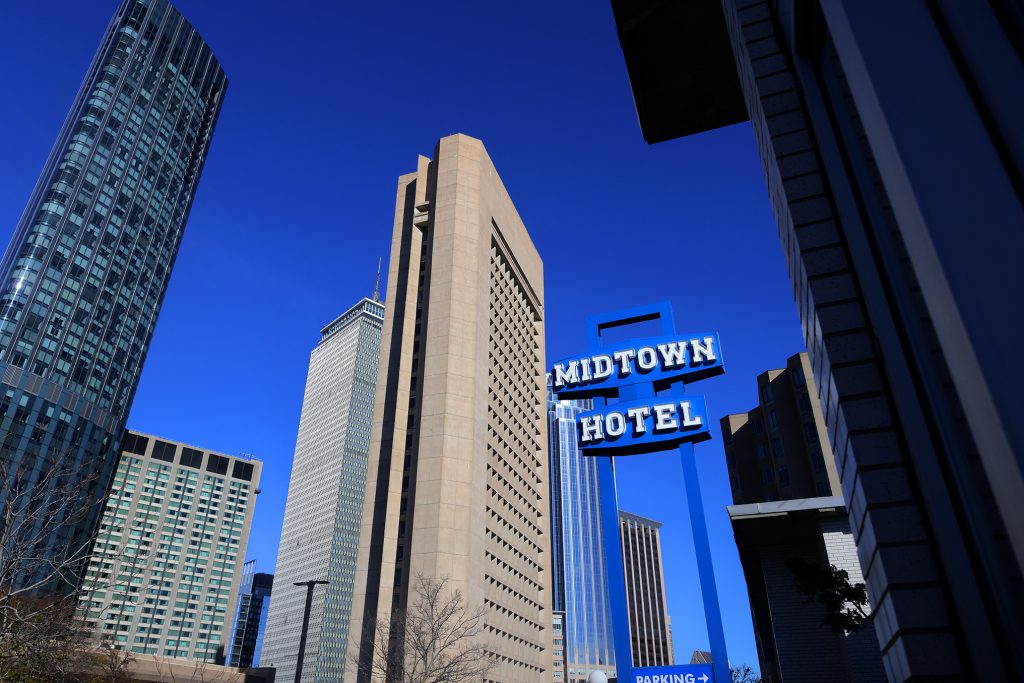
The refurbished sign for the Midtown Hotel rises among the Back Bay towers on Huntington Avenue on November 19, 2025. Photo by Lane Turner/the Boston Globe via Getty Images.
What was perhaps most disappointing was the upbeat tone of the accompanying wall text, proudly proclaiming the works’ origins—and by extension, the decision to deny an artist a potential job and opportunity to display their work. The sign seemed to suggest that the choice to use A.I. to decorate the hotel was somehow cutting-edge and innovative, instead of a cheap way to fill its walls.
“I’m not opposed to using advanced technology in the production of art,” Steed insisted. “I just don’t think it’s art if that thing does all the work, and if all of the work is imitating a real artist and then redirecting any possibility of profit to tech bros and not to actual artists.”
“Boston’s an art town. You can throw a rock and hit an artist. It’s easy to source someone who’s local,” he added. “What is frustrating about this is that the people [working at the hotel] made our stay great. They knew why we were there, and they were very lovely.”
But when it came to making the art, Midtown Hotel turned to a machine.
When I called the hotel, the person who answered claimed to be unaware that the portraits on display had been generated using A.I. She directed me to email the front office manager for Colwen Hotels; as of press time there has been no response. (The Andy Warhol Foundation for the Visual Arts declined to comment on this story.)
An Unexpected Chapter in the Hotel’s History
The Midtown Hotel first opened in 1961, a modest two-story building that has since seen the city grow up around it. It is just across the street from the Christian Science Plaza, and the land is owned by First Church of Christ, Scientist, which began shopping around the property in 2018.
National Development, a Massachusetts real estate investment and development company, signed a 99-year lease on the site in early March 2020. The Midtown Hotel shuttered during COVID, becoming temporary housing for Northeastern University students that fall. National Development soon announced plans, approved in 2021, to demolish the hotel and an adjacent four-story residential building, and replace them with a 10-floor structure with 325 apartments.
Northeastern moved out at the end of July, as reported by the school paper, the Huntington News. But with inflation—and construction costs—on the rise, National Development shelved the project and instead reopened the hotel.
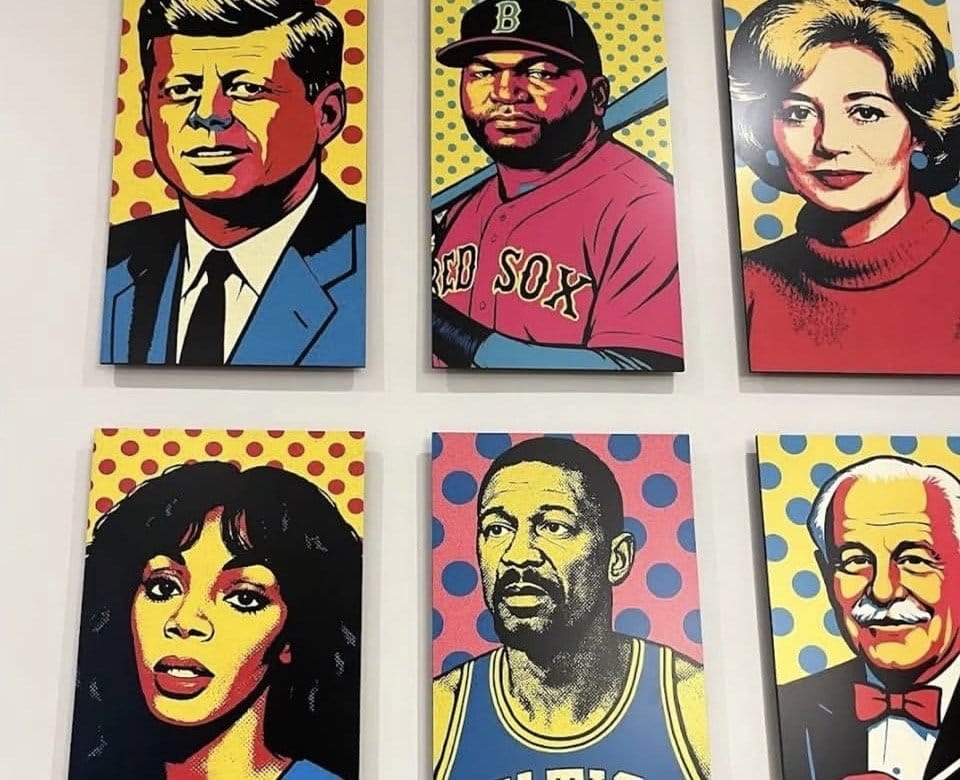
The A.I. art from the Midtown Hotel in Boston. Photo by Joel T., shared on Yelp.
“The bottom line is that if you’re going to finance and build a project like this, you’ve got to hit a certain return threshold,” company cofounder Ted Tye told the Boston Globe in an article on the hotel’s unexpected resurrection. “We just can’t do that right now.”
The hotel, which has not been active on its Instagram account since 2020, conducted renovations on a rolling basis, remaining open during construction. But now, its old posts are being hit with angry comments about the A.I. art. On Yelp, its average is just 2.6 stars.
Previously, the hotel had enjoyed a small wave of local press heralding its return, including a review Boston Globe extolling the “cleaned-up, odor-free” establishment that described the pre-renovation property as “one of the worst places I’d stayed in Boston.” It declared new Midtown a marked improvement, even giving a shout-out to the art: “Sprinkled throughout the hotel lobby and hallways are Warhol-esque portraits of Boston icons. You’re always under the watchful eyes of Donna Summer, Tom Menino, or Arthur Fiedler.”
The Boston Business Journal, meanwhile, acknowledged the A.I. origins of some of the “artistic touches” used to update the interior, noting that “virtually every surface inside the 160-room hotel was changed in the span of just a few months.”
Maybe they should have spent a little bit more time—and money, paid to an artist—on the decor.

Related Articles
-