People
Woman Behind the Viral ‘Beast Jesus’ Restoration, Cecilia Giménez, Dies at 94
The Spanish amateur painter became an unlikely internet icon after her botched fresco restoration went viral in 2012.

The Spanish amateur painter became an unlikely internet icon after her botched fresco restoration went viral in 2012.
Margaret Carrigan
 ShareShare This Article
Cecilia Giménez Zueco, author of the so-called “Beast Jesus”—the art restoration that went awry and became a viral internet sensation in 2012—has died at 94.
Irrespective of the artistic merit of her painting, Giménez’s well-intentioned work is arguably one of the foremost cultural touchstones of this century so far, at least for the chronically online, and it underscores the power of internet memes in contemporary society. Moreover, it’s a reminder that art doesn’t always need to be understood to be appreciated.
Giménez’s death was confirmed by Eduardo Arilla, the mayor of Borja, a town in northeastern Spain where Giménez lived and worked, who posted an obituary on his Facebook page. Describing Giménez as “a strong woman, a selfless mother, and a hard worker,” Arilla called her “irreplaceable” and expressed his “profound sadness” at her loss. “The world knew her through this anecdote but all of us already knew the great person she was and will remain in our memory.”
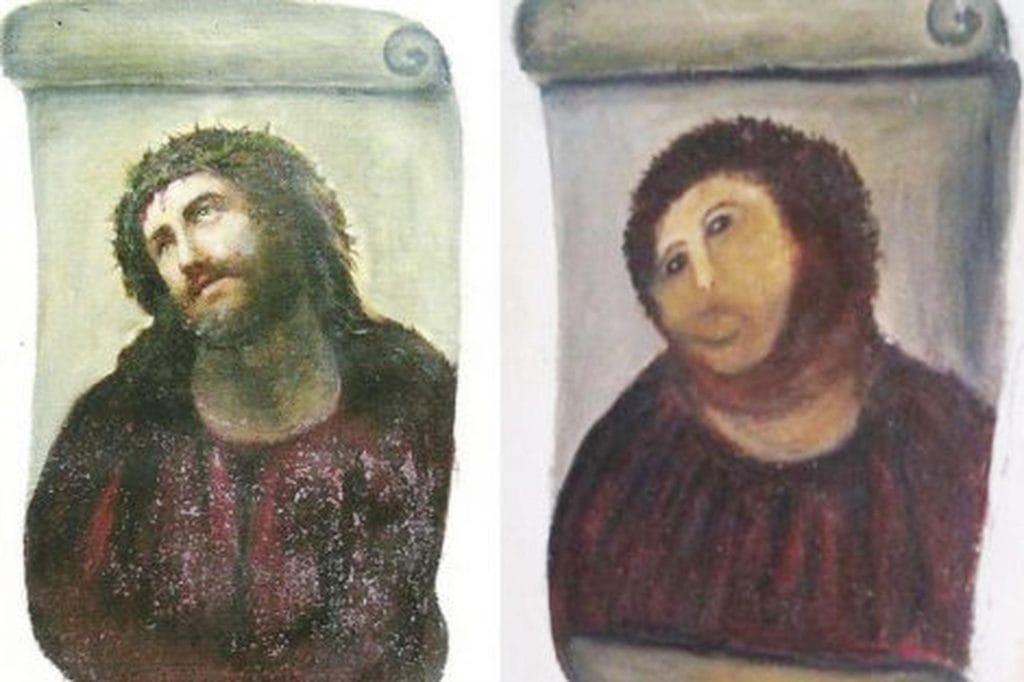
Elías García Martínez’s original Ecce Homo (1930), left, restored by Cecilia Giménez in 2013.
A long-time amateur painter, Giménez became a worldwide phenomenon at 81, when she attempted to restore Ecce Homo, a fresco depicting Christ by the late-19th-century Spanish painter Elías García Martínez, which had fallen into disrepair at Giménez’s local church in Borja. Her questionable handiwork came to global renown after the town’s cultural association posted before-and-after photographs of the painting to its blog under the headline “An Unspeakable Fact.” Indeed, the reworked fresco was what one might call more abstract than Martínez’s original interpretation of Jesus in a crown of thorns. The image birthed thousands of memes across sites like Reddit, 4chan, and Twitter before mainstream media picked it up. Suddenly, everyone was an art critic.
In the deluge of unfettered opinion that followed, Giménez’s painting assumed the popular moniker of “Beast Jesus” for its rather flat rendering of key facial features, like eyes, nose, and mouth, the latter of which was more of a brush-swept gaping maw in the restored mural. It was alternately referred to as Potato Jesus, for the nondescript brown roundness that now made up Christ’s head, or “Ecce Mono” and Monkey Christ, due to the ape-like aspects of the Lord’s new visage, according to some.
The memes became shorthand for a good thing turned bad, but they also generally celebrated irreverence—a key hallmark of millennial and Gen Z artistic taste. The work also spawned a whole subgenre of memes in which Christ’s mangled features were photoshopped into famous paintings, including Edvard Munch’s The Scream and Leonardo da Vinci’s Mona Lisa.
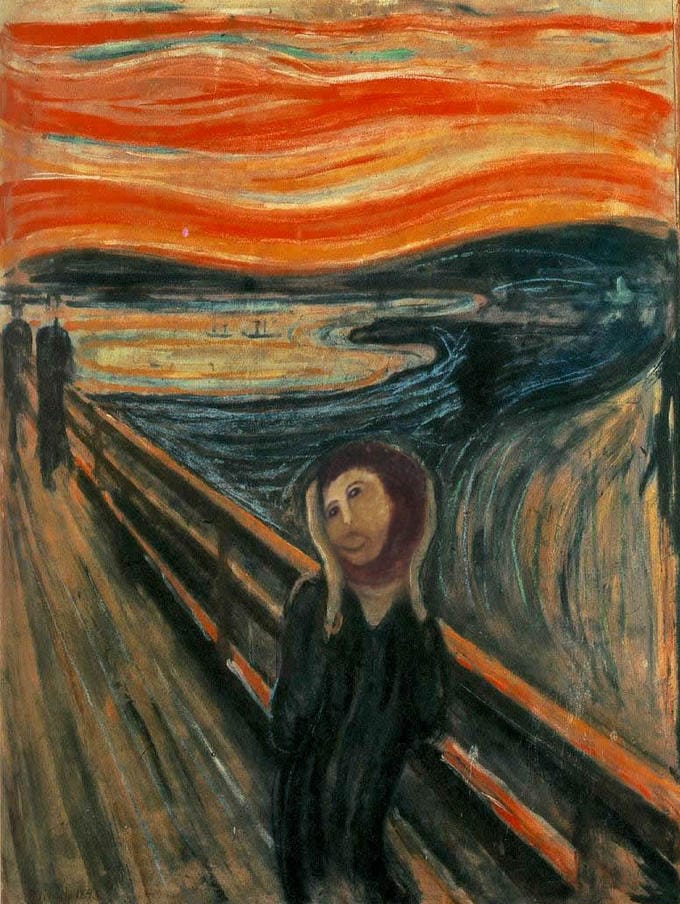
“Potato Jesus” photoshopped into Edvard Munch’s The Scream. Photo: knowyourmeme.
The attention—and derision—initially distressed Giménez. Family members said she cried endlessly and even refused to eat. The artist told the New York Times in 2014 that she felt “devastated,” and that the world thought “it was a crazy, old woman who destroyed a portrait that was worth a lot of money.” In truth, the church priest had OK’d the restoration—it was not an unsanctioned intervention or act of vandalism, as some had claimed—and Giménez said she had not yet finished her work when the cultural association posted the photos to its blog.
But the world works in mysterious ways, and Beast Jesus turned out to be a bad thing turned good for Giménez and her community. With her celebrity on the rise, the amateur artist was offered a few local shows and commissions. More than a decade after the infamous restoration went viral, Borja’s Ecce Homo remains an IRL tourist draw. According to the BBC, the town received some 5,000 tourists a year before 2012; in 2013, it welcomed 40,000 visitors, and even today, some 15,000 to 20,000 make the pilgrimage to see Giménez’s painting.
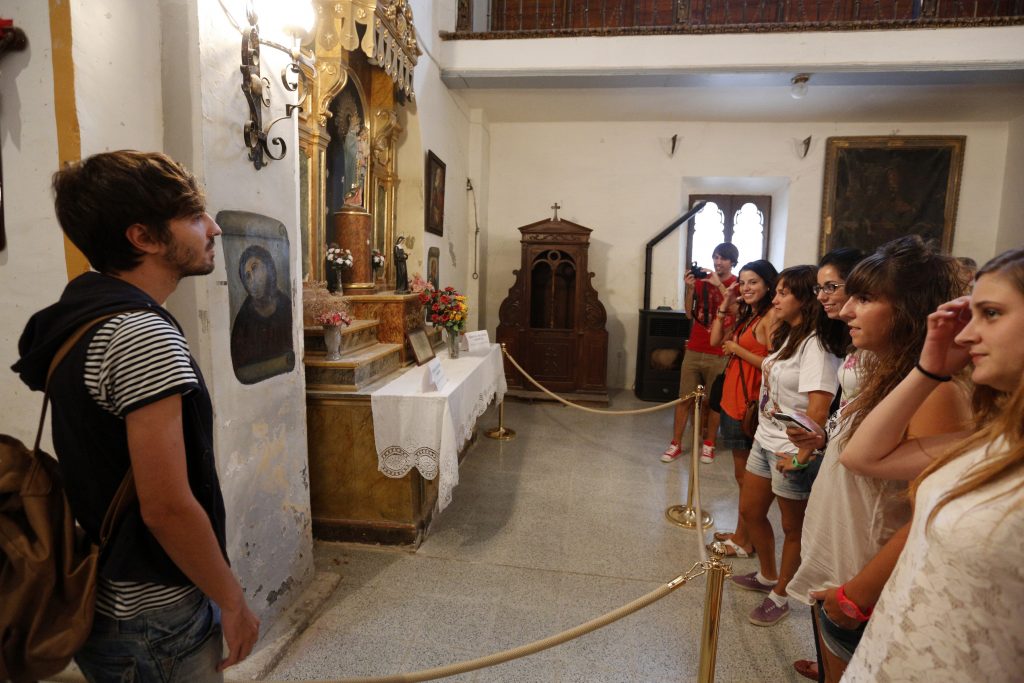
Visitors look at Ecce Homo at the Santuario de Misericordia church in Borja, Spain. Photo: Cesar Manso/ AFP/ Getty Images.
The town’s Centro de Interpretación Ecce Homo, opened in 2016, continues to frame the story for visitors with multilingual displays and official merchandise. The nearby Museum of Colegiata, housed in a 16th-century Renaissance mansion, also experienced a rise in annual visits for its religious, medieval art.
Following an agreement with the local council in 2013, Giménez received 49 percent of the profits from all merchandise featuring her restoration. She donated much of the proceeds to muscular atrophy charities.
Giménez’s story underscores life’s beautiful unpredictability, in which sometimes disasters are simply miracles by another name. Her work continues to reverberate through contemporary culture, inspiring a music video (2014); a Sky Arts documentary (2016); and a comic opera, Behold the Man: L’Opéra de Cecilia, first staged in the U.S. in 2023.