Art History
Was the Bayeux Tapestry Designed for Mealtime Reading?
A new study addresses one of the Bayeux Tapestry's great mysteries: its function.

by
Richard Whiddington
 Share This Article
In 2021, the headmaster of Dover College, a private school on the English south coast, began boasting in promotional materials that the Bayeux Tapestry once hung in its 12th-century refectory. The claim was without source or evidence, but it aligned with a theory that a University of Bristol historian had been contemplating. Namely, that the roughly 230-foot tapestry originally served as mealtime reading for monks—not at Dover Priory, however, but in the refectory of St. Augustine’s Abbey in Canterbury.
While scholars have largely settled the long-running debate over the tapestry’s authorship—the Canterbury monks were designers, and a nearby team of highly skilled embroiderers served as laborers—its intended function remains a mystery. This is due to the work’s numerous idiosyncrasies: Extremely long and costly to produce, it’s a propagandistic recounting of Duke William of Normandy’s conquest of England that is also filled with local gossip and Aesop’s fables. The kicker? There’s no record of the tapestry’s existence until 1476 when it appears in the inventory of Bayeux Cathedral. In this context, British scholar Benjamin Pohl’s proposition, newly published in Historical Research, makes some sense.
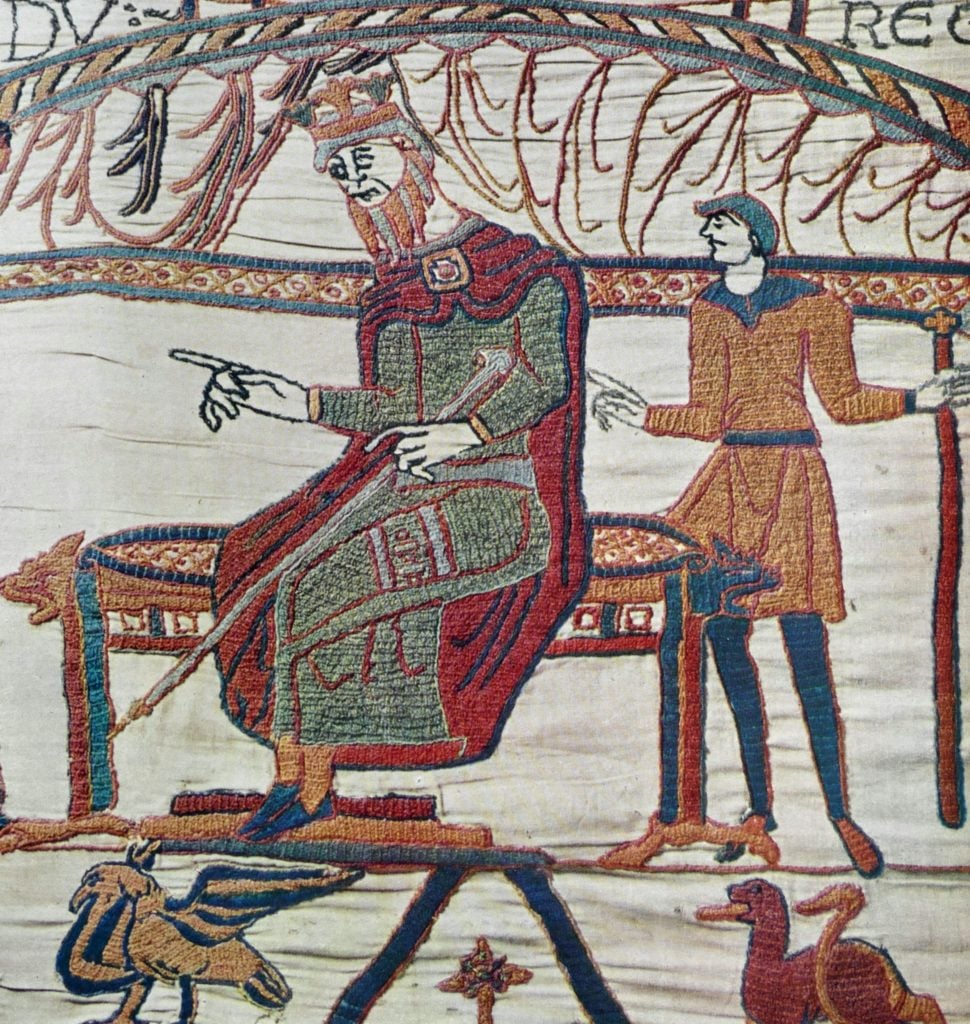
Episode from the Bayeux Tapestry, thought to date to the 11th century. Photo: Universal History Archive/Universal Images Group via Getty Images.
For starters, although William the Conqueror’s half-brother, Odo, Bishop of Bayeux, may have been the tapestry’s key patron, its intellectual architect was likely Abbot Scolland, the first post-conquest abbot of St Augustine’s Abbey. Pohl contends it was designed specifically for a new monastic refectory that Scolland commissioned. Although the refectory no longer exists, documentary and archaeological evidence show there was more than enough interior wall space to hang the full tapestry, which Pohl believes would have been placed at head height, making it “perfectly discernible from the seated position.”
According to the rules set out by the Order of Saint Benedict and followed by St. Augustine’s Abbey, monks were required to maintain complete silence while eating, with their attention devoted to the voice of a reader who delivered the day’s texts. These readings were moralistic in nature, and, in this light, the tapestry takes on new meaning. Yes, it tells the story of the Norman Conquest of England in 1066, but it’s also a commentary on worldly sins, moral failure, and the will of God. In an early tapestry episode, for example, Harold Godwinson, the final crowned Anglo-Saxon king of England, swears an oath to William over reliquary shrines; his later defeat at the Battle of Hastings, therefore, can be seen as a form of divine justice.
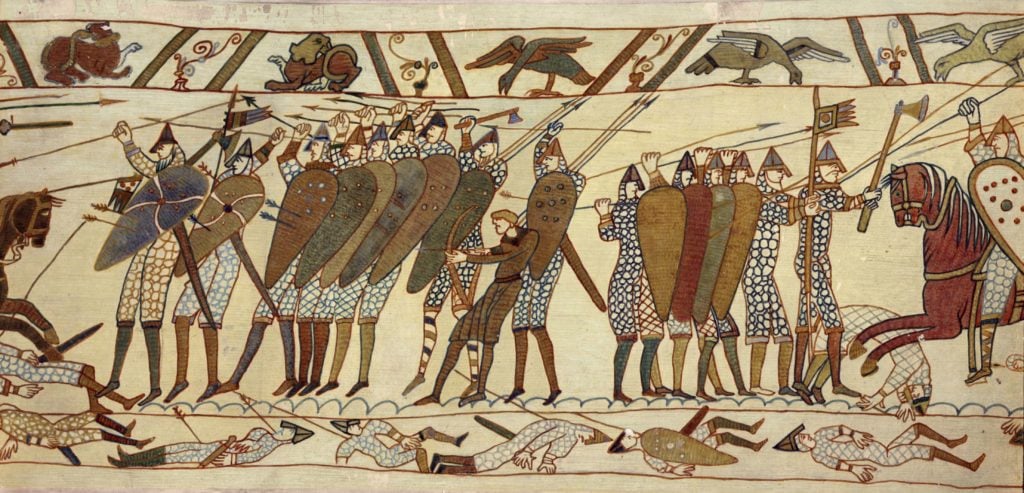
A section of the Bayeux Tapestry, a roughly 230-foot embroidered cloth depicting the Norman Conquest of England and the Battle of Hastings. Photo: Spencer Arnold/Getty Images.
The tapestry’s structure also supports the idea of a moralistic undercurrent flowing through the work. Broken into individual scenes, it can be read episodically as a series of separate but interconnected moral examples. “Each episode is a tale of both good and evil, victory and defeat, damnation and redemption,” Pohl wrote in his paper. “The moral (hi)story told in words and images by the Bayeux Tapestry was one that linked the monastic community with the world beyond the cloister.” The inclusion of Aesop’s Fables in the borders of the embroidery adds to the sense that the work is doing far more than just storytelling.
Then there’s the tapestry’s Latin. Its presence means the authors had a literate audience in mind, but the language itself is simple and far from poetic, suggesting it was suitable for monks with only a rudimental grasp of Latin. It also largely serves an explanatory function, outlining scenes, identifying characters, and telling viewers where to look (“hic,” the Latin word meaning “here,” for example, appears 40 times), all of which would have been useful as a means of nonverbal communication for the monks.
As to why there’s no record of the Bayeux Tapestry at Canterbury, Pohl offers a perfectly simple answer. The Abbey’s refectory building wasn’t completed until the 1120s, nearly half a century on from Abbot Scolland’s death.
“By the time the new building eventually went up residual knowledge about the Bayeux Tapestry’s intended purpose and location—and indeed its very existence—could have eluded the monastic community’s collective memory,” Pohl wrote. “We should consider the possibility that, whatever Scolland’s vision and ambition, the embroidery he had commissioned was never hung up in the refectory built and that for many years it was kept in a box.”

Related Articles
-


