Art History
Who Designed the Bayeux Tapestry? Its 93 Penises Offer Clues
The position and context of the male genitalia in the tapestry, historians believe, might shed light on its mysteries.

by
Richard Whiddington
 Share This Article
The Bayeux Tapestry has obsessed medieval historians for decades. Though it offers a vivid and singular account of the Norman conquest of England in 1066, fundamental questions surrounding the Tapestry, such as who designed it and why, remain unanswered.
Accordingly, it’s been the subject of intense academic research: its threads have received microscopic examination, its dyes have been chemically analyzed, and every gesture of its figures has been scrutinized for hidden meaning. Historians have also done a lot of counting. All told, there are 626 humans, 190 horses, 37 trees, 35 dogs, 33 buildings, and 32 ships. George Garnett, a professor of Medieval history at Oxford University, has tallied up an altogether racier subject: the Bayeux Tapestry’s penises. By his count, there are 93.
Until Garnett’s study in 2018, the horse and human genitalia that pop out along the 225-foot-long embroidery had gone largely unnoticed—unless you count the decision by female weavers in the 1880s to reduce the size of the horse penises to conform with Victorian standards of modesty. Garnett’s focus is not a symptom of an academic with too much time on his hands; rather, he believes the position and context of the penises can help answer some of the Bayeux Tapestry’s mysteries.

A Messenger Brings News of Harold to William, detail from the Bayeux Tapestry (c. 1070). Photo: Art Images via Getty Images.
Of the 93 penises depicted in the tapestry, 88 belong to horses and five to men. Three of these equine phalluses are notably larger than the rest and are used to indicate importance. By far the largest, perhaps unsurprisingly, belongs to the stallion of Duke William that appears being presented to the future king of England ahead of the Battle of Hastings. Second in size is the steed of Harold Godwinson, the Anglo-Saxon king of England. Third comes the horse of Odo of Bayeux, William’s half-brother, who is often credited with commissioning the Tapestry. Garnett disagrees with this attribution and one reason is the depiction of four penises attached to men as evidence.
These penises appear within the frieze, or border, which runs above and below the central action of the Bayeux Tapestry and was, until recently, considered merely decorative. The penises are all connected to men engaged in sexual activity. They allude, Garnett claimed, to Aesop’s fables, which were translated from Greek into Latin by Phaedrus in the 1st century B.C.E. and would have been available to well-educated people in England at the time.
“In every case, it is sexual activity which involves deceit or shame,” Garnett said in a recent episode of the HistoryExtra Podcast. “[The designer] wanted suggest that at various key points something suspect and reprehensible was going on. It’s a document written in code.”

The Bayeux Tapestry on view in France. Photo: Loic Venance / AFP via Getty Images.
As shown in the Bayeux Tapestry, in 1064 Harold washed up on the Norman coast and was led to Duke William as a captive of Guy of Ponthieu. Below this scene there is a naked man beseeching a woman who recoils and covers herself in shame. Garnett believes it points to a fable in which a father assaults his daughter.
As the Normans ride towards battle at Hasting there are two further explicit depictions, both in the upper border. One shows a naked man, whose penis is hidden by an axe and makes an offering to a woman. The second is of a man with a large mustache with a woman boasting profuse public hair. Both images, Garnett said, refer to Aesop fables concerning illicit sex and deception.
“Phaedrus actually says one of the purposes of Aesop fables is to make points obliquely without being explicit,” Garnett said. “It seems to me the designer is doing just that by suggesting different episodes in the narrative involving deceit, betrayal, and shame.”
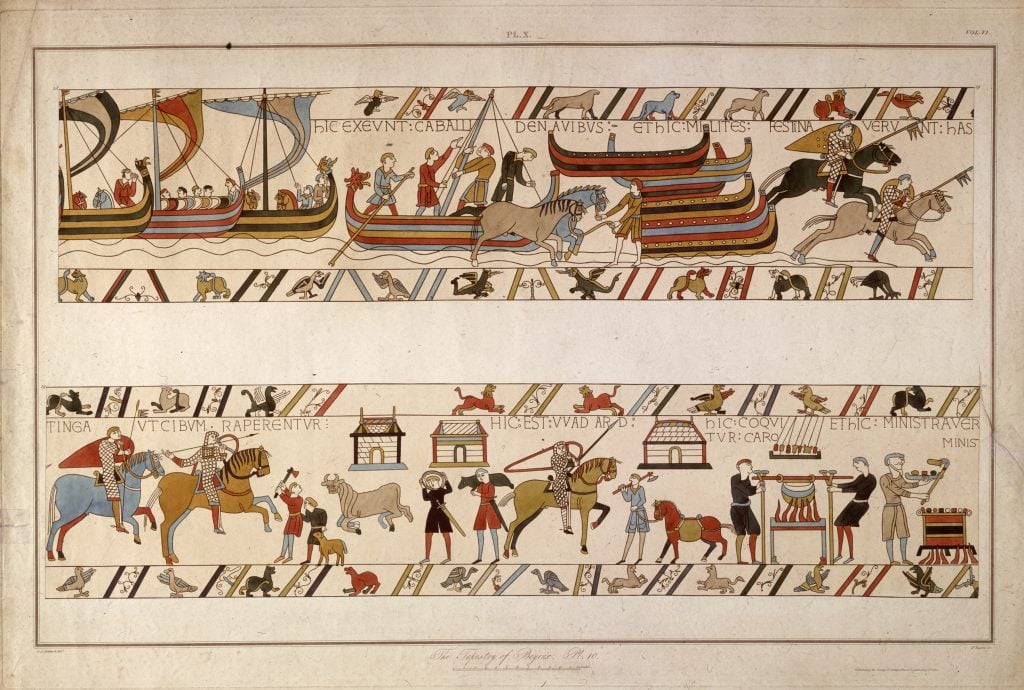
Plate from the Bayeux Tapestry (c. 1070), depicting the Norman army crossing the channel. Photo: Hulton Archive/Getty Images.
This critique, Garnett argued, rules out Odo of Bayeux who would have likely designed a much more flattering depiction of events (not to mention himself). Instead, it seems likely the designer was a learned English individual, based on the spelling of personal names and place names, and someone not strongly connected to either the church or the military, given the numerous mistaken depictions of armor and lack of attention to ecclesiastical matters.
“I think it tells us that this was not designed by a dirty old man,” Garnett said. “I think he wanted to convey serious doubts about the standard story which was told to justify the Norman conquest of England.”
Christopher Monk, a medieval scholar, recently proposed a sixth human penis, one attached to a running man in the Tapestry’s lower border. Garnett is unconvinced and believes it is the scabbard of the man’s sword. “It has a yellow blob at the end, which I take to be a depiction of brass,” Garnett said, noting if you’re not careful, you can fall into the “trap” of seeing penises everywhere.

Related Articles
-


