Opinion
Prized Basquiat Sold (Sort of) for a Fortune, Even as Many Artists Remain Stuck in a Hole: Kenny Schachter Reports
And A.I. will make all the precarity worse.

And A.I. will make all the precarity worse.
Kenny Schachter
 ShareShare This Article
The most unnerving and demoralizing essay that I’ve read so far on the proliferation of A.I. is “The 2028 Global Intelligence Crisis,” by James van Geelen and Alap Shah, in the Citrini Report on Substack. The piece, written as if it is the year 2028, envisions mass unemployment across every strata of the economy and a structural realignment affecting all walks of life. With over 20 million readers as of last week, it delivers the equivalent of a gut-wrenching whack whose incalculable aftereffects we are only beginning to comprehend—and feel.
The report’s focus is on white-collar professionals (a significant chunk of art buyers), who, as a result of A.I. displacement, will be spending radically less across the board. “People borrowed against a future they can no longer believe in,” the report states, with most “working twice as hard (with the help of A.I.) just to not get fired (from the repercussions of AI)…” It goes on:
In this cycle, the job losses have been concentrated in the upper deciles of the income distribution. They are a relatively small share of total employment, but they drive a wildly disproportionate share of consumer spending. The top 10% of earners account for more than 50% of all consumer spending in the United States. The top 20% account for roughly 65%. These are the people who buy the houses, the cars, the vacations, the restaurant meals, the private school tuition, the home renovations. They are the demand base for the entire consumer discretionary economy.
Last week, Twitter co-founder Jack Dorsey, CEO of Block (a financial services technology company), slashed his workforce by 40 percent, axing more than 4,000 employees, a decision he explicitly linked to the transformative consequences of A.I., rather than financial woes. The scorched earth of the 2020s is spreading from the ever-expanding battlefields of global wars (a topic too raw for these pages) to the very fabric of civilization at an alarming rate. I forgot to mention the unprecedented forms of lethal weaponry that alone are enough reason not to get out of bed tomorrow.
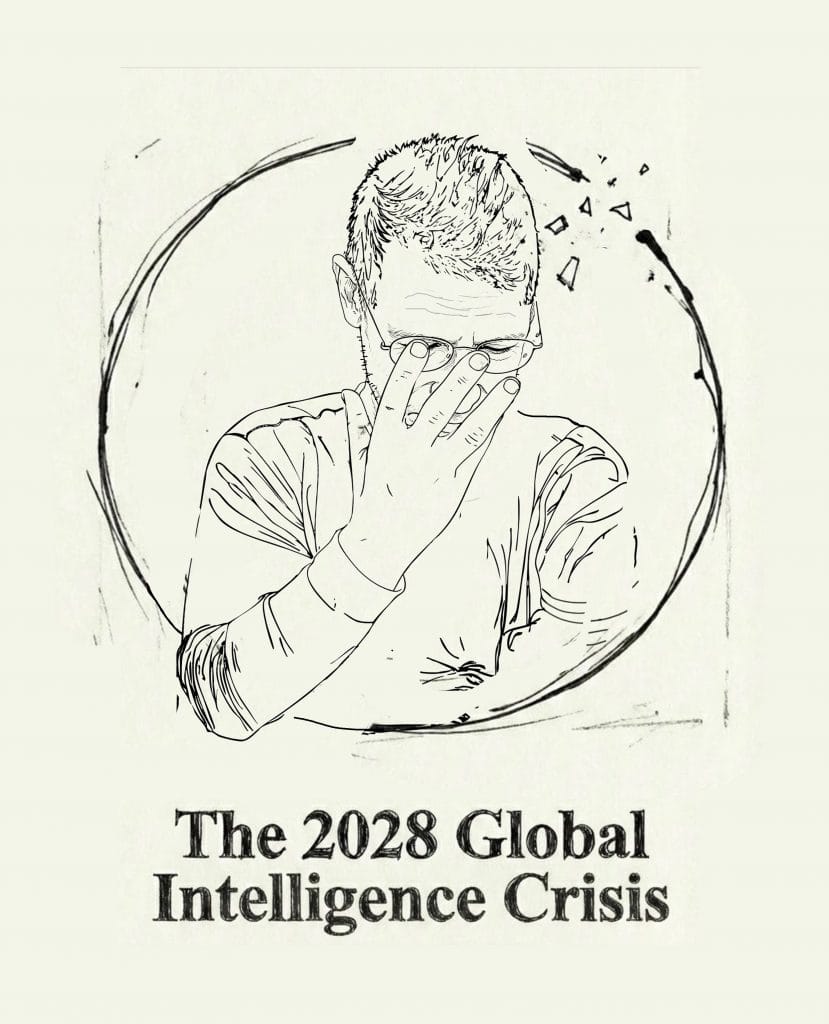
That’s all, folks! Gloom, doom, and ruin: The full scope oft the A.I. aftermath/bloodbath will be devastating. Buckle-up… Image courtesy Kenny Schachter
Our erstwhile pre-A.I. existence is a thing of the past, soon to be altogether forgotten by Gen Alphas, the generation after Z, born between 2013 and 2025. Granted, I’m too old to be writing about this. There are few tasks left that only humans can do. A.I. blogger and podcaster Zack Kass has coined the term “The Tragedy of Unmetered Knowledge” for the idea of intelligence being equated to a pay-per-use resource like electricity, gas, and the internet, rather than being valued as a scarcity. What price genius? Twenty bucks a month ought to buy it. The only thing left that still doesn’t come easily is making money, unless you’re a tech overlord, along with—tragically—peace, equality, and health.
Art is among the few things left that only humans can do (for the time being) that needs to be thoughtfully and carefully nurtured and supported more so than ever. But we’d be naïve, at best, to think the A.I. shit-show won’t have knock-on impacts on artists, galleries, museums, auction houses, and logistics companies. Sadly, it’s all but a fait accompli that our micro universe will wither even further. With the near-future employment landscape so bleak, who on earth will be in a position to buy emerging and mid-market artworks? Don’t answer.
Although my column is regularly classified as “opinion,” I’m staunchly resolute in my reporting when my personal and financial fates are on the line, as I’m liable for the veracity of every word I write, as is my editor. (Err, sorry about that.) The painstaking research involved (though it may not appear as such), is about as bulletproof as you can get: I’ve never been sued in 35 years of writing. There have been instances of fisticuffs thrown, lawsuits threatened, and graver still, death threats, but no formal legal proceedings have ever been undertaken. And I’m still alive… so far.
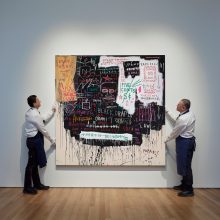
Granted, everyone makes mistakes. Besides I’m merely a man(-child), not machine—though we’re destined to be transformed into our best robotic selves. I confounded a sale factually in my last article that I have just about resolved, and I’d like to clarify matters. It appears that billionaire car dealer and former owner of the Philadelphia Eagles (football club) Norman Braman did indeed sell Jean-Michel Basquiat’s 1982 Philistines, but rather than an outright sale, he apparently retained a lifetime interest, enabling him to retain possession until his death, despite offloading the painting some years ago.
At the ripe age of 93 (and a half), having lasted so long since the consummation of the deal, I’d gather that the buyers (rumored to be the Qataris) are none too amused with the terms of the transaction. The only definitive source for the confirmation of this deal, besides Braman, and the sort-of-new-owners, is Jeffrey Deitch, his dealer/advisor forever, who has not responded to my repeated inquiries on the specifics of this issue.
There’s a stinking rich brand of asset accumulators who assemble what I used to call encyclopedia art collections, then Wikipedia and now ChatGPT art collections. With these collectors, wherever you might turn for reference on a canonized artist, you’ll find their signature work depicted. And that is the only type of artwork these buyers collect. Cf. the hoardings of Steve Cohen, Leon Black, Ken Griffin, Eli Broad, Sheikh Mohammed bin Ali Al Thani, David Geffen, et al. And, add recent converts to the ilk, Jeff Bezos and Mark Zuckerberg.
On the topic, I’ve been apprised that one of the biggest Modern art collections is heading to the auction block at Sotheby’s or Christie’s, potentially belonging to the estate of deceased Italian industrialist and former principal owner of Fiat, Giovanni Agnelli (1921–2003).
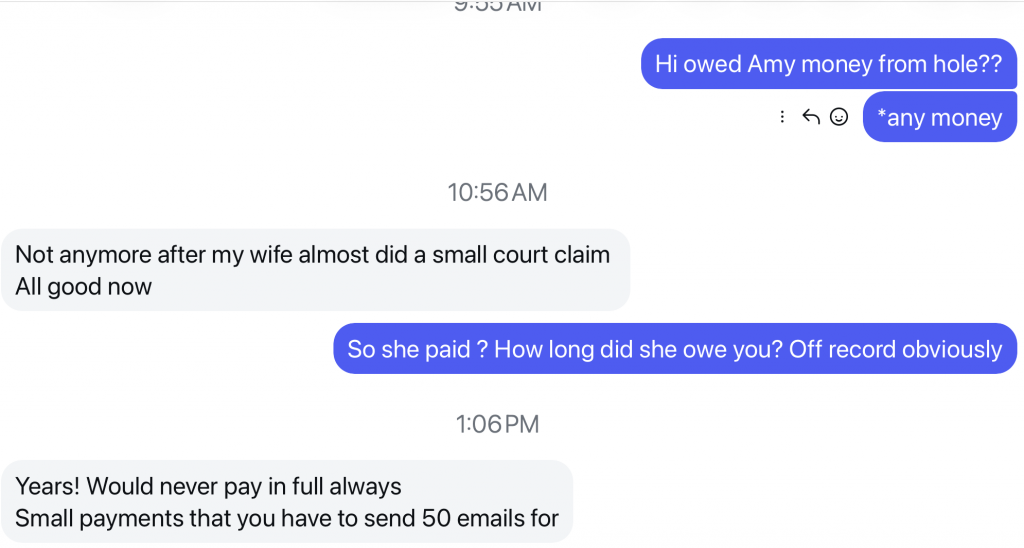
This artist got off easy(ish), though many artists are still in the hole, struggling to get paid for sold artworks after months (and sometimes years) from the Hole gallery. Photo courtesy Kenny Schachter
I like the Hole gallery’s proprietor, Kathy Grayson, and her beloved dog, Bertie (R.I.P.)—or I did, anyway, before fielding calls from a handful of disgruntled artists about her allegedly continuing to owe a number of them proceeds from consummated and paid-for sales, at best trickle-paying them in insultingly (as described by the recipients) minuscule and irregular anemic drips. They claim she has a history of ghosting emails for months on end and going years without any payments whatsoever, in some cases. The dog—better treated than many of her artists—became a cash cow for Grayson as a well-paid social media influencer.
In response to my texts, Kathy replied:
Hey Kenny! Dang I’m sorry, the business has been improving and catching up on payments, been making good progress recently. Def busting ass to get back to normal! As far as I know I am in touch with everyone, and responding and making payments towards all. Sigh…. Thanks for the heads up I’ll try to figure out who I have not been in touch with and resolve with them! I’m gonna make sure everyone is caught up. We report sales when clients pay, since so many the last few years disappear. We get 99% but for sure I’ve missed some, esp w giant group shows. Anyhoo I’m on it thank you so much for the text. If you’re in LA come see this crazy Barry McGee show (which she co-organized with Deitch projects)!
A few have continued showing with Grayson, in spite of her payment practices (or lack of them). I spoke to an artist who was promised an escrow account would be set up to prevent what she had previously endured, only for it to be flouted, and now she is back in the precarious position of futilely beseeching the gallery for delinquent funds. Another in a similar predicament is in the current McGee exhibition. He told me he couldn’t resist the career exposure of a Deitch-sanctioned show. He wasn’t alone in that regard, either.
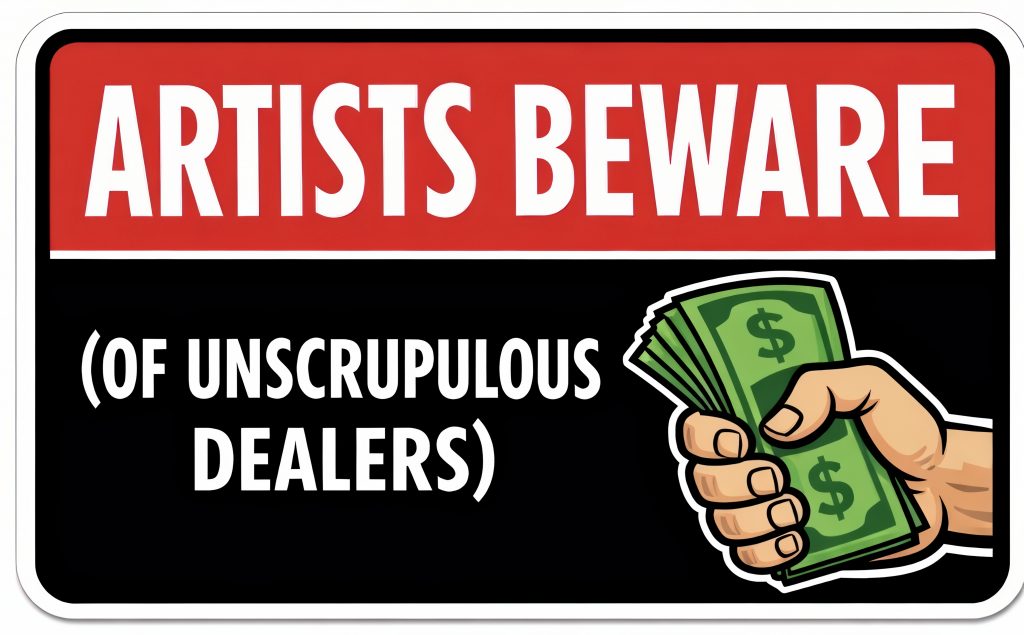
In today’s art world, forget buyer beware. It’s the seller/artist that must be constantly on guard against unscrupulous dealers. Image courtesy Kenny Schachter
What deplorable circumstances when opportunities are so scarce on the ground that some artists have no recourse other than to be owed outstanding monies and be compelled to continue toxic relationships. In the present environment, artists have become an increasingly desperate lot. And they (we) are invariably the first to get screwed since the stuff came off cave walls. Forget buyer beware, in today’s treacherous art world of dwindling opportunities, it’s oftentimes ARTISTS BEWARE (OF UNSCRUPULOUS DEALERS). And gallery employees, too, for that matter: I spoke to long past employees also stuck in same predicament.
I had an exhibition, and even after it was rescheduled to a less desirable slot, I was asked to pay for shipping just prior to its start—both to and from the space. Nevertheless, I wanted the imprimatur of the gallery, which is a strategy that I can no longer afford (nor can most others similarly situated).
This whole yeoman-like enterprise of recounting the machinations of the art market continues to weigh on me. Yes, I’ve written it before, but I’m frankly questioning why I bother. I may just revert to making, teaching, and writing about art.
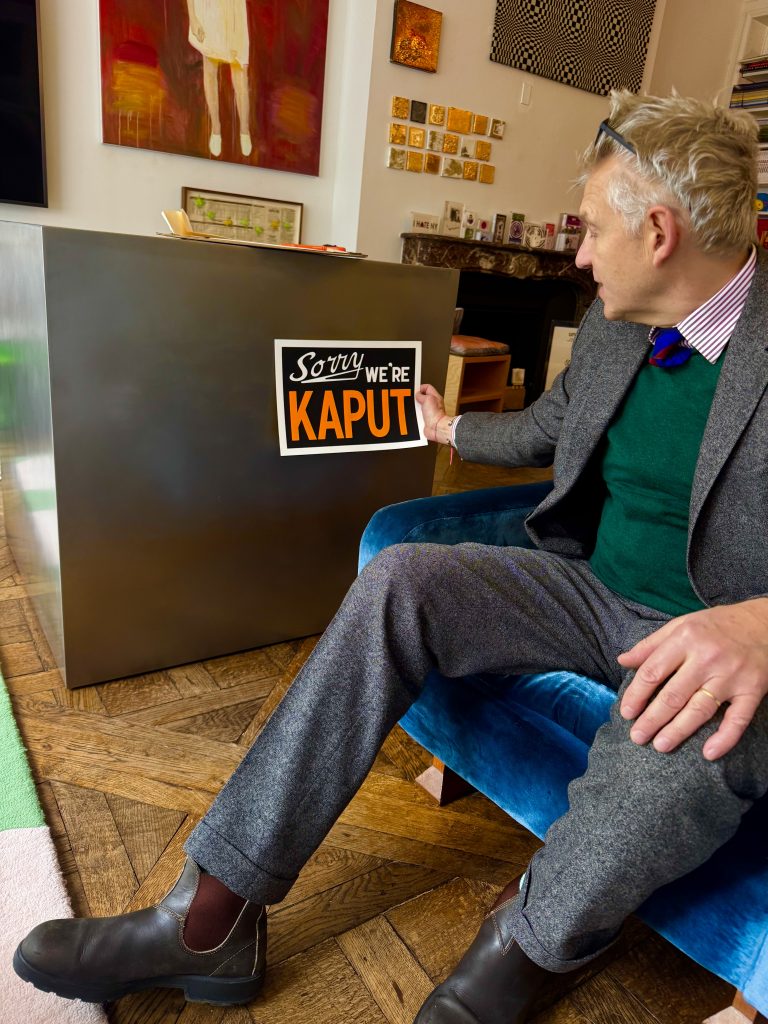
Having a gallery survive 30 years and not go kaput is a lot to celebrate these days. Anton Kern at my house celebrating no longer wanting to kill each other. Sorry We’re Kaput by Adam McEwen. Image courtesy Kenny Schachter
On an upbeat note, you’ll be happy to know, dealer Anton Kern is staging a 30th-anniversary exhibition entitled “Analog” (March 4–April 11) that includes Alvaro Barrington, Margot Bergman, Ellen Berkenblit, Katherine Bradford, Carroll Dunham, Rosemarie Trockel, Francis Upritchard, and dozens of others, some he’s exhibited over the decades and others he just happens to like. Good enough reason for me. Here’s an excerpt from the initial 1996 press release he launched with, setting the tone for the gallery’s programming:
Anton Kern is German and the son of a painter. When he speaks of an artwork, he always starts with the artist. As he describes the work, you can almost feel the work being made. Every description is followed by brief laughter. Anton likes paint, color, squiggles, humor, humanity.
The artist/dad referenced in the release above is Georg Baselitz. Kern’s brother, Daniel Blau, is also a dealer (of vintage photography and Modern art) with a gallery in Munich. I’ve known Anton long before he started his eponymous gallery and our relationship got off to a tumultuous start, to say the least. We met 35 years ago, when I’d scheduled an appointment to view three Matthew Barney photographs on the occasion of his first solo exhibition at Barbara Gladstone Gallery in 1991. I was there on behalf of collector AG Rosen, which I communicated to the gallery beforehand: They certainly weren’t for me at that stage of my career. Kern was ensconced behind the reception desk.
After disappearing into the back room for what seemed like an eternity (in reality 10 to 15 minutes), Kern returned only to inform me that there was “too much heat surrounding Matthew Barney” and nothing was available. I recounted the tale to Charlie Finch, who wrote for Coagula Journal at the time, and he relayed the story to a journalist writing a profile for the New York Observer on Barbara Gladstone who was going to include it in his article.
When I sent Gladstone an invitation to an exhibit I was curating, inscribed with the note: “Thanks for your generous hospitality read about it in NY Observer,” she proceeded to have the article killed, while Anton wanted to kill me from that point on, mistakenly believing I was trying to get him fired. I wasn’t. We’ve only recently reconnected after all these years, perhaps primarily due to the fact that we’ve both survived slogging in the art world this long.
I met AG Rosen when he was the financier behind a neckwear designer that employed me to sell ties. This was after law school (don’t ask). Rosen was practically the only collector I ever sold art to as a young curator staging hit-and-run exhibits, before the term pop-up came into existence. He proceeded to all but subsidize my career for a decade, until he was replaced by the extraordinary collector, publisher, writer, and museum founder Harald Falckenberg (1943–2023).
For the decade that Rosen supported my early curatorial efforts, throughout the 1990s, he always owed me money, and it was then that I received the sage advice that has stuck with me since: “The only thing worse than being owed money is not being owed money.” However, that rings mightily hollow when you have none.
I know a prominent critic writing for a legacy art magazine who is being repurposed as a content-creator for the publication as readership for the genre has dwindled to less than zero. Call it the societal endgame of truncated attention spans wrought by social media. With that in mind, I have casually launched a podcast myself, on all the usual platforms (Apple, Spotify, and YouTube), and the two victims that I’ve interviewed thus far are legendary figures, German dealer Karsten Greve and renowned scholar, curator, and retired gallerist Francis Naumann. Stay tuned for additional programming.
As noted in Naumann’s latest book (his 12th, I’m fairly certain), Impossible: The Love Affair Between Marcel Duchamp & Maria Martins and the Artwork It Inspired, out March 31 on Abbeville Press, a statement by artist Maria Martins was written into the Congressional Record in 1947. Here’s an excerpt from his book, beginning with Martins:
“It was by the destruction of works of art . . . that Hitler began his nihilistic drive of conquest, domination and destruction,” she wrote. “Art is liberation and construction; it is by art that we must rebuild this shattered world.” She believed that art offered a universal panacea, a means by which to counter the destructive aspects of war. “Art is eternal not in its styles, not in its schools, not in its technique, not in its conceptions, nor in its subjects, but in its ideal, in its definition, in its aims, in its consequences. Art is the most solid basis of peace.”
Amen.