

Editor’s Note: We are republishing this 2016 article that details a study identifying Banksy following the release of a Reuters investigation in March 2026 that claimed to have finally unmasked the guerrilla graffiti artist as Rob Gunningham. However, Gunningham was rumored to be the man behind the moniker as early as 2008 and many subsequent reports have all but confirmed this. The Reuters investigation suggested Gunningham has since changed his name to David Jones. Banksy’s lawyers maintain that the artist’s identity remains unknown.
A study conducted by scientists at London’s Queen Mary University claims to have discovered the identity of Banksy by using geographic profiling, a technique used to catch serial criminals. The academic research identified the anonymous graffiti artist as Robin Gunningham.
Geographic profiling is a sophisticated statistical analysis technique used in criminology to locate repeat offenders. The scientists looked for a correlation between 140 artworks in London and Bristol attributed to Banksy, and 10 commonly touted names purported to be the elusive street artist.
“The pseudonymous artist Banksy is one of the U.K.’s most successful contemporary artists, but his identity remains a mystery. The model takes as input the locations of these artworks, and calculates the probability of ‘offender’ residence across the study area,” the authors write in the paper.

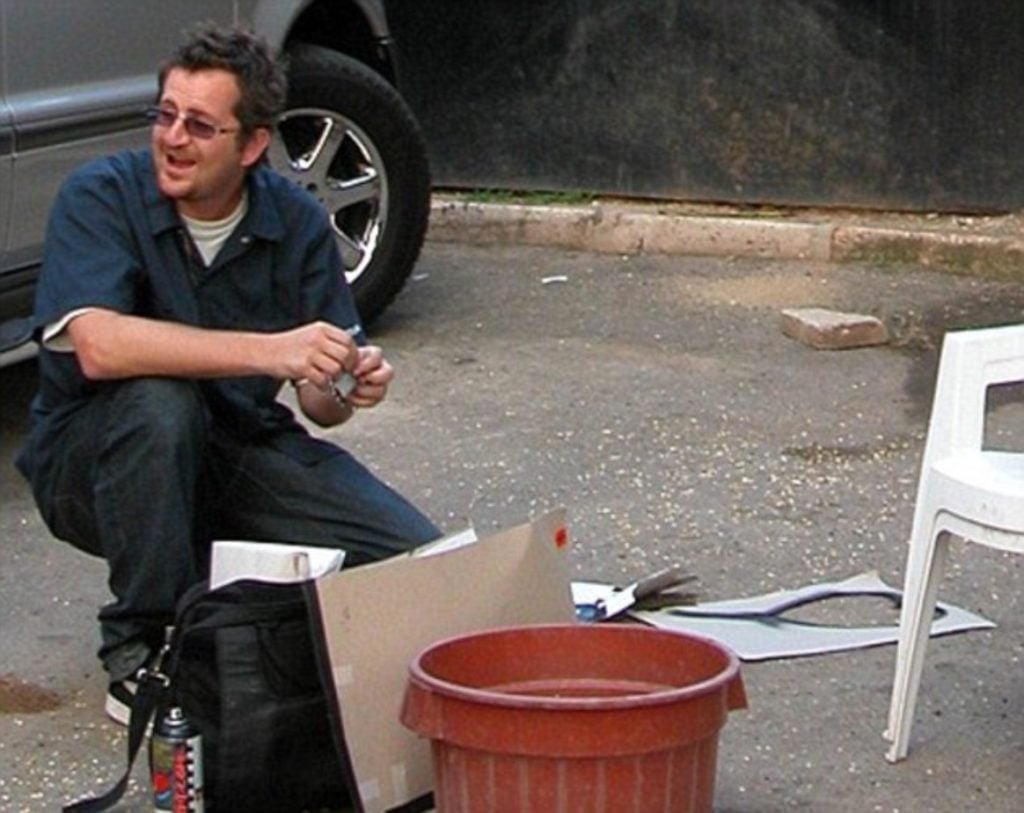
This picture of Robin Gunningham was supposedly taken in Jamaica in 2004.
According to the Independent, the analysis revealed a series of hotspots, narrowing down a number of areas for the researchers to investigate further. The hotspots included a pub, a playing field, a residential address in Bristol, and three addresses in London.
After cross-referencing the hotspots with publicly accessible information on the list of 10 potential Banksy “candidates,” the researchers found that each of the hotspots were places lived in or frequented by Gunningham—a name originally linked to Banksy in a 2008 newspaper investigation.
“I’d be surprised if it’s not [Gunningham], even without our analysis, but it’s interesting that the analysis offers additional support for it,” Steve Le Comber, a biologist and co-author of the study, told the BBC.
“What I thought I would do is pull out the 10 most likely suspects, evaluate all of them and not name any. But it rapidly became apparent that there is only one serious suspect, and everyone knows who it is. If you Google Banksy and Gunningham you get something like 43,500 hits,” he said.

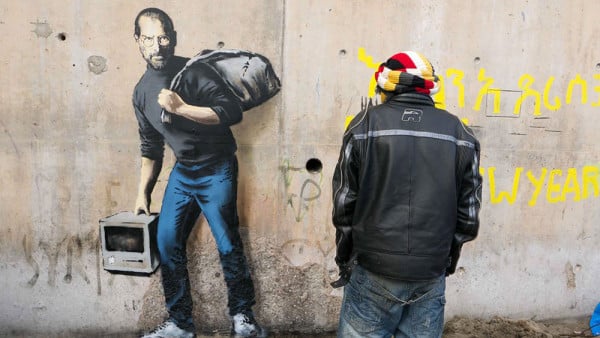
Banksy’s portrait of Steve Jobs in Calais.
Photo: via banksy.co.uk
But does the study hold weight? There have been several attempts to unmask the mysterious street artist. Individuals thought to be Banksy have been arrested outside London and in New York. Others identified him as a parking attendant, and some say Banksy is in fact female.
The authors maintain the artist’s identity isn’t really the point. They say the purpose of the study is to use the identification of Banksy as an example of how geographical profiling can help catch more serious criminals.
“These results support previous suggestions that analysis of minor terrorism-related acts (e.g., graffiti) could be used to help locate terrorist bases before more serious incidents occur, and provides a fascinating example of the application of the model to a complex, real-world problem,” the report states.
But for fans (and haters) of the elusive street artist this could be a huge revelation indeed. Meanwhile, Banksy’s own website was offline this morning, U.K. time.
This article was originally published on March 4, 2016 at 7:23 a.m. ET.