Artists
Do Artists Make Better Dealers?
When artists become gallerists, sensitivity meets business strategy—and the notion of running a gallery shifts shape.

by
Tom Seymour
 Share This Article
Do artists become a better class of dealer? Some of the most noted gallerists in the game did not begin in the salesroom but in the studio.
Leading dealers from across the world’s art capitals—New York, London, Los Angeles, Brussels and beyond—share an origin story rooted in artistic practice: the names of those behind Reena Spaulings Fine Art and Gavin Brown’s Enterprise have artistic origins. There is also Börkur Arnarson’s i8 Gallery in Reykjavik, Iceland, and, more recently, former artist and curator Nicolaus Schafhausen launched a commercial gallery, KIN gallery in Brussels. Beloved New York dealer Jack Hanley started out as a painter and, since closing his gallery last year, is back to painting. Upstart U.S. dealer Sebastian Gladstone got his start as an artist, and blue-chip painter Joe Bradley’s new Galerie Sardine in New York have been making waves. Does the experience of having labored in the studio shape how they work with artists— and how they see the art market?
For some, the move from artist to dealer came out of necessity. “The art world seemed so opaque and impossible to access,” recalled Gladstone, who began curating group shows in Los Angeles in 2010. “The only way to present the things me and my friends were doing was to present them ourselves.” His frustrations as an artist became the basis for his gallery’s structure: “Every show I did took so much work, and the end result was typically disappointing. Those lessons inform the infrastructure of the gallery, and the support it offers the artists we work with.”
Others came to dealing not through their own studio experience, but through proximity to it. Valentina Akerman didn’t train as an artist, but she runs Galerie Sardine in New York with her husband, the painter Joe Bradley. “I’ve been married to Joe for a long time and have seen his career evolve from a very intimate point of view,” she said. “That experience remains with me in how I am building this gallery and how I want to work with artists. I’ve been privy to their most intimate concerns–their struggles, what generally feeds them and supports them.”
Sardine describes itself not as a gallery, but as “artist project–based,” a distinction that Akerman insists is more than semantics. “We wanted the project to centre the artist, and to be really conscientious of the struggle of an artist,” she said. “In a city like New York, the challenges are immense, but I’ve seen how much a sense of stability and genuine support can change the course of a career.”

Valentina Akerman, co-founder of Galerie Sardine with Joe Bradley. Courtesy Theo Wenner
In Iceland, Arnarson, who represents some of country’s most significant artists, including Ragnar Kjartansson and Hildigunnur Birgisdóttir, followed a different path. Before founding i8 in the Icelandic capital in 1995, he worked as both a practicing artist and a press photographer in London. “My attempt at being an artist was always veiled in irony,” he told me. “I did show quite a bit for a short period, but took it less seriously than anyone else. Then the imposter syndrome changed from being a syndrome to a truth. I think the whole thing lasted less than four years.”
His experience, however brief, shaped how he now engages with artists. “Somebody told me that a former artist would make a better gallerist and a worse dealer,” he said.
This sensitivity often translates into patience and practical understanding. “The main takeaway from making art,” said Gladstone, “is that it’s hard. The process can be solitary and emotional, so I try to hold space for whatever artists might be going through. Good art takes time. Rushing or spreading artists too thin does nobody any favors.”
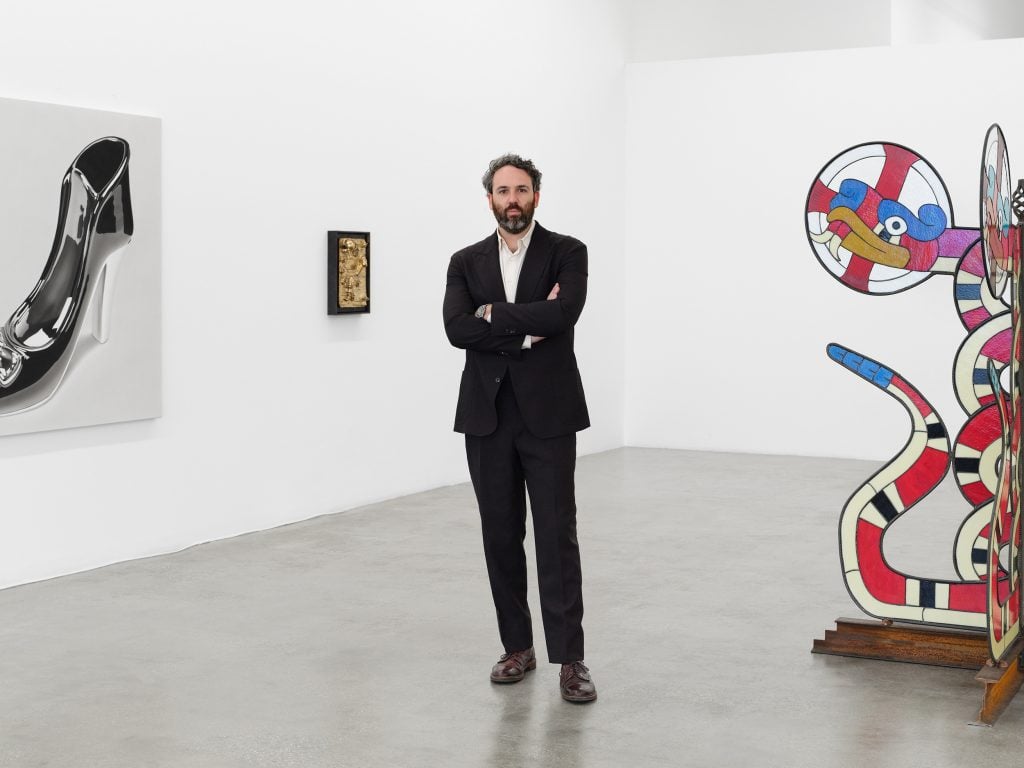
Sebastian Gladstone. Photo: Nik Massey, Courtesy of Sebastian Gladstone Gallery
The Creative Process
For Akerman, the most overlooked challenge is the emotional shock of moving from studio solitude into a public-facing role. “Art-making is a quiet and introverted pursuit,” she said. “You spend years in deep interiority, and then suddenly there is a show and you’re expected to be this public relations giant. The switch can be brutal, and not everyone is naturally good at talking about their work.”
Akerman described it as a kind of code-switching: “Artists have to move between these two worlds—one deeply interior, one incredibly public. The pressure to package themselves, to be charismatic and articulate on demand, is huge. I see that struggle again and again.” Her gallery, she said, tries to absorb some of that burden: “If we can help carry the weight of the public side, they can stay focused on the work.”
Arnarson sees the act of exhibition-making as a creative outlet in itself. “I do think making exhibitions is a very creative process—one that probably fulfills a lot of gallerists’ creative needs,” he added. But he stresses the importance of restraint: “Nothing turns out the lights faster than seeing a young artist doing a work that reminds you of something that you did yourself.”
Arnarson’s approach is echoed by Birgisdóttir—who represented Iceland at the 2024 Venice Biennale and whose work Arnarson sold from i8’s booth at Frieze London 2025. She describes running a gallery as “an art of its own,” adding: “There is an art to both managing difficult people and a healthy cultivation of art – the ability to manage both simultaneously is only within the power of few.”
For Birgisdóttir, Arnarson’s history as an artist creates an immediate shorthand. “Börkur understands my existence and less energy is used on understanding each other’s perspective,” she says. “He speaks art—he breathes it. It is all consuming.” She often turns to him while a work is still forming: “He is often the first person I ask for opinions on a piece in the making or to have a conversation on the latest show I just saw.”
That dynamic also cultivates mutual respect. “I have full trust in him,” she noted. “He understands my foundation – why I do what I do. I trust him to be honest and work in my best interest.”
Birgisdóttir also notes that the gallery’s commercial pragmatism rarely compromises her work: “i8 is a very gorgeous thing… its whole ‘brand’ is integrity to the arts. There are things that need to be realistic, but rarely reducing the art. When reality kicks in, it doesn’t hurt the work or its integrity—it’s just a way to become real.”

Installtion view of Ragna Róbertsdóttir’s solo exhibition in 2025 at i8 Gallery, Reykjavik. Courtesy of the artist and i8 Gallery, Reykjavík
Understanding Needs
And on the question of whether being a former artist makes someone a better dealer, Birgisdóttir answers simply: “Yes, for all the reasons above.” “By communicating directly with the artist about these realities and making decisions together about the intersection of sustainability and integrity,” she said, “you can maintain both.”
That balance between protection and pragmatism also shapes how dealers relate to collectors. “More and more, I get collectors asking for huge discounts,” Akerman told me. “And I always have to remind them: at the other end of this, there is a person doing this. The few artists who achieve great wealth are not the norm, and people forget that.” She sees her role as gently recalibrating that perception: “There’s a kind of meme-ified version of the artist’s life that makes it look effortless. But commitment to art is almost monastic. Some people spend their whole lives making work and never see it bear fruit in the world.”
Gladstone sees advocacy as central to his work. “I always found advocating for myself difficult as an artist,” he says. “But for the people I work with, I think about their needs, their families, their bills. It makes it effortless for me to advocate for them.”
Both gallerists suggest that an artist’s background can deepen understanding and communication, but it is not a guarantee of success. “Anyone can be a good dealer,” Gladstone says. “It comes down to staying true to your vision, building a community and working hard.”
Akerman agrees. “Whether or not you succeed as a gallery is so particular,” she said. “All the conditions may be there, but there are things that just happen on their own. What matters is intention. If you stay close to the true nature of artists and their needs, that energy propels outward.”

Nicolaus Schafhausen. Image: Steffen Jagenburg
If Arnarson and Birgisdóttir emphasize intuitive understanding, Nicolaus Schafhausen, director of KIN in Brussels, stressed multiplicity. “As a gallerist, one operates with several identities,” he said. “They allow me to shift between different modes of relating to artists, curators and collectors.” That multiplicity, he argues, prevents over-identification. “I manage to maintain a constructive distance between the artistic positions I represent commercially and their content.”
Though Schafhausen also began as an artist before moving into dealing, but he insists the shift was almost accidental. “I started by showing the work of my closest friends, and suddenly I was running a gallery,” he said. His path later expanded into curating, publishing and directing major institutions before returning to the gallery model three years ago. “The relationships with artists are entirely different from those I had as a curator—and that is perhaps what matters most to me.”
Unlike others who draw directly on their frustrations as emerging artists, he emphasized distance rather than identification. When asked whether his gallery’s ethos grew out of struggles he faced as an artist, he is blunt: “None.” He also rejects the notion that running a gallery extends his artistic practice: “A gallery has nothing to do with conceptual art for me. The construction of a program draws on curatorial practice, but it is not an artwork in itself.”

Installation view, Yalda Afsah: Barrage, KIN, 30/10/25 – 20/12/2025
Yet his artistic background still shapes his sensibility. “It’s a combination of risk-taking, presentation, and selection,” he says of where the ‘artist’ in him emerges. His guiding principle: “Treat the most important thing as the most important thing — meaning a precisely considered production of art that must always carry an art-historical dimension.”
On the commercial pressures artists face, he is pragmatic. “Artists are smart enough to pursue multiple strategies within their practice without compromising their vision,” he says. “Artists who make films or videos often produce photographs to finance their non-commercial ideas.” He also questions whether former artists make better dealers: “I have no real basis for comparison. Dealers with different backgrounds bring their own biographies and strengths.”
Whether in Los Angeles, London, New York, Brussels or Reykjavik, this cohort of dealers have found novel ways to create, this time by building the structures that allow others to do so. As Arnarson puts it: “Gallerists who were once artists might have a different sensitivity. But only if their angst is gone.”

Related Articles
-