Art History
Why Was Mondrian Obsessed With ‘Snow White’?
The 1930s Disney classic chimed with the artist who had to flee the Netherlands for London.

by
Richard Whiddington
 Share This Article
Piet Mondrian never intended to go to London. The dream was always New York, that modern place of vertical steel, fashion, and the jazz the Dutchman adored dancing to. Besides, American collectors had long been receptive to his work.
Geopolitics interceded. In 1937, two of Mondrian’s paintings had appeared in “Degenerate Art,” a Munich exhibition of works confiscated by the German authorities, essentially blacklisting him. A year later, as conflict crept closer to Paris, where he’d lived on and off since 1912, Mondrian dispatched inquiring letters to friends on both sides of the Atlantic. London answered first.
He settled in the leafy suburb of Hampstead and found it surprisingly to his liking. The air, most immediately, improved his health. He enjoyed Hampstead’s spaciousness and its broad, uncrowded streets, as well as the historic sites in the city proper, such as the Tower of London and St. Paul’s Cathedral. He was less fond of the vertiginous escalators that led into the Underground. Soon, he was referring to Paris as a “toy city” and praising the stoicism with which English people faced imminent war.
Mondrian was 66 years old when he abandoned his life in the French capital, and the seamlessness of the transition owed much to the community of artists that welcomed him. The painter Winifred Nicholson accompanied him by train and boat from Paris to London, the Russian sculptor Naum Gabo booked him into a hotel, Ben Nicholson found him his ground floor apartment, and others lent him furniture and showed him around. “A gentle nest of artists” was how one critic aptly described the Hampstead artistic circle of the 1930s, one that included Henry Moore, Paul Nash, and Nicholson’s second wife, Barbara Hepworth.
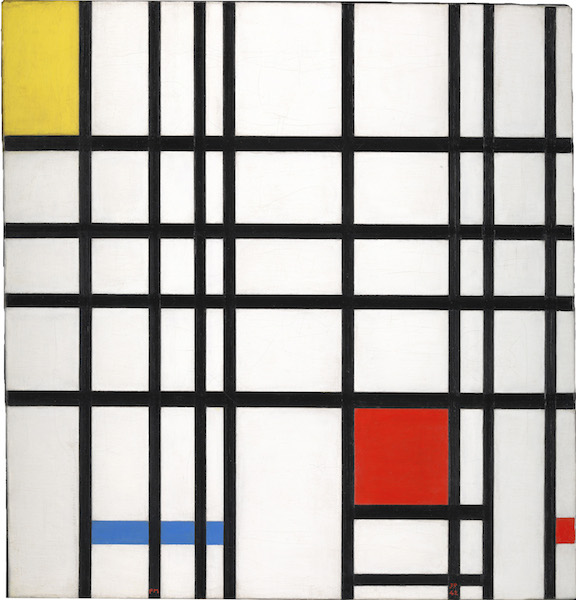
Piet Mondrian, Composition with Yellow, Blue and Red (1937–42). Courtesy Tate.
As he had in Paris, Mondrian quickly transformed the apartment into a space reflecting his artistic ethos. A curtain divided living his quarters from his studio, the walls were whitewashed, and painted cardboard rectangles were affixed to the walls, setting up a color scheme that he followed across his bookcase, table, and stools. In short, it was a living version of his canvases.
Mondrian’s friends were close by and he got to work—see Composition with Yellow, Blue and Red (1937-42)—soon connecting with London’s art establishment and its galleries. All the same, he felt out of place. This was partly down to his character. While depictions of Mondrian as an ascetic rigidly devoted to his art are overwrought, he was formal and aloof, someone Gabo later said was “not a man with whom you could have personal relationships.” He was also a generation older than the members of the Hampstead Group.

One of the only confirmed photographs of Mondrian, taken for his visa to the United States. Courtesy RKD Research.
Though Mondrian may not have expressed gratitude to his London circle openly, he did so in letters to Carel, his brother in Holland. Curiously, he used Snow White and the Seven Dwarfs as a reference. The two had seen Disney’s first feature-length film in Paris in early 1938 and Piet was besotted. He owned the film’s soundtrack on vinyl and bought up Snow White postcards—and he drew his own when those ran out.
The story of a princess forced to flee into a dark, foreign forest chimed with his exile from Paris, and in a metaphor spanning several letters in late 1938, he offered his London friends as the animals that care for the princess in the woods.

Still from Snow White and the Seven Dwarfs (1937). Photo: Walt Disney Productions / Alamy Stock Photo.
Nicholson and Hepworth become birds who “carry him to a pleasant place.” The Gabos, too, fly to him “bearing a brand-new blue quilt.” The landlord becomes the squirrel who paints the brown walls of his apartment white with its tail. His housemates are described as the cheery dwarfs, the music from their radios echoing the film’s “heigh-ho, heigh-ho.” Some of these letters Mondrian signed “Sleepy”—Carel was “Sneezy.” It was a secret pleasure Mondrian shared only with his youngest brother.

This Snow White postcard was sent by Carel Mondrian to Piet Mondrian in London. Courtesy RKD Research.
“It was kind of you to drop by. Thanks also for your kind letters,” he wrote in a October 2, 1938 missive. “For now, I can tell you that I’m happy here. The landlord has had the room cleaned by blanche-neige and the squirrel whitewash the walls with its tail. I will write as soon as I can. For the time being, the wicked shrew ‘War’ has thankfully gone away, heh.”
But by the mid-1940 his friends could no longer help him. Many had left London in anticipation of the Battle of Britain, and after enduring two months of airstrikes, Mondrian was forced to flee again, this time for New York.
What’s the deal with Leonardo’s harpsichord-viola? Why were Impressionists obsessed with the color purple? Art Bites brings you a surprising fact, lesser-known anecdote, or curious event from art history.

Related Articles
-


