Art History
Why Louis XIV Said ‘Non’ to Bernini’s Over-the-Top Vision for the Louvre
The Baroque master came to Paris with a radical vision—and left with a bruised ego.

by
Verity Babbs
 Share This Article
A quick search for “things to see in Paris” will provide you instantly with a list of world-famous buildings, from Notre-Dame to the Eiffel Tower. But topping those lists is, invariably, the Louvre, home to the Mona Lisa—and nearly the site of one of Bernini’s boldest architectural experiments.
Filled with some of the most recognizable works of art anywhere on Earth, including Leonardo’s Mona Lisa (1503), Delacroix’s Liberty Leading the People (1830), and David’s Oath of the Horatii (1784), the Louvre is the world’s most-visited museum—boasting around 9 million visitors per year—and it also has one of the most iconic facades.
The Louvre’s glass pyramid, designed by Chinese-American architect I. M. Pei and completed in 1989, is probably the most recognizable part of the Louvre complex (it’s certainly the most instantly commodified part of the architecture, reproduced endlessly on keyrings and T-shirts). But running behind the glass edifice are the rows of classical colonnades which have attracted visitors for more than 350 years.
These prominent wings of the museum were constructed in a classical style between 1667 and 1674, designed by three men, the architects Louis Le Vau and Claude Perrault, and the neoclassical painter Charles Le Brun (together known as “the Petit Conseil”). But the commission very nearly went to another artist: the Italian sculptor Gian Lorenzo Bernini.
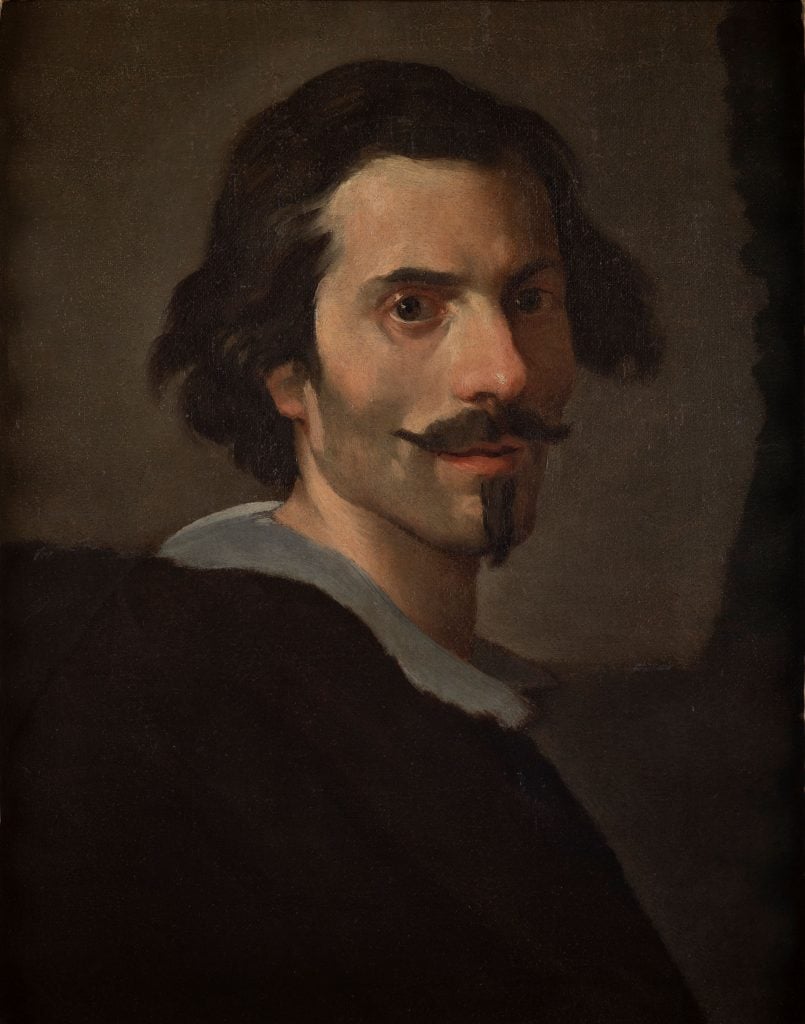
Gian Lorenzo Bernini, Self-portrait at a Mature Age , circa 1638-1640, oil on canvas, 53 x 43 cm, Galleria Borghese, Rome © Galleria Borghese / ph. Mauro Coen.
While best known for his baroque sculptures, like The Rape of Proserpina (1621–1622), Bernini was also an incredibly successful architect and urban planner, working for years in Italy under the patronage of Pope Urban VIII and then Pope Alexander VII, securing many of Rome’s most competitive commissions. By the 1660s, his work as a sculptor and architect saw him praised as one of Europe’s preeminent living artists.
In 1664 the French King Louis XIV and the First Minister of State Jean-Baptiste Colbert announced that they were searching for an architect to redesign the Louvre Palace, which had long been the home of the French royal court. Redesigning the palace wasn’t unusual—nearly every French king had added their own flourish since the Middle Ages.
Bernini had been encouraged by the Pope to travel to Paris in early 1665, having been invited to submit Louvre designs by Colbert. He arrived in June, and was provided with his own personal tour guide and translator—paid for by his Royal hosts. During his stay, Bernini created an incredibly well-received bust of the Sun King. This should have been something of a good omen for their next collaboration. But the relationship would quickly turn sour.

Louvre, east façade (study for the First Project) (1664). Image Courtesy of The Courtauld, London/ Samuel Courtauld Trust.
Bernini submitted four different designs for the palace to Colbert. His first, made in pen and brown ink, featured a grand Italianate oval pavilion at its centre (a wild choice in comparison to the rigid formation of straight-lines the Louvre ended up with). Bernini’s design was so admired that the English architect Christopher Wren, upon seeing it in Paris, said he “would have given [his] skin” to have made it himself. And yet neither this design, nor any of the following three, ever came to fruition.
Despite the fact that in October 1655, an elaborate ceremony—attended by the King himself—was held to celebrate the laying of the foundations for Bernini’s Louvre project, everything quickly came to a halt. A few days after the ceremony, Bernini returned to Rome. It would be another two years before Bernini’s designs were officially rejected.
So why were Bernini’s designs scrapped? While a pervasive rumor suggests it was because the King and his finance minister saw them as too Italianate, the two main reasons seem to be that Colbert did not believe Bernini’s designs were practical or comfortable enough, and that Bernini, the young king, and his courtiers fundamentally clashed heads.
More than a decade later, perhaps in an attempt to let bygones be bygones, Bernini was commissioned once again by Louis XIV, this time for an equestrian statue of the king. This could have been the perfect opportunity for a truce, after the mess with the Louvre. However, Louis hated the likeness so much, he had it partially recarved and hidden away, barely in view at Versailles. Some wounds never heal.
What’s the deal with Leonardo’s harpsichord-viola? Why were Impressionists obsessed with the color purple? Art Bites brings you a surprising fact, lesser-known anecdote, or curious event from art history.

Related Articles
-


