Art & Tech
Robot Artist Ai-Da Makes Her Architectural Debut
The robot's first building design is now on view at Denmark's Utzon Center.
by
Jo Lawson-Tancred
 Share This Article
- Robot artist Ai-Da debuts retro-futuristic architecture concept in Danish exhibition.
- Ai-Da’s design imagines space-age co-living for humans and humanoids.
- “I’m not a robot” show explores A.I.’s role in 21st-century architecture.
After making her name as a painter, the world’s first robot artist, Ai-Da, is having a go at architecture. Her A.I.-generated, retro-futuristic design for “a building of the future” has gone on display in Denmark.
The imagined studio home “invites reflection on how humans and humanoids might work together positively to shape the future of living,” Ai-Da herself explained.
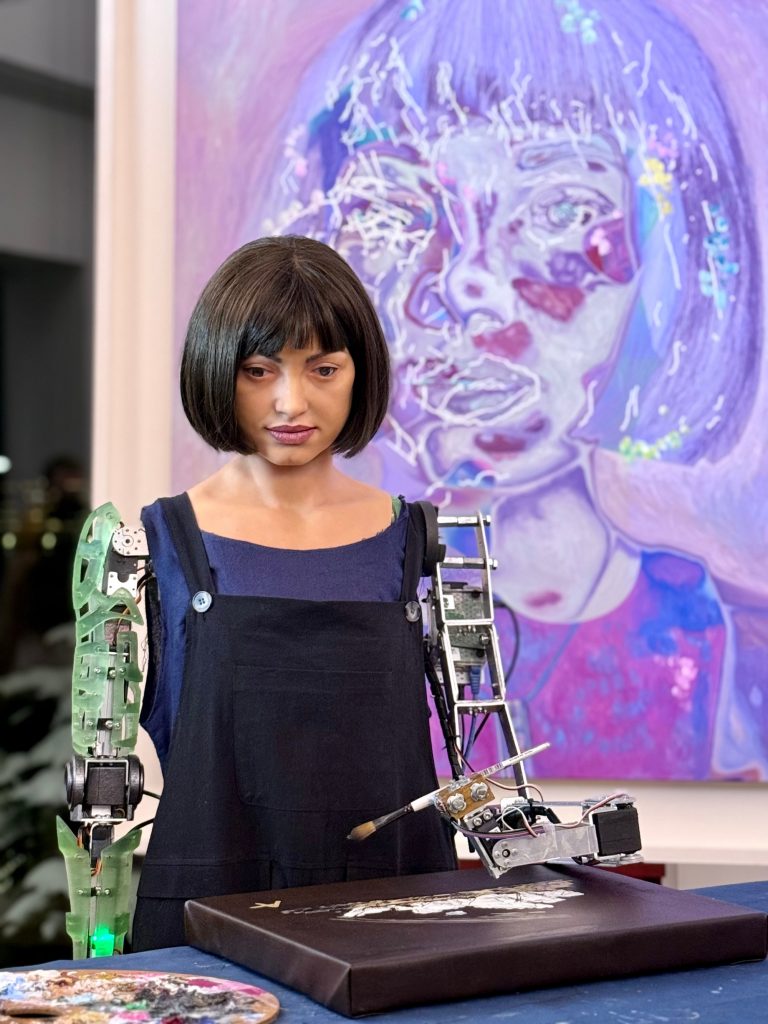
Ai-Da is an experimental artistic project initiated by the British gallerist Aidan Meller in 2019. Taking humanoid form, she has long made headlines for her unique A.I. mind that “sees” the world around her through cameras and powers her high-tech, robotic arm to make art.
Ai-Da is currently one of the star attractions of “I’m not a robot,” an exhibition exploring the ways in which robots will shape the architecture of the 21st century at Denmark’s Utzon Center until October 18. This month, she revealed her own vision for the future.
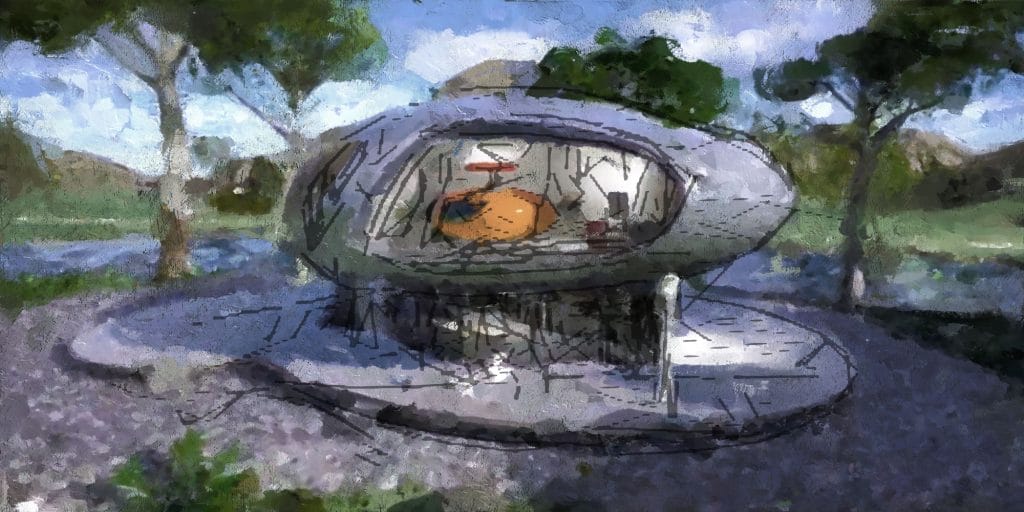
Ai-Da’s design for a home and studio. Image courtesy Utzon Center.
The concept for Ai-Da’s creation is a building that is adapted for “space exploration and co-living spaces for humans and humanoids,” Meller told Dezeen. As such, the main structure is a smooth-edged pod that is wrapped around with sweeping, curved windows. Ai-Da told the magazine that this look was inspired by the space-age optimism of the 1950s and 1960s.
Meller, who tends to dance around the question of how much agency Ai-Da takes in her creations but will admit that she works with a team of “assistants,” said the building design emerged out of a back-and-forth discussions between the robot and his team.
“This models how human artists work—sometimes they use their influences from past interactions with other people or past experiences, or sometimes they take on commissions,” he explained. The myth that artists work in isolation has been debunked by “postmodern critique,” he added, while the Ai-Da project is intended to be a “contemplation of the human condition as we increasingly incorporate A.I. into our lives.” Nonetheless, he insisted, she always retains “the majority creative influence as she is the main artist and executer of her works.”
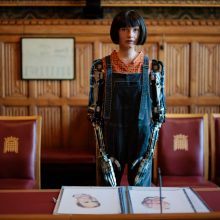
Ai-Da, whose punny name is a tribute to the 19th-century mathematician Ada Lovelace, has become a recognizable figure for her short bob and overalls. In 2022, she addressed the U.K. parliament about the future of A.I. In 2024, her triptych A.I. God was the first robot-authored work to be sold by Sotheby’s, fetching an impressive $1 million.
“I’m not a robot” is on view at the Utzon Center in Aalborg, Denmark through October 18. Ai-Da’s building designs will also be exhibited in London later this year.
Related Articles
-