People
Gallerist Kamel Mennour on A.I., Changes in Paris, and the Future of Art Philanthropy
The French dealer weighs in on art fairs, collectors' appetites, and if he has a succession plan.

The French dealer weighs in on art fairs, collectors' appetites, and if he has a succession plan.
Vivienne Chow
 ShareShare This Article
This article is part of the Artnet Intelligence Report, Mid-Year Review 2025. Our analysis of the first half of the year’s market trends provides a data-driven overview of the current state of the art world, highlighting auction results and trends, and spotlights industry experts with fresh ideas on the road ahead.

Having spent over a quarter century in the art business, the star Paris dealer of Algerian roots is not afraid of the seismic wave of transformation that is hitting the industry right now. He explains why he is excited about the future, from philanthropy to art fair models and A.I.
You have been actively involved in philanthropic initiatives such as the establishment of the Mennour Institute, fund raising auction, and most recently donation of 180 works to Musée d’Art Moderne. Can you tell us why you get yourself involved in these initiatives?
When you give, it’s a gift. I started alone with nothing. I would’ve been so pleased if I could have someone to give me a hand or explain things to me. Witnessing the hard life my mother led also made an impact on me–she divorced my father with no money, and had to work 20 hours a day cleaning houses, sleeping just a few hours a day.
So when I became a little bit senior, a bourgeois, I want to give back. I didn’t know anything about philanthropy at first, but I did it with my heart and my spirits, with support from friends and artists. We began with the fund raising auction to benefit Institut Imagine in Paris about a decade ago, and over five editions [the event takes place bi-annually] we have raised €32 million ($37.4 million). I have more new ideas in mind. In fact, everyone can do this in their own way. And this idea of sharing will shape the world a better place.
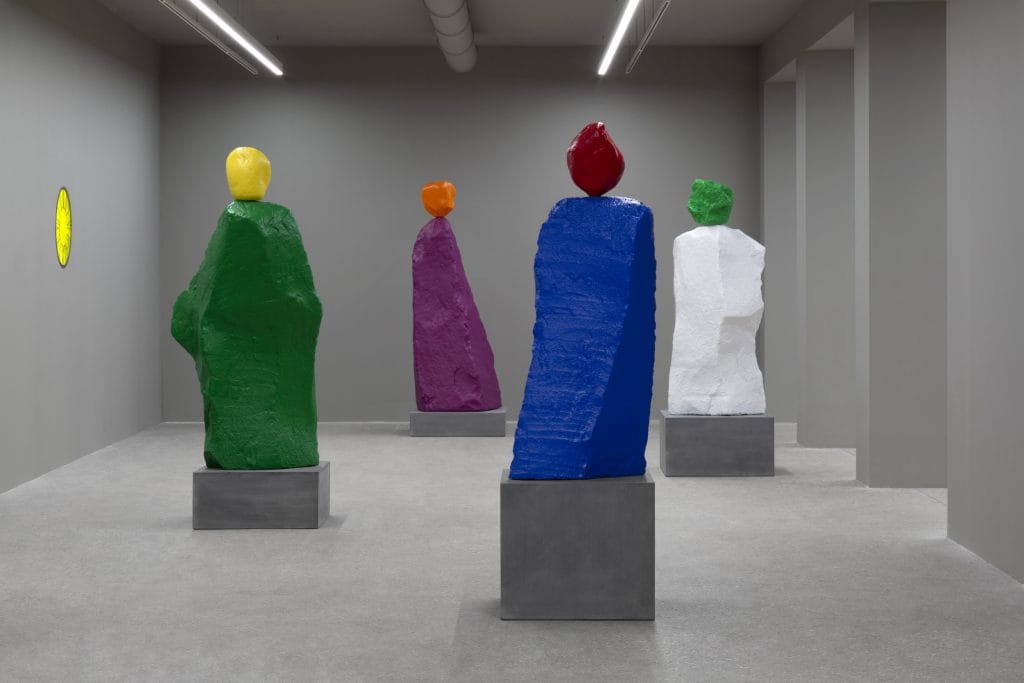
Installation view of ‘Ugo Rondinone: still” at Mennour in Paris in 2024. Courtesy of the artist and Mennour, Paris.
The art market is challenging to say the least, with major dealers bowing out and art fairs shuttering this year. What kind of changes do you foresee the art market will experience?
We have seen a major contraction over the past four or five years. I was surprised to learn that they are closing. Tim Blum is an extremely good friend of mine, and then there are others such as Olivier Babin of Clearing, Adam Lindemann of Venus Over Manhattan. I am not closing at all. I still have plenty of ideas and many things I want to do, to share, and invest.
Maybe, the problem was that there has been too much money. I have nothing against money, but there was too much. But now, we have the opportunity for people who are here genuinely for art, not just for money.
Art fairs are exploring the new frontiers. For example, the new Art Basel Qatar [which will not have traditional booths] is like a biennial, rather than a traditional art fair. We are all living new experiences and I am sure Art Basel will be leading on that. It’s very important for them to change the way to do fairs.
Collectors’s behavior may have changed, too. Some people would like to get there, have some rest, some good time with the sun and to see 25 to 30 one-man shows rather than a fair that we experience every time whether you go to Miami, Basel, or Hong Kong. They are all the same. I can imagine some collectors are fed up with that.
I also need to find something new for different fairs. We are doing eight or nine fairs a year. Maybe we find one of two fairs bringing, for example, only young, emerging artists. I think it will refresh and reset the model. Some dealers are doing 14 or even 16 fairs a year. I’m sure there will be a Darwinian decision. People will go to the most important fairs, focusing on the best exhibitions, and not wasting time to go to all the small fairs.
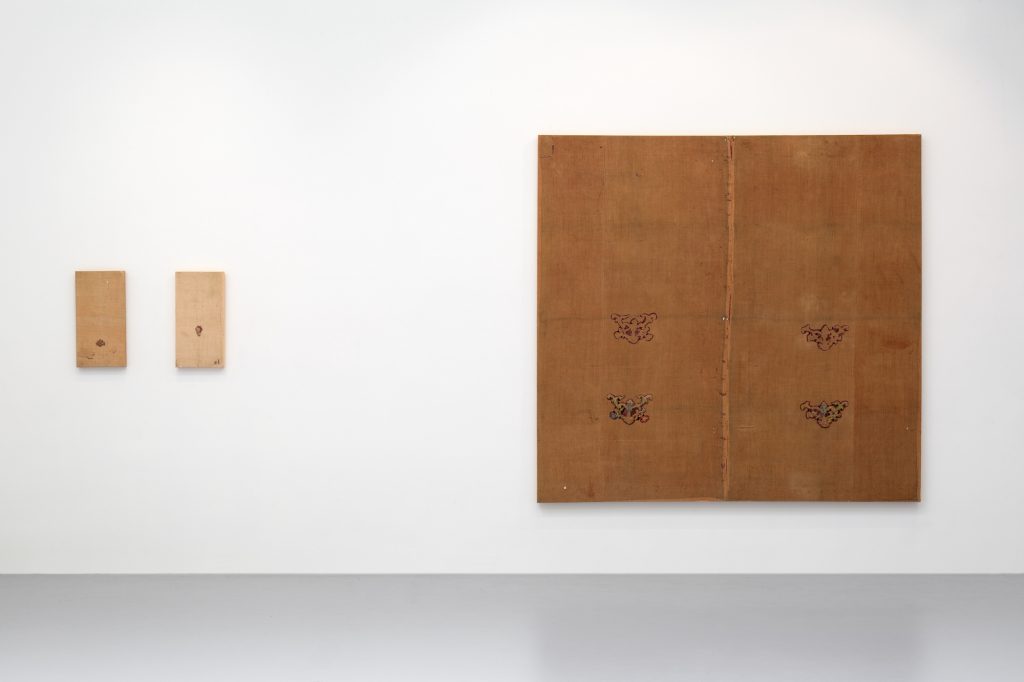
Installation view of “Sidival Fila: A rose is a rose is a rose,” curated by Christian Alandete and Emma-Charlotte Gobry-Laurencin, at Mennour in 2024.
Speaking of Art Basel, since the Swiss fair was launched in Paris, how do you think that has changed Paris and European art scene and market?
Paris was already a little bit on the map but now, Paris is definitely on the map, taking on a central position in the art market. I was on the FIAC committee 10 years ago when we were competing with Frieze. We worked hard on bringing good colleagues to Paris. But the turning point was when Art Basel arrived. They are not here not just to do the fair but events around [the city] and to bring all the best people, curators, [museum] directors, and collectors from around the world.
So, that’s very good for us. A lot of big names are in Paris now, such as Gagosian, Hauser and Wirth, and White Cube. Many people were saying that Americans were not coming to Art Basel in June as they were waiting to go to Art Basel Paris. So perhaps there would be a shift.
What is your take on AI and how will it impact the industry?
AI will be extremely important for us. We hired two new guys who are 22 and 24 years old to work with us on building shows and information search with the help of AI. I’m sure all the leaders in the art world are using AI as an assistant, a tool for valuation, appreciation, and to create with artists.
Do you think galleries should have a succession plan?
No. I have five kids and my eldest is 23. He’s been coming to fairs with me the past couple of years and he seems to be very interested in art. Having fresh blood, fresh energy from a 23-year-old gives this 59-year-old father a lot of new ideas and aspirations.