Artists
25 of 2025: 5 Trailblazing Performance Artists to Know
We spotlight 25 boundary-pushing artists who have been dominating the conversation this year.

by
Brian Boucher &
Vivienne Chow &
Jo Lawson-Tancred
 Share This Article
The art world is crowded, but some voices rise above. In this series, we spotlight 25 emerging artists who have been defining 2025: painters pushing the canvas forward, sculptors reinventing form, fiber artists weaving new narratives, performance artists transforming presence, and time-based visionaries bending film, sound, and technology. These are the talents shaping culture today—and the ones to watch. We highlight five artists whose performance art is dominating the conversation this year.
Geumhyung Jeong

Geumhyung Jeong and Toys, Selected (2025), her recent work on view at Canal Projects, New York. Photo by Walter Wlodarczyk. Courtesy Canal Projects.
Geumhyung Jeong has charmed the art world with her enigmatic yet captivating performances that often see her dancing intimately with the eerie machine parts she built from scratch. These performances are not just mesmerizing to watch. They are also thought-provoking as they probe into the uncanny relationship between humans and robots, one that no longer lives only in the fictionalized imagination of sci-fi but is slowly creeping into our reality as the world moves further into automation and places greater emphasis on A.I.
But are humans controlling the machines or vice versa? Watching Jeong construct and deconstruct the wired machine parts while attempting to steer them with her body via remote control offers one way to explore this question. “Everyone would say something different about what a robot is,” Jeong told Artnet News in an interview. “I see us as being in character together.”
Born in Seoul in 1980, Jeong initially studied acting, dance, performance, and film animation in South Korea. She took part in artist residency programs including Hermès Foundation Missulsang Residency in Paris in 2016, followed by London’s Delfina Foundation in 2017. The award-winning artist began incorporating objects in her choreography practice, such as in her 2018 performance at “Spa and Beauty” at Galerie Klemm in Berlin, which saw her breathing life into the still objects as she transformed them into her “collaborators” through her erotically charged bodily movements. She taught herself robotics and brought them on as part of her ensemble. “I was quite shy at first when my work was introduced as robots. I just thought that I would like to make a remote-controlled vehicle with human-shaped parts like the head or limbs.”

Installation view of Geumhyung Jeong’s Toys, Selected (2025) at Canal Projects. Courtesy of Canal Projects. Photo by Izzy Leung.
Today, Jeong is a visionary artist and choreographer who is in demand internationally. Some of her notable performances include Kunsthalle Basel in 2019 and Palazzina dei Giardini in Modena in 2020. She was featured in the 2022 Venice Biennale’s main exhibition “The Milk of Dreams” in Arsenale and also held a solo exhibition at London’s ICA last year. The artist noted that she was excited about the extension of her presentation at New York’s Canal Projects, Toys Selected (2025), which sees the artist explore the themes of desire and control between humans and technology. Currently on summer break, the show will return on September 19 through November 22. Jeong will also be presenting three different performances at the Transart Festival in Bolzano in September.
Jeong, who lives in Seoul, noted that she is currently not represented by any gallery. While most of her works in recent years are presented at institutions around the world, she is not ruling out working with galleries and independent spaces. She also develops her own projects at her atelier in Bucheon. The relationship between humans and technology remains a central theme of her practice. “There is a codependency, but in the end, machines do not need us. We need them,” she said.
—Vivienne Chow
Maja Malou Lyse

Maja Malou Lyse. Photo: Lasse Lund.
When an artist gets tapped to represent their country on the global stage at the Venice Biennale, the art world sits up and pays attention. Maja Malou Lyse’s Denmark Pavilion at next year’s 61st edition will certainly be one to watch, so say those already familiar with her provocative, unflinching contributions to the discourse around sex, desire, and the body. For Lyse, sexuality can never be divorced from history, politics, and identity, and she is unafraid to delve into the inevitable complexities that result when our sexual liberation collides with misogyny, the media, and mass-consumption.
Take “Sex Is Not a Natural Act,” a 2023 exhibition at Galleri Nicolai Wallner in Copenhagen, which featured just one statue of a toppled, oversized vibrator, which Lyse described as “one of the most interesting cultural objects.” Decontextualized and reconsidered for its sculptural properties—abstract, futuristic, even “post-human”—the piece calls attention to the ways in which sex has been objectified within a social construct. Is this a tool for intimacy or alienation?

Maja Malou Lyse, Antibodies (still). Image courtesy of the artist.
However racy her subject matter, Lyse has had no difficulties securing mainstream institutional approval since her debut in 2021, with a solo exhibition at Kunstmuseum Brandts. She has since staged performances at the National Gallery of Denmark and internationally, at Tate Modern in London and Moderna Museet in Stockholm. Last fall’s “MM,” at leading Danish non-profit Ovegaden, centered around a nude photograph of Marilyn Monroe signed and owned by Hugh Hefner. The image had been used as the centerfold for Playboy’s inaugural issue in 1953 without the actress’s consent, a haunting fact that has prompted Lyse to explore the ripple effect of porn’s ever antagonistic relationship with female autonomy through video and ready-mades.
—Jo Lawson-Tancred
Amol K. Patil

Amol K. Patil. Photo: Aadya Patil.
Mumbai-born artist Amol K. Patil, now based in Amsterdam and his native city, is fast spreading his international reach, with 2025 solo shows at Röda Sten Konsthall, Gothenburg, Sweden, and the Berkeley Art Museum and Pacific Film Archive, in California. He’s also currently in two major international exhibitions: SITE Santa Fe in New Mexico and the Berlin Biennale. This widespread visibility builds on previous appearances on the global stage in shows like the Gwangju Biennale (2024), Documenta (2022), and the Yokohama Triennale (2022).
Showing with Project 88 in Mumbai and TKG+ Projects in Taipei, Patil works in various media, including performance, sculpture, and painting. A performance at the India Art fair in 2019 earned a mention in Artforum, which pronounced his Take the City (2019), in which he blew bubbles and invited street sweepers and backstage staff into public view, to be “soft and whimsical.”

Saviya Lopes and Amol K. Patil perform at the “Rights To The City? Forum,” May 12, 2018,at Conway Hall in London, U.K. Photo: Rob Harris.
His recent shows in Gothenburg and Berkeley explored the experiences of India’s working-class population, specifically through studying residential structures in Mumbai for early 20th-century migrant laborers, highlighting how these often overcrowded spaces nonetheless provided a place for community. As Artnet News wrote in 2024, highlighting his work at the Gwangju Biennale, “his late father, Kisan, who died when the artist was a child, was an avant-garde playwright, and his grandfather was a poet. Both adopted art as a form of resistance, which greatly influenced Patil.”
He’s gained attention of critics like Natasha Marie Llorens, who wrote for e-flux that implicit in the Gothenburg show is “the idea that the struggle is the vector for solidarity, and that it alone bears representing.” Said the artist, “The idea of the exhibition is based on seeing and experiencing the traces of human history, lives and conversations of different generations behind wall cracks, through layers of paint, across skin and touch.”
—Brian Boucher
Coumba Samba

Coumba Samba. Photo: Lengua. Courtesy of the artist and Arcadia Missa, London.
Senegalese-American artist Coumba Samba uses means as elemental as mud and as universal as color to explore subjects like global economic flows, colonial histories, and the meetings of cultures in works that take such varied shapes as performance, sculpture, painting, and installation. Along with artist Gretchen Lawrence, she’s also half of the electronic music duo New York, which has played in galleries and nightclubs from London to Los Angeles.
Regarding the duo’s unusual name, Samba told Document Journal, “It’s been really fun confusing people.” She and Lawrence provided the soundtrack for FIFA, a performance at London’s Cell Project Space last year. A collaboration with École des Sables, it drew from sources like football, Senegalese Laamb wrestling, and the South American game Queimada to explore themes like labor and ideology, with performers going at it in a bed of mud.
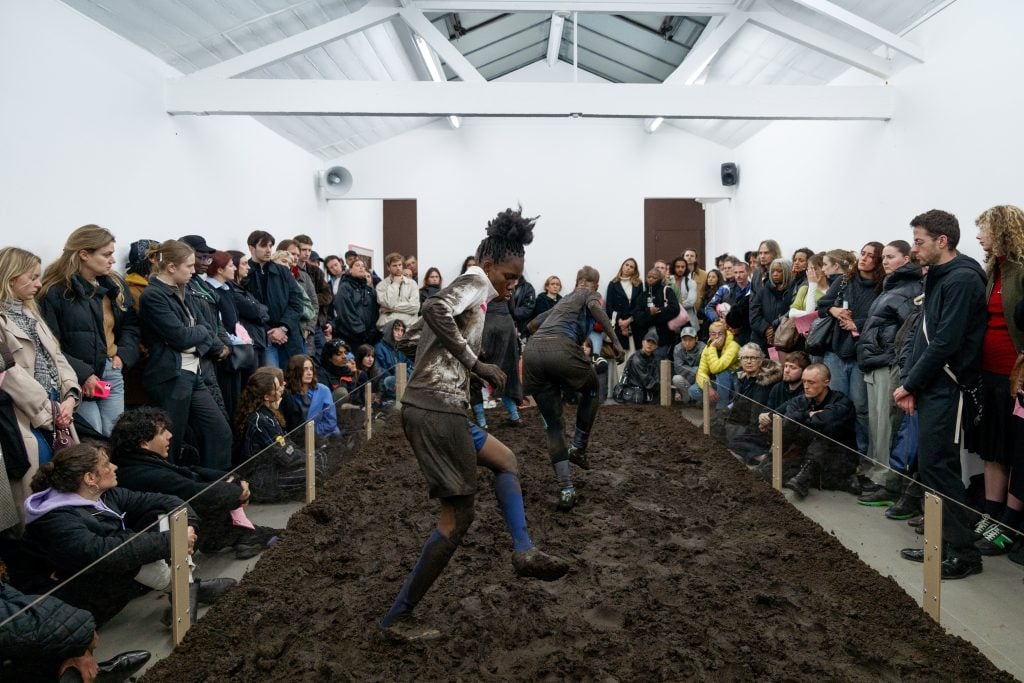
Coumba Samba, FIFA (2024). Performance by École Des Sables. Sound by Gretchen Lawrence Photo: Anne Tetzlaff; Courtesy of the Artist and Cell Project Space, London.
But the artist works in various media, not just performance. In her Stripe and Stripe Blinds painting series, for example, the London-based artist explores the ways that colors—including red, green, and yellow, all common in many African flags—carry social and geopolitical messages. “I believe her work is particularly relevant in this very moment in time given the current discourse surrounding identity, heritage, geopolitical conflicts, and equality,” art dealer Thomas Stauffer told Artnet News last year.
“I’m interested in color and power,” the artist told Art in America, discussing a 2024 show at New York’s Empire Gallery that included poles painted with colors from national flags and a livestream of the sounds of diplomats at the nearby headquarters of the United Nations. And in a recent show at London’s Arcadia Missa gallery, the artist used radiators painted in various colors to comment on the international flows of gas as the West looks for new sources in an era of sanctions on Russia.
In 2024, Artnet News listed Samba as an artist who could make it big in 2025. She’s delivering on that promise: she has already appeared in a video promoting Balenciaga’s summer campaign, and come September, she’ll have a solo at Kunsthalle Basel, co-curated by London project space Galerina.
—Brian Boucher
Bárbara Sánchez-Kane

Bárbara Sánchez-Kane in his studio in Mexico City. Photo: Georgianna Chiang. Courtesy of Kurimanzutto Gallery.
Art and fashion perennially mutually cross over, and artists have long pushed at gender roles—just think of Marcel Duchamp’s feminine alter-ego, Rrose Sélavy. Both tendencies have hit a peak today, and artist Bárbara Sánchez-Kane personifies these trends. Add to the mix that the artist, born in 1987 in Mérida, Mexico, questions notions of “Mexicanidad” when artists are challenging narrow concepts of cultural identity, and you can’t be more of-the-moment.
Sánchez-Kane started an eponymous, genderless fashion line in 2016, and has increasingly shown in art settings, fearlessly ranging among performance, poetry, installation, sculpture, and painting. The artist dubs these creations “art and confection,” and they’ve garnered raves from Vogue to Frieze. The presentations of the clothes blur the boundary between runway show and performance art: “It’s like a reconstruction of a fashion show, with what looks like a backstage but at the front of the gallery,” the artist told Artnet on the occasion of a 2023 event at New York’s Kurimanzutto gallery.

Bárbara Sánchez-Kane, Prêt-à-Patria (2024). Photo: Marco Zorzanello. Courtesy La Biennale di Venezia.
The artist is perfectly content to challenge you in even the most basic ways, for example, interchangeably using he and she pronouns; writing for Artnet News in 2023, Lee Carter alternated between referring to the artist as him and her. Gender-confronting forms pop up all over, for example in military uniforms that are cut away to expose red lingerie in the rear, in a performance recorded in the 2021 film Prêt-à-Patria, which punned on the French fashion term prêt-à-porter, or “ready to wear,” and patria, the Spanish word for homeland.
Institutional exposure has come in the form of performance-presentations of Sánchez-Kane’s fashion lines at the Institute of Contemporary Art Los Angeles (2017), Paris’s Palais de Tokyo (2019), and Mexico City’s Museo Experimental El Eco (2020). And just last year, he/she achieved one of the greatest goals an artist could hope for, representing Mexico in the 2024 Venice Biennale.
—Brian Boucher


Related Articles
-


