

As another year draws to a close, we remember all those in the art world who have died over the last 12 months. Some were giants in their fields, while others have had quieter, less-heralded careers—and some leave behind questionable legacies. But all are now acknowledged here in our pages for their contributions to arts and culture, and our condolences go out to those who knew and loved them.
Julia Alexander, museum director and foundation head (1967–2025)


Julia Alexander in 2024. Photo: The Walters Art Museum.
During her tenure, she helped shape many of the Yale Center for British Art’s “most celebrated exhibitions and publications, nurtured students with genuine care, and helped shape the museum’s intellectual life,” reported the Yale News.
Sylvain Amic, arts administrator and museum director (1967–2025)
Sylvain Amic was appointed just last year to lead the Musée d’Orsay and the Musée de l’Orangerie in Paris, having long aspired to the role. He had previously directed the Musée Fabre in Montpellier and the Museums of Rouen. “He played a key role in the development of French laws calling for the restitution of treasures and human remains,” reported the New York Times.
Wallis Annenberg, arts philanthropist (1939–2025)


Wallis Annenberg attends Alvin Ailey’s 2017 opening night Gala at New York City Center. Photo: John Lamparski/Getty Images.
“In more than 20 years in leadership positions at her family’s Annenberg Foundation [she] oversaw more than $3 billion in grants and donations to projects that include the arts, wildlife and older adults,” wrote the New York Times. “Ms. Annenberg also provided $23 million to the Los Angeles County Museum of Art in 2008, $17 million of it to acquire a valuable collection of 19th- and 20th-century photographs, and $6 million for its capital campaign. She had previously given $10 million to endow the museum’s directorship.”
Timothy App, painter and arts educator (1947–2025)


Timothy App working in his studio Photo: Joe Rubino.
“Over five decades, App, an Akron, Ohio, native who began teaching at MICA in 1990, became a standout figure in American abstract art thanks to more than 25 solo exhibits, including a career retrospective in 2013 at the American University Museum in Washington, D.C.,” the Baltimore Banner reported. “App’s distinctive geometric style forgoes people or places, and instead evokes emotion through structure, clean lines and open space.”
Jo Baer, painter (1929–2025)


Jo Baer in 2020. Photo: © Yaël Temminck.
Jo Baer started out in the late 1950s as an abstractionist in Los Angeles. She then moved to New York in 1960 and painted in a Minimalist vein, after which she moved to the countryside in Ireland in 1975 and to Amsterdam in 1984, where she spent her remaining years. Pace gallery president Samanthe Rubell told Artnet News that Baer was “one of the truly great practitioners of Minimal Abstraction,” who “shook the very definition of painting with her revolutionary canvases.”
Leonid Bazhanov, curator (1945–2025)

Leonid Bazhanov. Photo: Jürg Vollmer / maiak.info.
Leonid Bazhanov was an art historian and curator who founded the National Centre for Contemporary Arts (NCCA) in Moscow. “His death closes a promising but brief era in Russian contemporary culture that grew out of the Soviet unofficial art movement but has been quickly silenced under Vladimir Putin,” wrote the Art Newspaper.
Tony Bechara, painter and museum director (1942–2025)
“Animated by the chaos of the city’s streets, [Tony Bechara] graduated to painting kaleidoscopic grids that he meticulously mapped,” the New York Times wrote. “He was embraced by critics and invited to exhibit in museums. He became a patron of the arts and of fledgling Latino artists and, for 15 years, led El Museo del Barrio, a showcase of Puerto Rican art that he expanded to encompass works from all over Latin America.”
Stan Beckensall, archaeologist (1932–2025)


Stan Beckenstall shows off some of Britain’s best examples of rock art. Photo: Owen Humphrey, PA Images via Getty Images.
In 1966, teacher Stan Beckensall discovered prehistoric rock art in Northumberland, sparking a lifelong passion, wrote the London Times. Despite initial disinterest from professionals, he went on to identify and study hundreds more carvings across northern England.
Dara Birnbaum, video artist (1946–2025)
“She also demonstrated—to a whole cohort of later artists, including Cory Arcangel and Martine Syms—that mass media was fair game as artistic material, and that its power could, if only temporarily or in principle, be turned against itself,” wrote the New York Times. “Of all her edits and remixes, Ms. Birnbaum’s most subversive response to mass media may have been simply to turn down its volume.”
Judith Hope Blau, painter (1938–2025)


Judith Blau with her bagel art in 1976. Photo: courtesy of People of Play.
“There we were, living in a bagel factory in Eastchester,” Blau told a New York Times reporter in 1979. “My children, Laurie and Ricky, my physicist husband and I, once a serious painter, were totally preoccupied with preserving, painting, packing and selling hundreds of smiling bagel products.”
Mel Bochner, painter (1940–2025)


Mel Bochner at Villa Sciarra in Rome in 1985. Photo: by Lizbeth Marano, courtesy of Bochner Studio and Peter Freeman Inc., New York/Paris.
“When [the School of Visual Arts] asked him to organize a Christmas show of drawings that year, he reached out to his friends Sol LeWitt, Eva Hesse and Robert Smithson, as well as to other artists he admired, like Carl Andre, and asked them for sketches of their works in progress. S.V.A. didn’t have the money to frame the drawings, so Mr. Bochner photocopied them—the school had a new Xerox machine—and collected them in four binders,” the New York Times reported. “It was an early salvo in the flourishing movement of conceptual art: the idea that an artwork didn’t need to be an object. Some say it may have been the first conceptual exhibition.”
Erik Bulatov, painter (1933–2025)

Russian painter Erik Bulatov in Paris in 2018. Photo: Joel Saget/AFP via Getty Images.
“Before Mr. Bulatov’s canvases emerged on the global art scene in the late 1980s, during a period of greater openness in the Soviet Union, he lived a double life in Moscow, working as an illustrator of children’s books while secretly painting anti-Communist images in defiance of the state-mandated style of Socialist Realism,” wrote the New York Times. One of his most famous paintings, depicting the phrase “Glory to the CPSU” in bold red letters over a blue sky, transformed a party slogan into metaphorical prison bars.
Kathan Brown, printmaker (1935–2025)
Kathan Brown was the founder of the San Francisco-based company Crown Point Press, who helped revive the centuries-old art of intaglio printmaking in the United States, producing limited-edition prints by artists like Elaine de Kooning, Chuck Close and Francesco Clemente, reported the New York Times.
Sheila R. Canby, curator (1949–2025)
“Sheila R. Canby [was] a leading authority on Islamic art who curated a humanizing portrait of Islam through its cultural treasures at the Metropolitan Museum in New York, offering an alternative to the hostile narratives of religion and politics after 9/11,” the New York Times reported.
Renato Casaro, artist and illustrator (1935–2025)

Renato Casaro attending the 80th Venice International Film Festival in 2023. Photo: Vittorio Zunino Celotto/Getty Images.
Dubbed “the Michelangelo of movie posters,” Renato Casaro was the little-known artist who painted Impressionistic art for 1960s spaghetti westerns, the Rambo series and Terminator 2: Judgment Day, among other films,” wrote the New York Times.
Rutherford Chang, conceptual artist (1979–2025)

Rutherford Chang at his show “We Buy White Albums” at Recess Gallery, New York. Photo: ©Eilon Paz for Dust and Grooves, from the article We Buy White Albums
Conceptual artist Rutherford Chang was known for transforming his vast collection of the Beatles’ White Album into a reflection on time and material decay, and for melting 10,000 pennies into a copper block to question the true value of currency. “Mr. Chang’s projects were the fruit of a playful, obsessive mind,” reported the New York Times.
Brian Clarke, stained glass artist (1953–2025)


Brian Clarke.
While in primary school, Clarke visited York Minster and was struck by its 15th-century stained-glass window—an experience that changed his life, said the New York Times. He went on to become a prolific and innovative stained-glass artist, pioneering techniques like lead-free panels, pointillism, and free-standing glass screens.
Chuck Connelly, artist (1955–2025)


Chuck Connelly attends a screening of The Art of Failure: Chuck Connelly Not For Sale. Photo: Michael Loccisano/FilmMagic via Getty.
“Mr. Connelly rose to renown in the early 1980s, when he was represented by the prestigious SoHo art dealer Annina Nosei and hobnobbed with hot fellow artists like Julian Schnabel and Jean-Michel Basquiat. He made about $1 million from the sale of his paintings in that decade,” the New York Times reported. “Mr. Connelly was known for his thick applications of paint and his furious brushstrokes. He worked on a remarkable breadth of subjects, including his cat Fluffy; still lifes (one of them showed a box of Bran Flakes, a bowl and a hammer); the perilous loop-the-loop of a roller coaster (or maybe there are two?); and portraits of the 20 children, all smiling, who were killed by a gunman at Sandy Hook Elementary School in Connecticut in 2012.”
Matthew Courtney, artist (1959–2025)
Artist Matthew Courtney helped found the Lower East Side arts nonprofit ABC No Rio. “Courtney was also a longtime fixture of SoHo’s street community. Beginning in the early 2000s, he erected his makeshift, sidewalk-based Steps to Nowhere Gallery outside storefronts and restaurants on Prince Street, including metal steps that led into the wall of a now-defunct J.Crew, the Apple Store, and Fanelli Cafe, showcasing brightly colored Pop Art portraits and humorous poetic meanderings,” reported Hyperallergic.
Alwyn Crawshaw, painter (1934–2025)
Through his engaging teaching style and passion for art, Alwyn Crawshaw became a familiar and trusted figure to millions of aspiring artists across Britain and beyond. Over a long and prolific career, he created and presented numerous art programs for the BBC and Channel 4, including A Brush With Art, The Painting Challenge, and Crawshaw Paints. “His approachable, down-to-earth manner and clear demonstrations made painting accessible to everyone, earning him a devoted following,” the Eastern Daily Press wrote.
Dennis Crompton, architect (1935–2025)


Dennis Crompton at the Palace of Arts, Krakow, in 2009. Photo: courtesy of the artist’s estate.
“Crompton’s remarkable career spanned several decades and left an indelible mark on modern architecture. As a key member of the avant-garde architectural group Archigram, established in London in 1961, Crompton played a pivotal role in revolutionizing architectural practice, together with Warren Chalk, Peter Cook, Ron Herron, David Greene, and Michael Webb,” wrote ArchDaily.
Alonzo Davis, artist and gallerist (1942–2025)


Alonzo Davis. Photo: courtesy of the Alonzo Davis studio.
Alonzo Davis, a leading African American artist, educator, and gallerist who was a tireless advocate for Black artists and social justice, wrote Artnet News.
Helga de Alvear, art dealer and art fair founder (1936–2025)

Helga de Alvear after receiving the Portuguese Medal of Cultural Merit in 2024. Photo: Carlos Criado/Europa Press via Getty Images.
“De Alvear started buying art in 1967, first from a gallery owner friend, Juana Mordó, who she went on to work with in 1980. On Mordó’s death in 1984, de Alvear took over. In 1995 she opened her eponymous dealership,” ArtReview reported. “In the intervening three decades she has come to represent artists including Ángela de la Cruz, Elmgreen and Dragset, Thomas Demand, and Isaac Julien. De Alvear continued to collect ‘with my eyes, not my ears,’ she was wont to say, amassing 3,000 works.”
Christophe de Menil, art patron and designer (1933–2025)


Christophe de Menil at the Pre-Opening Benefit for The Watermill Center in 2006. Photo: Donald Bowers/Getty Images.
“For two decades, Ms. de Menil was a costume designer for the avant-garde theater director Robert Wilson,” wrote the New York Times. “An art collector herself, she was a patron of Willem de Kooning as well as the choreographer Twyla Tharp. She introduced the Los Angeles architect Frank Gehry to New York as the designer of her Upper East Side carriage house in Manhattan. And as a society grande dame she was an inveterate party giver whose guests included Robert Rauschenberg, Merce Cunningham, Kitty Carlisle Hart, Susan Sontag, John Cage and Patricia Kennedy Lawford.”
Aaron De Groft, museum director (1965–2025)
An injury as a student athlete at Virginia’s College of William & Mary sent Aaron De Groft to the university’s Muscarelle Museum of Art, where he trained under a young Glenn Lowry, eventually becoming director. But his final years were plagued by a legal dispute over a Jean-Michel Basquiat forgery scandal at the Orlando Museum of Art the OMA. De Groft vouched for the authenticity of the works—but then the FBI raided the museum, which promptly fired him. “At the time of his death, De Groft was in a legal dispute with the OMA,” reported the Art Newspaper.
Saul and Ellyn Dennison, collectors (1929–2025; 1931–2025)


Ellyn Dennison and Saul Dennison at the New Museum 40th Anniversary Spring Gala in 2017. Photo: Paul Bruinooge, ©Patrick McMullan.
Ellyn Dennison and Saul Dennison collected a wide range of art, from classical sculpture to Conceptual art to photography, and were major supporters of New York’s New Museum, where he was president of the board of trustees from 1999 to 2013, wrote ARTnews.
Bill Dilworth, arts worker (1954–2025)

Bill Dilworth, the caretaker of The New York Earth Room, in 2017. Photo: Christina Horsten/dpa/via Getty Images.
For 35 years, Bill Dilworth tended a Manhattan loft filled with dirt, otherwise known as The New York Earth Room, a monumental artwork by Walter De Maria, a lion of Minimalism who died in 2013. “The Earth Room had a few caretakers before Mr. Dilworth took it on in 1989,” the New York Times wrote. “But no one was as committed to the mission as he was: He considered the job as urgent as that of a lighthouse keeper. He watered and raked the soil, plucking the odd weed or mushroom. (The mushrooms were edible, and delicious, by Mr. Dilworth’s account.) The work allowed him, he said, ‘to settle into the art world in a way that was personal and comfortable and meaningful.’”
Chris Doyle, artist (1959–2025)
A multimedia artist who made trippy animations inspired by a wide range of visual influences from Walt Disney to Kurt Schwitters to Persian miniatures, Chris Doyle showed his unique work at institutions including the Brooklyn Museum, Queens Museum, the Massachusetts Museum of Contemporary Art, and the San Francisco Museum of Modern Art, wrote the New York Times.
Rosalyn Drexler, painter (1926–2025)

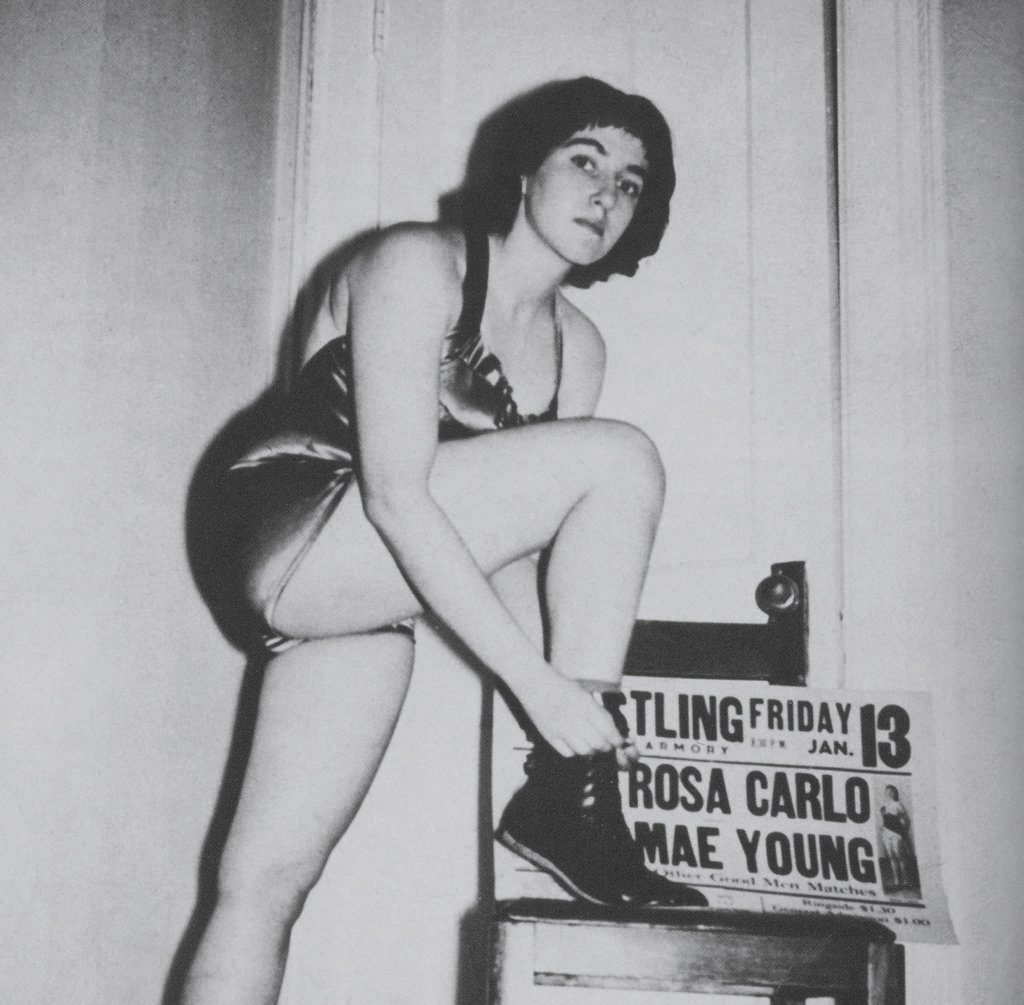
Sherman Drexler, Rosalyn Drexler as “Rosa Carlo, the Mexican Spitfire” (c. 1950). Photo: courtesy of Garth Greenan.
“It was a rich life,” Drexler told Artnet News in 2017, recalling fondly the New York art scene of the 1960s, which she described as “a smaller community” where folks such as Franz Kline, and Elaine and Willem de Kooning would all attend each other’s openings and gather at watering holes such as the Cedar Bar and Max’s Kansas City.
Milton Esterow, art journalist and publisher (1928–2025)
Milton Esterow was a New York Times arts journalist who, in 1972, bought and reinvigorated ARTnews magazine and, at both media outlets, helped bring an investigative edge to culture reporting, especially regarding artwork looted by the Nazis, the New York Times reported.
Fred Eversley, sculptor (1941–2025)


Fred Eversley at home in New York City in 2019. Photo: © Taylor Dafoe.
Eversley, known for his striking resin sculptures, created both opaque and translucent parabolic discs that act like optical lenses—sharpening and distorting views while shifting colors with light and movement. His work, often described as kinetic without moving parts, has earned major public commissions, including installations at Miami International Airport, West Palm Beach, and Central Park, the New York Times wrote.
Terry Farrell, architect (1938–2025)
“His typical building style was post-modernist, exuberant, and playful, with his famous commissions including London’s MI6 building and the headquarters for ITV’s 1980s breakfast show TV-am, with giant breakfast eggcups perched on the roof,” wrote the BBC. “He gained a reputation for making big buildings fun.”
Nona Faustine, artist (1977–2025)


Photographer Nona Faustine attends the Eighth Annual Brooklyn Artists Ball at The Brooklyn Museum. Photo: Nicholas Hunt/Getty Images for Brooklyn Museum.
“Faustine was best known for her self-portrait series White Shoes (2012–21), in which she posed nude or partially clothed in symbolic white heels at various former slave auction sites across New York,” wrote Hyperallergic. “These places included the Tweed Courthouse, where Faustine pictured herself naked and pushing against a stone column at the top of the steps leading into the building; and the Wall Street intersection of Water and Pearl Street, where she appeared with shackled wrists standing on a wooden box as traffic whirs in the background.”
Ming Fay, sculptor (1943–2025)
For more than 50 years, Fay made “giant, unnervingly realistic fruits, vegetables, seashells, wishbones and semi-imagined ‘hybrid’ objects with a signature technique of painted papier-mâché over steel armature,” reported the New York Times.
Jackie Ferrara, sculptor (1929–2025)
“Jackie Ferrara [was] a sculptor who stacked lengths of wood into objects that resembled pyramids, stairways and towers, imbuing the sleek forms of Minimalism with an aura of ancient mystery,” the New York Times wrote. “Whether she was making a small stepped pyramid that could fit on a side table, or a kingly outdoor piece like Amphitheater (1999), which could seat 200 visitors at the Los Angeles County Museum of Art, she remained the most craft-obsessed of Minimalists.”
Elsa Honig Fine, art historian (1930–2025)
“When Ms. Fine began publishing Woman’s Art Journal in 1980, the art world was still largely male dominated, and many female artists were relegated to the supporting roles of muse, wife or hobbyist,” wrote the New York Times. “Ms. Fine, in particular, was frustrated with the cyclical nature of attention received by artists like Frida Kahlo, Alice Neel and Leonora Carrington, who were discovered, forgotten and then rediscovered and hailed as folk heroes. Woman’s Art Journal sought to maintain their presence in the spotlight.”
Janet Fish, painter (1938–2025)


Janet Fish in 1974. Photo: courtesy of DC Moore Gallery, New York.
“Dubbed a ‘visionary of the real” by art critic Gerrit Henry, Fish alchemized commonplace objects into radiant compositions,” wrote her gallery, New York’s DC Moore. “Fish’s work from the late 1960s and 1970s earned her a place at the forefront of a growing number of artists working within the parameters of realism… Fish stood out, however, in that her approach to the ‘real’ was inextricable from the artifice of painting.”
Tony Fitzpatrick, artist and gallerist (1958–2025)


Tony Fitzpatrick. Photo: Peter Rosenbaum.
“His multidisciplinary approach to art was evident early in his career; in the late 1980s he was appearing as an actor in films and local theater, hosting a movie review show on radio, writing for a local newspaper and had his work accepted at group gallery shows in New York and Philadelphia,” reported WBEZ Chicago. “As a gallery owner, Mr. Fitzpatrick often advocated for people who didn’t necessarily follow the traditional art school trajectory but who he felt still had a valuable voice.”
Richard Flood, curator (1943–2025)
Curator Richard Flood was known for organizing forward-looking exhibitions that spotlighted rising artists and emerging trends. Beyond museums, he shaped the art world through roles at Artforum, Frieze, Gladstone Gallery, and by founding the New Museum’s IdeasCity initiative, wrote ARTnews.
Ceal Floyer, artist (1968–2025)


The artist Ceal Floyer at her solo show at Lisson Gallery Milan in 2014. Photo: Venturelli/Getty Images.
“Her work was frequently sly and dryly funny,” ARTnews reported. Her most famous piece, Light Switch (1992–99), featured a projector beaming an image of a 35mm slide depicting a light switch at a wall. The projection was not a light switch but an image of one, though it was ironically made possible through electric illumination.
Llyn Foulkes, artist (1934–2025)

Llyn Foulkes in 2013. Photo: Nicholas Hunt © Patrick McMullan.
“A Renaissance man who resisted the rote taxonomy of genre, Foulkes was a painter, jazz musician, filmic muse and art world troublemaker, bucking the commercial commodification of his practice throughout his long career,” reported the Art Newspaper. “His varied, anarchic practice, which he termed ‘consistently inconsistent,’ did not always endear him to the art establishment, but his trailblazing legacy sets him apart as a paragon of originality.”
Flo Fox, street photographer (1945–2025)


Flo Fox in 1994. Photo: Gigi Stoll, Creative Commons Attribution-Share Alike 4.0 International.
Prolific photographer Fox’s views of the streets of New York City have made their way into the collections of such august institutions as the Brooklyn Museum and the Smithsonian Institution—an accomplishment all the more remarkable considering she was blind in one eye from birth and suffered from multiple sclerosis, the disease eventually paralyzing her from the neck down, reported the New York Times.
Rosalind Fox Solomon, photographer (1930–2025)
Adopting photography at the age of 38, Solomon came to take compelling black and white portraits across the American South and in countries around the world, attracting critical acclaim for her ability to humanize her subjects, reported the New York Times.
Pope Francis, religious leader (1936–2025)

Pope Francis waves from the Popemobile in 2013 in Rio de Janeiro, Brazil. Photo: Buda Mendes/Getty Images.
“A Jesuit priest known for championing the poor and migrants, the environment, and, to a certain extent, the LGBTQ community, Francis was also progressive in his views on art, welcoming contemporary artists to the storied Vatican Museums in Rome,” wrote Artnet News. “In Francis’s first year as pope, Vatican City staged its first-ever pavilion at the Venice Biennale. In 2018, it did the same at the architecture biennale. And just last year, Francis became the first pope ever to visit the famed exhibition.”
M. Paul Friedberg, landscape architect (1931–2025)
M. Paul Friedberg became known for revitalizing public spaces, often with an eye toward engaging children in adventure playgrounds, and went on to develop a first-of-its-kind landscape architecture undergraduate program for City College of New York, which he directed for 20 years, the New York Times reported.
Frank Gehry, architect (1929–2025)


Architect Frank Gehry poses with miniatures of his designs in Los Angeles in 1989. Photo: Bonnie Schiffman/Getty Images.
“At first, Gehry adhered to the Modernist principles dominating architecture in that era,” wrote Artnet News. “But, L.A.’s freewheeling atmosphere—and the artistic scene Gehry fell into there, befriending installation artist Robert Irwin and sculptor Larry Bell—inspired the architect, who had a humanist bent, to experiment. A trapezoidal, wood-frame studio he made in the 1970s for the colorful geometric abstractionist Ron Davis offered early evidence of such a shift. Even as minimalism has come to dominate contemporary architecture, Gehry’s designs never lost their whimsy. Buildings are all the more in peril of getting a bit more boring without him.”
Jill Godmilow, artist and filmmaker (1943–2025)
“Her films consistently challenged conventions of documentary form and pushed audiences to reconsider the politics of representation,” wrote the Society for Cinema and Media Studies.
Vicki Goldberg, photography critic, art historian, and biographer (1936–2025)
“Vicki Goldberg [was] an influential photography critic and the author of a lauded 1986 biography of Margaret Bourke-White, the pioneering and colorful Life magazine photographer,” wrote the New York Times. “Though she was trained as an art historian, Ms. Goldberg began writing about photography in the 1970s, when the medium was having a renaissance after a postwar lull.… Ms. Goldberg’s scholarship was rigorous and her knowledge expansive.”
Eunice Golden, painter (1927–2025)
“Ms. Golden’s nudes were not portraits. She focused on genitals and limbs, rendering them as landscapes—as male topographies—using strong, gestural brushwork in her paintings or firm charcoal lines in her drawings. Her penises were almost always erect,” the New York Times wrote. “Ms. Golden was investigating her own sexual experiences and fantasies. She was protesting the age-old bias against women being allowed to depict male nudes. And she was using the idea of a literal male landscape as a proxy for what she felt was a barrage of phallic imagery in everything from architecture to advertising.”
Barbara Goodbody, photographer (1936–2025)


Barbara Goodbody. Photo: Courtesy of the Maine Museum of Photographic Arts (Camden).
Barbara Goodbody followed up a career in public relations for political campaigns with a second life as a photographer, experimenting with a wide variety of techniques and helping the Maine Media Workshops and College gain accreditation as a masters program, reported Hyperallergic.
Joe Goode, painter (1937–2025)
Goode got his start as a member of L.A.’s “Cool School” in the 1960s, and went on to a career that didn’t neatly fit into any single movement or recognizable style, straddling Pop Art, Conceptual art, and the Light and Space movement, wrote Hyperallergic.
Martha Gorman Schultz, textile artist (1921–2025)
A Diné weaver who was a master of the Navajo loom, Gorman Schultz grew up tending the family sheep—producing and dying her own wool—and went on to influence generations of Navajo fiber artists, including her daughter Marilou Schultz and her granddaughter Melissa Cody, Hyperallergic wrote.
James Grashow, sculptor (1942–2025)


James Grashow in his studio. Still from the documentary Jimmy & the Demons, courtesy of Jennifer Wastrom, directed by Cindy Meehl.
An illustrator whose work was featured in publications such as Time and the New York Times, as well well album covers for Jethro Tull and the Yardbirds, Grashow was also an inventive sculptor, crafting large-scale, otherworldly installations out of humble corrugated cardboard.
Marco Grassi, restorer and critic (1934–2025)


Marco Grassi in 2018. Photo: Sean Zanni, ©Patrick McMullan.
“As a third-generation scion of Florentine art restorers and dealers, Mr. Grassi, a rare freelance restorer, was the product of a world that was itself rarefied: the art of late medieval and early Renaissance Tuscany, and those who lived among it,” the New York Times wrote.
Art Green, painter (1941–2025)
Chicago Imagist Green was a founding member of the city’s short-lived but influential Hairy Who, who once said he aimed to make art that “hit you in the eyes,” wrote ARTnews.
John Adams Griefen, painter (1942–2025)
A master of color who often painted on a monumental scale, with work in the collections of the Metropolitan Museum of Art in New York, the Boston Museum of Fine Arts, the Sydney Museum, among other institutions, John Adams Griefen was also a teacher, working for years out of a Tribeca loft space in building he and other artists has converted, the Telegram and Gazette reported.
Nicholas Grimshaw, architect (1939–2025)


Nicholas Grimshaw in 2011. Photo: Sylvain Gaboury/PatrickMcmullan.
Nicholas Grimshaw, knighted in 2002, was best known for designing Cornwall’s Eden Project and later founded the Grimshaw Foundation to support sustainable, innovative design among young people, wrote the BBC.
Robert Grosvenor, sculptor (1937–2025)


Robert Grosvenor in the 1970s. Courtesy of the artist and Paula Cooper Gallery, New York.
Robert Grosvenor, known for large-scale abstract sculptures, gained early recognition in the 1960s Minimalist scene but forged his own path using industrial materials and unconventional forms that challenged spatial norms with dry wit and ambiguity. His diverse practice also spanned photography, drawing, and collage, wrote Hyperallergic.
Niede Guidon, archaeologist (1933–2025)
“Dr. Guidon was perhaps best known in international scientific circles for her disputed findings that human beings arrived in the Americas 30,000 years ago or more,” wrote the New York Times. “But few questioned her accomplishments in tracking down and preserving hundreds of millennia-old rock paintings in a semiarid, cactus-studded, impoverished corner of Piauí state. In 1979, at her insistence, the Brazilian government made the area a national park, and in 1991, again largely because of her, Unesco, the United Nations cultural agency, declared it a World Heritage site.”
Kristján Guðmundsson, conceptual artist (1941–2025)
“During his late teens, Guðmundsson trained as a pilot, before emerging in the mid-1960s as a founding member of the SÚM (Samband Ungra Myndlistamanna – Association of Young Visual Artists) movement in Reykjavik,” wrote ArtReview. “In 1982, he represented Iceland at the 40th Venice Biennale. Guðmundsson’s visually sparse works involve time, space and other invisible forces. In his ‘supersonic drawings’ he experimented with mark-making by firing a gun parallel to a sheet of paper, the speed and heat of which then left a darkened line on the surface.”
Agnes Gund, collector and philanthropist (1938–2025)


Agnes Gund, president of Museum of Modern Art at its reopening in 2019. Photo: Carley Margolis/FilmMagic via Getty Images.
“As a collector, Gund was a champion of contemporary art, encouraging MoMA to expand its holdings in that area. She owned work by some of the great American artists of the 20th century, many of whom she counted as friends—Roy Lichtenstein, Mark Rothko, James Rosenquist, Jasper Johns, Claes Oldenburg, Ellsworth Kelly, Brice Marden, and Frank Stella,” reported Artnet News. “But Gund, a self-proclaimed feminist and prominent Democratic donor, was also known for supporting artists of color and women artists. She believed firmly in the power of art to solve problems.”
Juan Hamilton, artist (1945–2025)
An accomplished potter and abstract sculptor, Juan Hamilton acquired a unique degree of art world infamy through his relationship, as a young man, with an octogenarian Georgia O’Keeffe, serving as her caretaker and closest companion, to the consternation of her family, wrote the New York Times.
Nick Hedges, photographer (1943–2025)
“Between 1968 and 1972, while men walked the surface of the moon and hippies dropped acid, a young man in his mid-twenties was photographing an entirely different world: the dire living conditions of the urban poor in England and Scotland, where little had changed since the Victorian era,” wrote the Art Newspaper. The photographs Nick Hedges made during this time were used in a national housing campaign that would have a profound effect on the British public and help to make the case for a change in the law.
Bill Horrigan, curator (1951–2025)
“Bill Horrigan [was] a curator who built Ohio’s Wexner Center for the Arts into a destination for film and video art, in the process paving the way for other museums to embrace work made in those mediums,” wrote ARTnews.
John Humble, photographer (1944–2025)


John Humble at the American Visionary Art Museum in 2015. Courtesy of the Humble Estate.
For five decades, John Humble focused his lens on areas of Los Angeles often overlooked or dismissed, “the oddities, absurdities, and mundane beauty of LA,” as gallerist Craig Krull, who worked with Humble for two decades, told Hyperallergic.
Peter Arthur Hutchinson, Conceptual artist (1930–2025)


Studio portrait of Peter Arthur Hutchinson in 2019. Photo: Nick Lawrence.
It was a 1970 Time magazine article about an artwork comprising piles of breadcrumbs at a dormant volcano that first brought attention of Peter Arthur Hutchinson’s unique branch of Conceptual art, fascinated by “the meaning of art that no one sees” wrote the Provincetown Independent.
Bill Ivey, former National Endowment for the Arts chair (1944–2025)
Ivey was a guitar-playing folklorist who quelled conservative opposition to the National Endowment for the Arts during three years as chairman of the agency. “Mr. Ivey changed the agency’s image by, among other things, distributing grants to projects in 20 states where federal arts money was rarely spent,” wrote the New York Times.
Ken Jacobs, experimental filmmaker (1933–2025)

Ken Jacobs, winner of The Douglas Edwards Independent Experimental Film/Video Award for Star Spangled to Death. Photo: J.Sciulli/WireImage for LAFCA via Getty Images.
“Ken Jacobs, the pioneering filmmaker whose experiments with cinematic form led many to consider him the éminence grise of the American avant-garde… began to tinker seriously with filmmaking in 1955,” the New York Times reported. “He began studying with Hans Hofmann, the German-born artist and influential teacher, who offered free painting classes in New York City. Though he wasn’t in Hofmann’s class for long, the painter’s work left an imprint on Mr. Jacobs, who would later describe his filmmaking as ‘Abstract Expressionist cinema’ in homage.”
Barbara Jakobson, collector (1933–2025)


Barbara Jakobson attends an event celebrating the release of “New York, New York,” beginning with a gala screening at Lincoln Center and continuing with an afterparty at Studio 54, in New York City. Photo: Lynn Karlin/WWD/Penske Media via Getty Images.
“A player in the art world before art was an asset class, Ms. Jakobson was a woman of modest privilege and discerning taste who collected not just works but also the people who made and sold them,” reported the New York Times. “Tart and dishy, she was socially strategic and opinionated, intimidating to some but a delight to many others, who valued the depth and breadth of her knowledge, her mentorship and her courtship of the new. She was known for her friendships, particularly with the influential dealer Leo Castelli, whose taste helped form her own.”
Napoleon Jones-Henderson, artist (1943–2025)
Jones-Henderson, a pivotal member of the AfriCOBRA collective, helped define a bold visual language that merged African art traditions with Black cultural expression in the U.S. His work gained international acclaim through key exhibitions, including Soul of a Nation (2017), AfriCOBRA’s Venice show (2019), the Biennale of Sydney (2020), and a 2022 survey at the Institute of Contemporary Art Boston, according to ARTnews.
Mitchell D. Kahan, museum director (1951–2025)
“During his 26 years of leadership, Dr. Kahan reshaped the museum and its role in the region,” wrote the Akron Art Museum of its late director. “He guided the realization of the museum’s landmark 2007 expansion, a bold architectural project that transformed the institution’s capacity and national visibility from 1986 to 2013.”
Suki Seokyeong Kang, artist (1977–2025)


Suki Seokyeong Kang. Photo: courtesy of Kukje Gallery.
“Kang’s early studies were in traditional East Asian ink painting, but she made her name with bracingly contemporary objects, interweaving postminimal forms, traditional craft techniques, and industrial production,” wrote Artnet News. “Over the past decade, Kang became one of the leading artists of her generation. She appeared in the 2016 and 2018 Gwangju Biennales in South Korea, the 2018 Shanghai Biennale, and the 2019 Venice Biennale. In 2022, she installed her first major outdoor sculpture commission in Qatar.”
Ed Kerns, artist (1945–2025)
“Before his 2022 retirement, Kerns spent more than 40 years working in Easton [at Lafayette College]. He taught his craft, built the college art department almost entirely from scratch and found numerous ways to inject art directly into the blood of the city,” the Lafayette reported. “Kerns was a well-known and widely respected abstract artist.”
Udo Kier, collector and arthouse film actor (1944–2025)
“Andy Warhol introduced the young Kier to the art scene in the early 1970s. The Pop Art artist brought the German actor with the unusually green, piercing eyes to New York to collaborate on parodies of the horror films Dracula and Frankenstein,” Monopol reported. “Art was also his passion off-screen. Works by Andy Warhol, David Hockney, Sigmar Polke, and Rosemarie Trockel adorned his walls.”
Val Kilmer, actor and artist (1959–2025)

Val Kilmer at the 58th Cannes Film Festival. Photo: Stephane Cardinale/Corbis via Getty Images.
“Despite losing his natural speaking voice, Kilmer found creative outlets beyond the screen,” wrote Artnet News. “He wrote, made music, photographed, and painted. His visual art practice, in fact, blossomed in recent years, as he staged shows of his Pop-inflected works and sold pieces directly to fans online.”
Alison Knowles, artist (1933–2025)
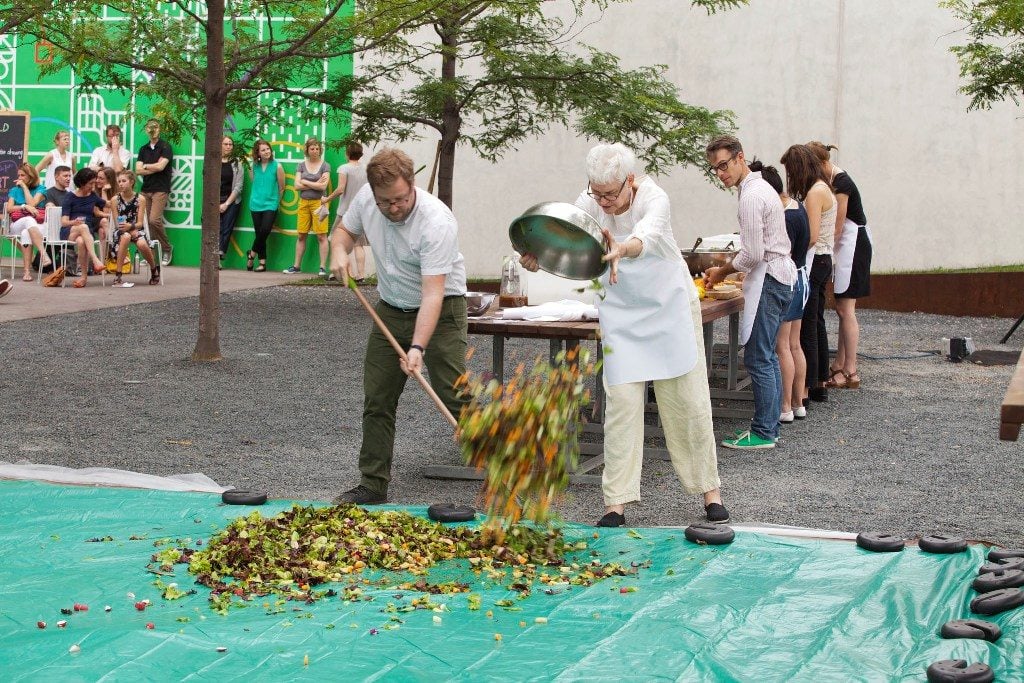
Alison Knowles (right) performing Make a Salad at the Walker Art Center in 2014. Photo: courtesy of the Walker Art Center.
Knowles’s iconic performance piece Make a Salad debuted at London’s Institute of Contemporary Arts in 1962, where she prepared and served iceberg lettuce to visitors. Over the years, she reprised the work at venues like Tate and the High Line, scaling it up for larger audiences using sanitized rakes and shovels. “Continuing with her own blend of sensory, participatory work well beyond the heyday of Fluxus in the 1960s, Ms. Knowles became known for a couple of signature elements,” wrote the New York Times. “One was beans, which she praised as ‘affordable and available.’ She cooked with them regularly and made art with them frequently, embedding them in handmade paper or placing them loose in paper pouches to turn them into sound makers.”
Koyo Kouoh, curator (1967–2025)
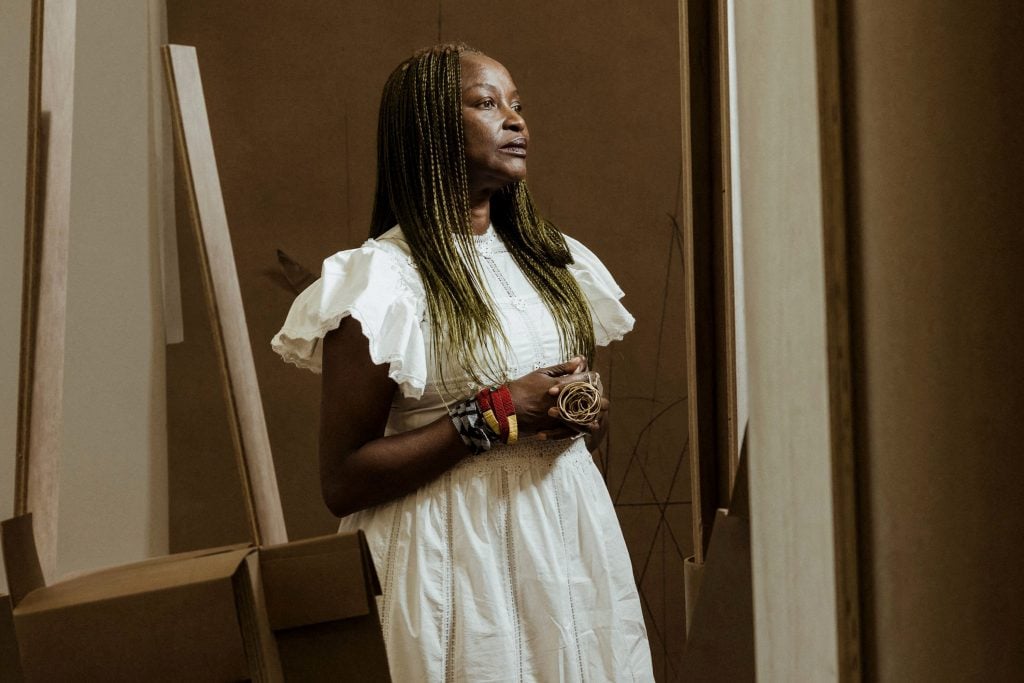
Koyo Kouoh in Cape Town, South Africa, in 2023. Photo: Marco Longari/AFP via Getty Images.
Koyo Kouoh, executive director and chief curator of Cape Town’s Zeitz MOCAA and the first African woman appointed to lead the Venice Biennale, died suddenly this year. The Biennale praised her “intellectual rigor and vision,” calling her passing “an immense void” in the global art community. Her chosen theme for the biennial, “In Minor Keys” will go ahead as planned, being realized by a curatorial team that Kouoh herself assembled. The exhibition will run May 9–November 22, 2026.
Max Kozloff, art critic, editor, and photographer (1931–2025)
Something of an art critic wunderkind who would eventually lead Artforum and become a photographer in his own right, Max Kozloff helped document the New York art scene in the 1960s and 70s and “the waning dominance of Abstract Expressionism,” the New York Times reported.
Mort Künstler, painter (1931–2025)
“Mr. Künstler developed a sense of dramatic realism early in the 1950s as an illustrator for pulp novels and men’s adventure magazine,” the New York Times reported. “As he branched out in the 1970s to create large canvases of epic scenes in American history, including more than 350 images of the Civil War, he consulted historians and experts and visited the locations of his scenes to ensure the accuracy of his work.”
Armand LaMontagne, sculptor (1939–2025)
“Mr. LaMontagne began earning a place in the hearts of New England’s rabid fan base in the 1980s with his painstakingly detailed representations of beatified Boston Hall of Famers like Ted Williams and Carl Yastrzemski of the Red Sox, Bobby Orr of the Bruins and Larry Bird of the Celtics,” the New York Times wrote. “To achieve lifelike results for his wooden sculptures, which were sometimes later cast in bronze, he invited his famous subjects—those who were still alive, at least—in for a fitting of sorts, measuring their arm lengths, thigh circumference and so forth, and then photographed them in an appropriate sporting pose.”
Gilles Larrain, photographer (1938–2025)
A former painter, Gilles Larrain photographed celebrities such as John Lennon and Yoko Ono, Mikhail Baryshnikov, and Norman Mailer for leading magazines, before pivoting to release Idols, a groundbreaking book documenting the drag culture and celebration of gay and transgender life, the New York Times reported.
Serge Lasvignes, museum director (1954–2025)
Serge Lasvignes was director of the Pompidou in Paris, helping spearhead plans to open a new satellite venue in southern Paris, and extending the institution’s “international reach,” reported the Art Newspaper.
Amy Lau, interior designer and art fair founder (1968–2025)


Amy Lau in 2008. Photo: Paul Morigi/WireImage via Getty Images.
Amy Lau was a talented interior design, known for her expertise in Modernism, who helped found the Design Miami fair, now a staple of Miami Art Week, wrote the New York Times.
Leonard Lauder, collector and philanthropist (1933–2025)


Leonard Lauder at the Breast Cancer Research Foundation’s Hot Pink Party in 2015. Photo: Kevin Mazur/WireImage.
Lauder’s cosmetics business, Estée Lauder Companies, made him one of the richest men in the U.S. That wealth afforded Lauder the opportunity to own some of the world’s most significant masterpieces, wrote Artnet News. The Whitney Museum of American Art in New York was another beneficiary of Lauder’s largess. He made the largest gift in the museum’s history in 2008, with a combination of art and money worth $131 million, including 50 paintings by Jasper Johns. When the museum opened its Meatpacking flagship in 2014, it named the building after him.
Kelvin LaVerne, artist and designer (1937–2025)
“Kelvin and his father often traveled to Greece and Italy for inspiration, spending months there sketching,” the New York Times reported. “Their fabrication methods were laborious and often dangerous. They developed a secret recipe to age their work, a mixture of chemicals and soil in which they would immerse a piece and freeze it for weeks, until it acquired a patina to their liking. They cast bronze using the lost-wax technique, an ancient and involved process. They brazed their work, a kind of welding. They sliced fretwork by hand—a tricky endeavor, often resulting in bloodied fingers. A single piece could take months to complete.”
Mel Leipzig, painter (1935–2025)
“In contrast to many contemporaries working in Abstract Expressionism or Minimalism, Mr. Leipzig was so devoted to verisimilitude that his favorite of his works was a 1991 acrylic on canvas view of his son, Joshua, sitting insouciantly in a bedroom festooned with graffiti and dirty laundry while three musician friends sprawl on the floor,” wrote the New York Times.
Daniel Lelong, dealer (1933–2025)

Daniel Lelong in 2009 at Galerie Lelong in Paris. Photo: courtesy of Galerie Lelong, New York and Paris.
“Lelong was trained as a lawyer but made a career pivot in 1961, when art dealer and collector Aimé Maeght approached him to provide legal assistance in establishing the country’s first-ever private art foundation,” reported Hyperallergic. “While working on the Maeght foundation, Lelong collaborated with some of the most well-known artists of the 20th century, including Joan Miró, Marc Chagall, and Francis Bacon. These connections, the gallery said, helped Lelong facilitate significant artwork acquisitions by notable collectors of the era, such as Joseph Hirschorn, namesake of the D.C. museum and sculpture garden.”
Jose Lozano, artist (1959–2025)
“Lozano’s artwork came to animate spaces in Latino communities, including Aliso Dreams, a mural painted on the side of the L.A. Plaza Village apartment complex near Olvera Street in Los Angeles, and the Lotería Card #1 mural that stands at the Bristol Swap Mall food court in Santa Ana,” wrote the L.A. Times. “His art sometimes faced criticism for supposedly depicting Chicanos in unflattering fashion. Others saw his artwork as political resistance.”
Gerald Luss, architect and interior designer (1926–2025)
“His plan for the Time-Life offices… was so true to its era that it provided the model for the sets of Mad Men,” the New York Times wrote. “He decorated the walls with murals by artists like Josef Albers and Fritz Glarner. Even the lowliest clerk could walk along rich plush carpets or gaze down on the Avenue of the Americas (Sixth Avenue to most New Yorkers) like a royal.”
David Lynch, filmmaker and artist (1946–2025)

David Lynch at the Academy of Motion Picture Arts and Sciences’ 11th Annual Governors Awards in 2019. Photo: Michael Tran/FilmMagic.
“Over a filmography spanning more than four decades, Lynch birthed a creative vision that injected everyday scenarios with sinister, otherworldly elements. That unsettling dreamlike tenor was sustained throughout his name-making movies, from Blue Velvet (1986) to Inland Empire (2006), and the hit TV series he co-created, Twin Peaks (1990–91),” wrote Artnet News. “So singular was this aesthetic that it called for its own descriptive, ‘Lynchian.’”
Alastair Mackinven, artist (1971–2025)
“His cross-disciplinary work, which spanned figurative painting, film sculpture and performance, often brought a playful, critical perspective to the act of artmaking itself, while drawing into question the institutional framework of the gallery. In one performance at Camden Arts Centre in London in 2008, he deliberately glued his hand to the floor of the gallery and waited to see how long it would take for gallery staff to offer him help,” wrote ArtReview.
Paul Marantz, lighting designer (1938–2025)
“His projects, sometimes done in concert with his business partners, Charles Stone and the Tony Award-winning lighting designer Jules Fisher, included new buildings—the Sainsbury Wing of the National Gallery in London (1991), the Rock and Roll Hall of Fame in Cleveland (1995), the Getty Center in Los Angeles (1997), the Museum of Islamic Art in Qatar (2008), the Barnes Foundation in Philadelphia (2012)—as well as many venerable old structures,” reported the New York Times. “And he and his partners were the megawatt wizards who, in 2002, helped realize Tribute in Light, the 9/11 memorial in Lower Manhattan with two luminous columns built on 88 searchlights.”
Paul McDonough, photographer (1941–2025)
Paul McDonough disliked the label of street photographer, but he made New York City his office capturing “stark romantic images, like a couple kissing in Central Park or youngsters at play; and statues, which he whimsically juxtaposed with human look-alikes,” the New York Times wrote.
Orien McNeill, artist (1979–2025)
The waterways were were Orien McNeill lived and where he made his art, homesteading on Brooklyn’s heavily polluted Gowanus Canal 20 years ago and helping Swoon take an ambitious floating art project featuring boats made from salvaged materials to the Venice Biennale, wrote the New York Times.
John McQueen, basketry sculptor (1943–2025)
In a statement after his death, the American Craft Council told the New York Times that John McQueen had “redefined the field of contemporary basketry to embrace nonfunctional sculpture, exploring concepts of containment and space.’”
Robert Mnuchin, dealer (1933–2025)

Robert Mnuchin. Photo: Richard A. Smith/Mnuchin Gallery
“Mnuchin was a major force at the top tier of the art market, exhibiting works by Willem de Kooning, Andy Warhol, Mark Rothko, and Franz Kline,” Artnet News‘s Katya Kazakina wrote. “He was also known as an advisor to billionaires like Steve A. Cohen and Mitchell Rales.
Alessandra Mondolfi, artist and activist (1969–2025)

Alessandra Mondolfi. Photo: James Eisele.
“Mondolfi was best known around South Florida for her protest art, which included posters and wearable pieces with in-your-face political messaging,” wrote the Miami New Times. “Just a few months after [President Donald Trump’s] first inauguration, she organized creatively minded anti-Trump marches across South Florida and other U.S. cities with the help of the Artful Activist, a progressive art collective… Among the works she created for the Artist March were large ‘Resist’ letters composed of American flags that could be seen with drones or by plane.”
Rodrigo Moya, photographer (1934–2025)
“Mr. Moya chronicled a tempestuous period in Latin American history. In the 1950s and ’60s, a time of rapid modernization and single-party rule, he documented the poverty and tumult of Mexico. He then widened his focus to photograph armed conflicts throughout the region and luminaries like the Cuban singer Celia Cruz, the novelist Carlos Fuentes and the painter Diego Rivera,” the New York Times reported.
Thomas Neurath, art book publisher (1940–2025)


Thomas Neurath. Courtesy of Thames and Hudson.
Neurath’s close relationship with artists, including David Hockney, was central to Thames and Hudson’s publishing legacy. “Whenever he could, Thomas combined business abroad with exploration of museums and galleries,” wrote the Art Newspaper. “One colleague summoned to Thomas’s office after he had returned from a trip to Karlsruhe expected to discuss the deals that had been made but was given instead an excited account of a visit to an exhibition of sound art at the ZKM Media Museum.”
Graham Nickson, artist and arts educator (1946–2025)
“Graham Nickson [was] an erudite British-born artist known for boldly figurative paintings rendered in lush, saturated colors—and for his influential stewardship of the New York Studio School of Drawing, Painting and Sculpture, the bastion of fine arts in Greenwich Village,” wrote the New York Times. “In his first year at the school, he conceived the Drawing Marathon, a two-week boot camp required for full-time students but also open to the public. With Mr. Nickson as its amiable, indefatigable guru, it became a cult-like pilgrimage for many, despite the eight-hour days and the critiques stretching late into the night, which required enormous stamina.”
Hans Noë, architect and sculptor (1928–2025)
“Mr. Noë spent three years as a student at the Cooper Union in Manhattan, where he found a mentor in the sculptor and architectural designer Tony Smith, who introduced him to other downtown figures, including Mark Rothko, for whom he stretched canvases, and Barnett Newman,” the New York Times reported.
Tatsumi Orimoto, performance artist (1946–2025)
First initiated in 1991, Orimoto twined loaves of bread—white flour baguettes, bloomers and rolls—onto his face. Now transformed into his alter-ego he paraded through the streets, sometimes with a similarly dough-dressed entourage, in Japan, U.K., U.S., Turkey, Nepal, and Germany, with each of the more than two hundred happenings documented by an assistant,” wrote ArtReview. “His route into performance came after his application to art college was rejected six times in a row. Instead, Orimoto traveled to the U.S., where he met Nam June Paik and, influenced by Yoko Ono and John Cage, became immersed in the Fluxus movement.”
Martin Parr, photographer (1952–2025)

British photographer Martin Parr at the National Portrait Gallery in London in 2019. Photo: Tolga Akmen / AFP via Getty Images.
“Parr made images that revel in quintessentially British eccentricities. Yet in them, we can all recognize our own foibles and pretensions. If some photographers seek profundity or fantasy, Parr offered a much more simple proposition. Whether turning his lens on a rundown coastal town or a middle-class garden party, he revealed what was already in front of us: a world of telling details, if you only care to look,” wrote Artnet News.
Leonardo Patterson, antiquities dealer (1942–2025)


Leonardo Patterson with a Maya temple in 1982. Photo: Paul Matthews/Fairfax Media via Getty Images.
“First in Miami and then in New York, he developed a reputation for always having rare, beautiful items, at a time when owning an authentic Olmec stone head was the height of Manhattan chic,” the New York Times wrote. “Mr. Patterson’s impoverished background only added to his appeal. He claimed to straddle the line between two worlds, as a globe-trotting sophisticate who retained a sturdy foothold in the jungles of Central America, giving him unmatched access and insight into the antiquities trade. He made a fortune.… In 2015, a court in Munich convicted him of trafficking in fake and illegal artifacts.”
Peter Phillips, painter (1939–2025)

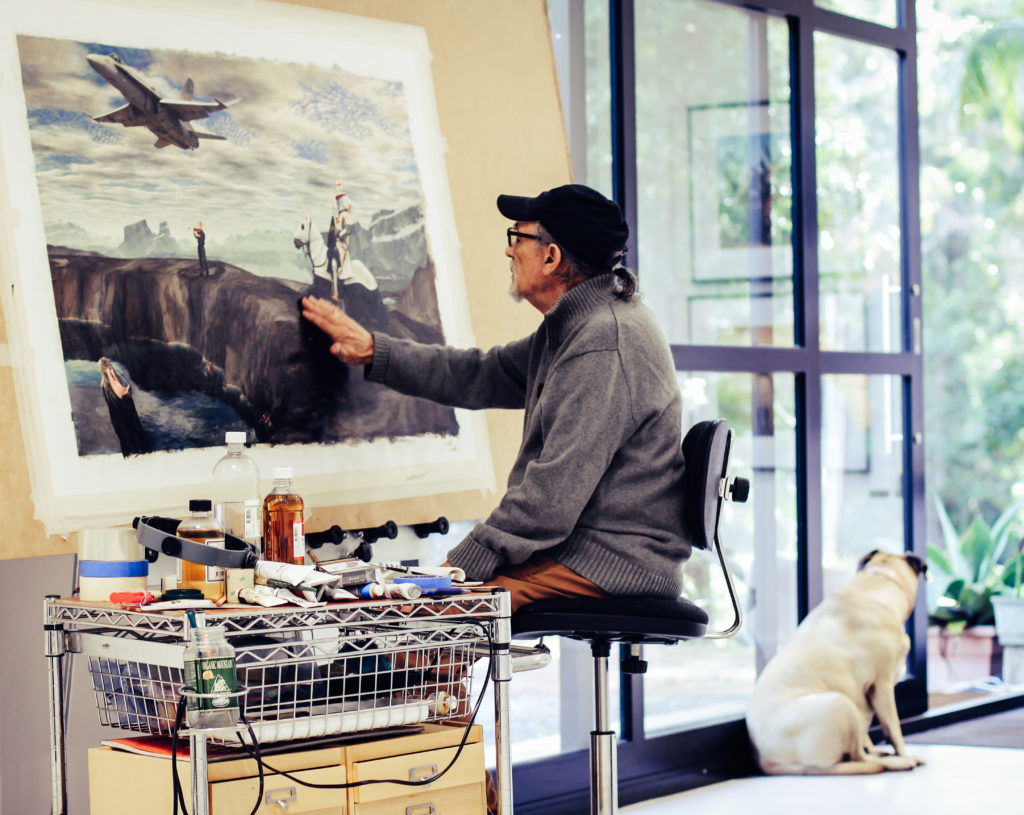
Peter Phillips in his studio. Courtesy of the artist.
“Mr. Phillips was part of a new generation of art mavericks who shook up the staid culture of prewar Britain—and the doldrums of the post-World War II recovery years—just as the 1960s were starting to swing,” wrote the New York Times. “Mr. Phillips’s approach evolved over the years: He turned to a sleek, airbrushed style that further blurred the line between high art and commercial art, and at times veered into photorealism, as with his sensuous ‘Mosaikbild’ paintings from the mid-1970s. In the ’80s, his work became more conceptual, featuring fantastical shapes and figures.”
Leonard Polonsky, arts philanthropist (1942–2025)
“In 2021, Mr. Polonsky made a $12 million donation to establish a new permanent exhibition at the New York Public Library on Fifth Avenue. Library employees spent three years sifting through 56 million artifacts in storage to identify 250 or so of the most awe-inspiring,” reported the New York Times. “The resulting display, known as ‘The Polonsky Exhibition of the New York Public Library’s Treasures,’ resembles a gilded curio shop of priceless items—among them, George Washington’s copy of the Bill of Rights (with 12 amendments instead of 10); Thomas Jefferson’s annotated version of the Declaration of Independence; a Gutenberg Bible; an Andy Warhol painting of a Studio 54 ticket; and stuffed animals that inspired A.A. Milne’s Winnie-the-Pooh.”
Arnaldo Pomodoro, sculptor (1926–2025)


Italian sculptor Arnaldo Pomodoro in his studio. Photo: Emanuele dello Strologo/Corbis via Getty Images.
“A self-taught artist who trained as an engineer and goldsmith, Mr. Pomodoro was best known for his imposing bronze spherical sculptures, which stand outside the United Nations headquarters in New York, inside Vatican City, on the campus of Trinity College Dublin and at the Hirshhorn Museum and Sculpture Garden in Washington, D.C., among many other locations,” wrote the New York Times.
Qiu Shihua, painter (1940–2025)
A survivor of China’s Cultural Revolution once forced to make propaganda posters and perform unskilled labor, Qui Shibua created work that combined Chinese aesthetics with Western abstract techniques, such as “white landscapes” meant to invoke calm and emptiness wrote Art Asia Pacific.
Dorgham Bassam Qreiqea, artist (1997–2025)
“Born in 1997, Qreiqea was a skilled muralist, oil painter, and portrait artist who exhibited in Gaza’s since-destroyed arts spaces, including Shababeek for Contemporary Art, where he was meant to have his first solo exhibition in late 2023. He had a studio space at his family home in Shuja’iyya, which was destroyed by the Israeli military in the last year,” Hyperallergic wrote. “Qreiqea had always focused on community empowerment as an artist, working especially to improve and enrich the lives of Palestinian children.”
Jaune Quick-to-See Smith, artist (1940–2025)

Jaune Quick-to-See Smith. Photo: Grace Roselli/Pandora’s Boxx Project, courtesy of the artist’s estate and Garth Greenan Gallery, New York.
“In 2023, her largest retrospective, ‘Jaune Quick-to-See Smith: Memory Map,’ opened at the Whitney Museum of American Art, exploring her use of Pop and Abstract Expressionist elements and her own visual motifs to address issues from land rights (as in Survival Map, 2021) to the commodification of Indigenous culture (Spam, 1995),” Artnet News reported. “In works such as Trade Canoe: Making Medicine (2018), which confronted environmental destruction, and Trade (Gifts for Trading Land With White People) (1992), on colonial acquisition, emerge Smith’s provocative critiques as much as her dark humor.”
Raquel Rabinovich, artist (1929–2025)
“Rabinovich [was] best known for her monochromatic paintings and glass sculptures… over a storied career, her works ranged from hard-edge abstraction to film and land art,” wrote Artnet News.
Arnulf Rainer, artist (1929–2025)
“Throughout his life, Arnulf Rainer searched for radical and new artistic solutions—and found them in his art,” Der Standard wrote. “His art not only rejected prevailing norms of painting, but also erased content and form, thereby creating new ones—surrendering itself fully to existentialist questions.”
Marcia Resnick, photographer and Conceptual artist (1950–2025)
“Ms. Resnick frequently captured her subjects in the wild, but more often she took them home for overnight sessions at her Canal Street loft, in the building that she and other young artists had colonized in the mid-1970s,” the New York Times reported. “It was during her Canal Street sessions that Ms. Resnick began to focus on male subjects, deliberately upending the age-old practice of men memorializing women. She wanted to subvert the male gaze. She called this work her ‘Bad Boy’ series.”
Walter Robinson, art critic and painter (1950–2025)


Walter Robinson in 2016. Photo: Patrick McMullan via Getty Images.
“Robinson was one of those exceedingly rare figures who always managed to be up to something new and intriguing… Robinson was omnipresent, a good quality in a journalist. After working as an editor at the East Village Eye and Art in America, he was tapped in 1995 to run Artnet Magazine, this publication’s predecessor,” wrote Artnet News. “When Artnet Magazine was shuttered that year, Robinson devoted himself to painting and enjoyed a late-career resurgence, showing with dealers like Jeffrey Deitch and Vito Schnabel.”
Abel Rodríguez, artist (1934/44–2025)
A member of the Indigenous Nonuya ethnic group, Rodríguez didn’t consider himself an artist—his colorful ink-on-paper drawings were a means of relaying and communicating his deep knowledge of the tropical plants of the Amazon basin and their medicinal properties, reported Hyperallergic.
Doris Lockhart Saatchi, collector (1937–2025)
“It was in the 1970s that she and her husband at the time, the British advertising executive Charles Saatchi, began assembling what the New Criterion magazine described in 1986 as ‘one of the finest collections’ of contemporary art in the world, buying hundreds of works by artists like Donald Judd, Brice Marden, Andy Warhol, Robert Ryman, and Carl Andre,” reported the New York Times. “With Mr. Saatchi’s money—he had made his fortune in part as the adman who helped make Margaret Thatcher prime minister of Britain—and his wife’s discerning eye, the couple had the resources to give modernist art exceedingly wide visibility in both Britain and America.”
Jillian Sackler, collector and philanthropist (1940–2025)
As the wife of the art philanthropist and collector Arthur Sackler, Sackler enjoyed considerable prestige—until the Sackler name turned to mud due to the family’s association withe the opioid epidemic, prompting her to mount a defense that Arthur’s branch of the family never benefitted from the sale of Oxycodone, reported the New York Times.
Josh Sailor, gallerist (1937–2025)
“Sailer devoted himself wholeheartedly to his passion for contemporary art, starting with the founding of Galerie Ulysses. He played an important advisory role in the renovation of several museums, including New York’s MoMA (1978) and the Belvedere Palace in Vienna (1987),” the Art Newspaper reported. “Sailer also worked to develop an interest in Austrian and German artists at leading U.S. museums.”
Sebastião Salgado, photographer (1944–2025)
“Working mostly in black and white, Mr. Salgado garnered widespread acclaim at home and abroad with his striking images of the natural world and the human condition, often traveling around the globe to photograph impoverished and vulnerable communities. In all, he worked in more than 120 countries throughout his career,” wrote the New York Times. “Mr. Salgado was especially interested in the plight of workers and migrants, and spent decades documenting nature and people in the Amazon rainforest.
Clovis Salmon, documentary filmmaker (1927–2025)
“Known by his nickname ‘Sam the Wheels’ and self-taught, Salmon came to prominence capturing the Brixton riots in 1981, documenting the experiences of police brutality and racism meted out to his friends and family in the South London Black community,” ArtReview wrote. “Using a Super-8 camera concealed in his coat, his footage of the two day disturbance has been used in countless documentaries and films since, regarded as one of the primary sources for the events that would have a lasting imprint on race relations in the U.K.”
Raymond Saunders, artist (1934–2025)


American artist Raymond Saunders in the 1970s. Photo: Anthony Barboza/Getty Images.
“Saunders’s work is characterized by an assemblage style with an extensive use of black paint that tied together both his commonplace lived experiences and formal art training. Saunders weaves complex narratives through elusive means and, in so doing, often prods the very fabric of what it means to be an educated Black American man,”ARTnews reported.
Rosalind Savill, curator and museum director (1951–2025)

Rosalind Savill. Photo: courtesy of the National Portrait Gallery, London.
“Dressed in rich colors and arrayed in arresting jewelry, with flowing blond hair and a bewitching smile, Savill radiated confidence in her role as the director of the Wallace Collection, London, from 1992 to 2011,” wrote the Art Newspaper. “She transformed that rather staid national museum into a vibrant tribute to the culture and artifacts of 18th-century France.”
Constance Schwartz, curator and museum director (1929–2025)
“A prominent figure in the art world for more than 30 years, Schwartz was a renowned curator, art historian, educator, and fine art consultant,” wrote the Long Island Press. “In 1989, the Nassau County Museum of Art became a private non-profit institution, and, one year later, Schwartz became its first director and chief curator, a position she held for more than 23 years. Under her visionary leadership, NCMA became one of the most respected regional museums in the country.”
Ricardo Scofidio, architect (1935–2025)


Ricardo Scofidio attends MoMA’s Party in the Garden in 2019. Photo: Andrew Toth/Getty Images for MoMA.
“He and Elizabeth Diller, his former student at the city’s Cooper Union, opened the firm Diller + Scofidio in Manhattan’s East Village in 1979. It expanded to Diller Scofidio + Renfro, or DS+R, with the 1997 addition of Charles Renfro. In 1999, they were recognized with a MacArthur ‘genius’” grant, the first architects accorded that honor. They also enjoyed a 2003 retrospective at New York’s Whitney Museum of American Art,” reported Artnet News. “In 2009, Diller and Scofidio were named among TIME magazine’s most influential people in the world.”
Peter Sedgley, painter (1930–2025)
“To Peter Sedgley art was not something that existed only in the rarefied atmosphere of galleries and museums, though his work was exhibited in the most prestigious of them,” the London Times wrote. “An audacious stalwart of the 1960s explosion in experimental expression, he argued long before Banksy arrived on the scene that art belonged on the street and that its purpose was to surprise, perplex and even to shock as long as it stimulated a reaction from those passing by.”
Gretchen Dow Simpson, painter (1939–2025)
“Ms. Simpson was best known for her meditative images of the seaside and country architecture of the Northeastern seaboard,” the New York Times wrote. “While modest, solitary buildings were often her subject matter, Ms. Simpson’s work was not purely representational. A former commercial photographer, she applied a telephoto approach to many of her paintings, zooming in on windows, doorways or rooftops to emphasize the juxtaposed angles and intersecting lines that characterized her work, giving it the feel of abstract art.… it was her two-decade run producing cover paintings for the New Yorker that most shaped her legacy.”
Joel Shapiro, sculptor (1941–2025)

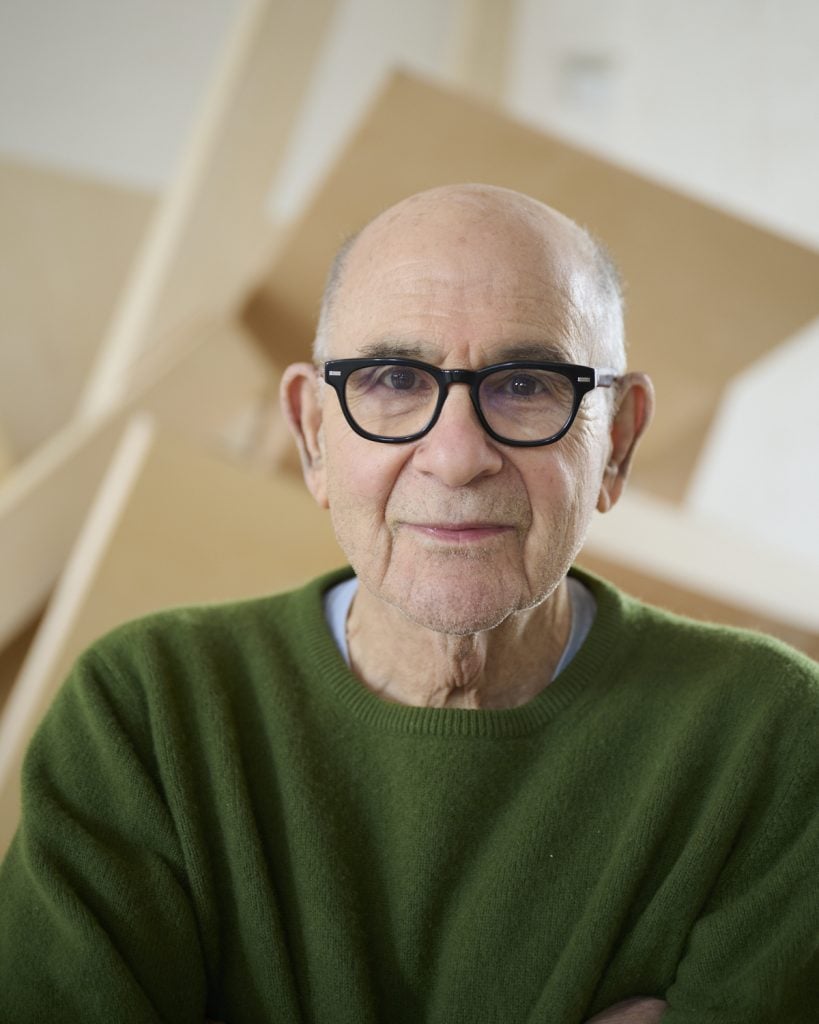
Sculptor Joel Shapiro in 2024. Photo: Kyle Knodell.
“Mr. Shapiro’s best-known sculptures are easy to recognize. Constructed from wooden beams jutting in different directions, they typically suggest a human figure with outstretched arms, a blocky head and a torso shaped like a cereal box,” reported the New York Times. “From one piece to the next, his figures variously leap with apparent joy, dance balletically, fall backward, twist in existential pain, topple onto their heads or collapse onto the floor in a tangle of arms and legs. Their subject, in the end, is balance, or rather imbalance—of both the spatial and mental sort.”
Karen Shaw, curator and conceptual artist (1941–2025)
Karen Shaw was both a dedicated mother and artist, creating avant-garde feminist artwork that is in the collection of the New York’s Museum of Modern Art, among other institutions, while also working as a curator at Long Island’s Islip Art Museum, wrote Newsday.
Beuford Smith, photographer (1941–2025)

Beuford Smith attends “Soul of a Nation: Art In the Age Of Black Power 1963-1983” at the Broad. Photo: Leon Bennett/Getty Images.
“Mr. Smith came of age in the early 1960s, when Black photographers had scarce opportunities to be hired by mainstream publications,” wrote the New York Times. “He joined a collective of talented Black photographers in Harlem called the Kamoinge Workshop, a networking group that offered encouragement to its members, helped nurture their skills and told stories about Black people through their photos.”
Chris Steele-Perkins, photographer (1947–2025)
“What distinguished Steele-Perkins throughout his career was a willingness to go where others did not. In 1970s and 1980s Britain, while many of his contemporaries focused on institutions or political unrest, Steele-Perkins instead turned his camera towards overlooked spaces,” wrote the Art Newspaper.
Carla Stellweg, dealer and curator (1942–2025)
“Stellweg was a pivotal figure in the Latin American art world, working mainly between Mexico City and New York,” reported the Art Newspaper. “The founder and editor-in-chief of the bilingual art magazine Artes Visuales, she went on to become an early promoter of Latin American artists including Liliana Porter, Ana Mendieta and Luis Camnitzer through her New York galleries Stellweg–Seguy Gallery and Carla Stellweg Latin American and Contemporary Art.”
Drew Struzan, artist (1947–2025)
An illustrator with a knack for dynamic realism, Struzan was behind enduring, iconic posters for numerous films—from Indiana Jones and the Last Crusade (1989) to Harry Potter and the Sorcerer’s Stone (2001), as well as seven Star Wars movies and the Back to the Future trilogy. “His illustrations fully captured the excitement, tone, and spirit of each of my films his artwork represented,” director George Lucas told the New York Times after the artist’s death.
Gerd Stern, artist (1928–2025)


Gerd Stern. Photo: Robert R. McElroy/Getty Images.
“Mr. Stern’s life was as colorful, confusing and sometimes chaotic as his art,” wrote the New York Times, noting that in 1963, he began taking LSD, a further influence on his art. In a 1968 profile, the New York Times Magazine characterized him as “a bearded bard and proselytizer-practitioner of a new art.”
Robert A.M. Stern, architect (1939–2025)
“Stern is big on fitting into context,” the New Yorker’s architecture critic Paul Goldberger wrote in 2007. “His business school at the University of Virginia is pure Thomas Jefferson; his Norman Rockwell Museum in Stockbridge looks like a classic New England meeting house; he’s done sprawling Shingle Style houses in East Hampton and Spanish Colonial ones in California.
Walter Swennen, painter (1946–2025)


Walter Swennen in 2018. Photo: Independent Photo Agency Srl/Alamy Live News.
“An enduring figure in European contemporary art, he is widely credited with reshaping the field’s understanding of what painting can do,” wrote Artnet News.
Margaret Tedesco, artist and curator (1952–2025)
“Tedesco was a generous, nearly omnipresent figure at Bay Area performances, poetry readings, gallery openings, film screenings and talks,” reported KQED. “Tedesco leaves behind an enormous archive of artwork, printed materials and ephemera—a collection that occupies one of the bedrooms of her apartment.”
Sara Terry, photographer (1955–2025)
“She shunned traditional conflict photography, trying instead to capture lingering traces of strife—sometimes in the faces of those who survived it and sometimes by photographing the haunted places war had passed through,” the New York Times wrote. “Ms. Terry’s capacity for sympathizing with her subjects and their suffering made her stand out.”
Oliviero Toscani, photographer (1942–2025)

Italian photographer Oliviero Toscani. Photo: Catherine Cabrol/Corbis via Getty Images.
“Toscani’s provocative campaigns for the Benetton fashion house, where he served as artistic director for more than two decades, drew attention to issues ranging from racism to capital punishment and helped transform the company into a global brand. Among his most controversial adverts was one featuring his photograph of a nun and priest kissing, which was eventually banned in Italy,” reported the Art Newspaper. “Working for fashion magazines including Elle, Vogue, L’Uomo Vogue, and Harper’s Bazaar, [he] gained a reputation for advertising campaigns that blurred the boundaries between art, marketing, and activism.”
Norman Toynton, painter (1939–2025)
From inauspicious career beginnings as a classmate of David Hockney’s at the Royal College of Art in the 1960s, where he and Allen Jones, were expelled “for rebelling against his conservative professors’ teachings,” Norman Toynton went on to enchant critics with his paintings on Masonite pegboard, wrote the Guardian.
Ruth Thorne-Thomsen, photographer (1943–2025)
Armed with a pinhole camera, Ruth Thorne-Thomsen created postcard-sized, often surreal images of miniature landscapes she built, elevating travel photography into art, the New York Times reported.
Zurab Tsereteli, painter and sculptor (1934–2025)
“Tsereteli, who was often described as being a businessman as well as an artist, had been serving as president of the Russian Academy of Arts since 1997 and controlled multiple museum spaces in Moscow. Two of them were dedicated to his own art, one adjacent to the academy headquarters, another his studio, attached to a pre-revolutionary mansion in Moscow where he hosted dinner parties with Gypsy singers,” wrote the Art Newspaper. “Tsereteli’s 98m-tall, 1,000-ton monument to Peter the Great, which he created out of stainless steel, bronze and copper in 1997 near Christ the Savior Cathedral in view of the Kremlin, became a flashpoint of protest by critics who said it distorted the Russian capital’s cityscape.”
Günther Uecker, artist (1930–2025)


Günther Uecker in his studio in 2020. Photo: Fabian Strauch/picture alliance via Getty Images.
“His meditative work with nails grew partly out of an interest in purification rituals including Gregorian chant. By the late ‘50s, he was integrating nails into his work, and soon would add corks and cardboard tubes to his arsenal… Uecker drove nails not only into painting-like surfaces, but also items such as pianos, chairs, and television sets,” Artnet News wrote. “He joined the Zero Group, created by artists Heinz Mack and Otto Piene, in 1961. The group’s name reflected a desire to return art to a ‘zero base.’”
Guy Ullens, collector (1935–2025)
Art collector Guy Ullens developed an interest in Chinese contemporary art in the 1980s and ’90s, eventually founding an eponymous institution in Beijing’s 798 art district to spotlight these works, wrote the Art Newspaper.
Jack Vettriano, painter (1951–2025)
“Mr. Vettriano, a Neorealist painter with a penchant for eroticism, often depicted ordinary people, particularly glamorous women, in intimate situations with Scotland as the backdrop. Fans of his work included the actor Jack Nicholson and the songwriter Tim Rice, but critics savaged his work as lowbrow and, at times, chauvinistic,” the New York Times wrote of the painter, best known for The Singing Butler, the most expensive work at auction in Scotland.
Dorothy Vogel, collector (1935–2025)


Art collector Dorothy Vogel attends the New York Premiere of Herb And Dorothy 50×050 at the IFC Center. Photo: Rob Kim/Getty Images.
A reference librarian, Dorothy Vogel and her husband, post office employee Herbert Vogel, stretched their humble means to become some of the 20th century’s leading American art collectors, amassing over 4,000 works by leading artists, many of which they would leave to the National Gallery in Washington, D.C., wrote the New York Times.
Lumin Wakoa, painter (1982–2025)

Lumin Wakoa. Photo: Quyn Duong, courtesy of Harper’s Gallery, New York.
“Wakoa’s paintings drifted between abstraction and figuration, and often were based on sights she had seen: half-remembered bouquets, leafless trees, forests stuffed with greenery,” ARTnews reported. At the time of her passing, her career was on a strong upward trajectory. In the past year, she held solo exhibitions at Various Small Fires in Seoul and Harper’s in New York. The year prior, she showed with Various Small Fires in Los Angeles—who also featured her work at two Frieze art fairs—and exhibited in London at Taymour Grahne Projects.
Thornton Willis, painter (1936–2025)
Known for painting abstract geometric shapes, Thornton Willis was a third-wave member of the New York School whose work defied categorization in a single genres, spanning Abstract Expressionism, lyrical abstraction, and Color Field painting, among other styles.
Robert Wilson, theater director, playwright, and visual artist (1941–2025)
“Robert Wilson [was an] acclaimed theater director, playwright and visual artist who shattered theatrical norms with stunning stagings of his own imaginative works as well as innovative collaborations with a diverse roster of artists, from Philip Glass to Lady Gaga,” wrote the New York Times.
Frank Wimberley, artist (1926–2025)


Frank Wimberley in 2019. Photo: by Laurie Lambrecht, courtesy of Berry Campbell, New York.
A member of the Abstract Expressionist and Black Arts Movements, Frank Wimberley helped established the Eastville Artists group on Long Island’s East End, where he was a fixture of the art scene, painting nearly up until his death at 99, wrote Hyperallergic.
Elaine Wynn, collector and philanthropist (1942–2025)
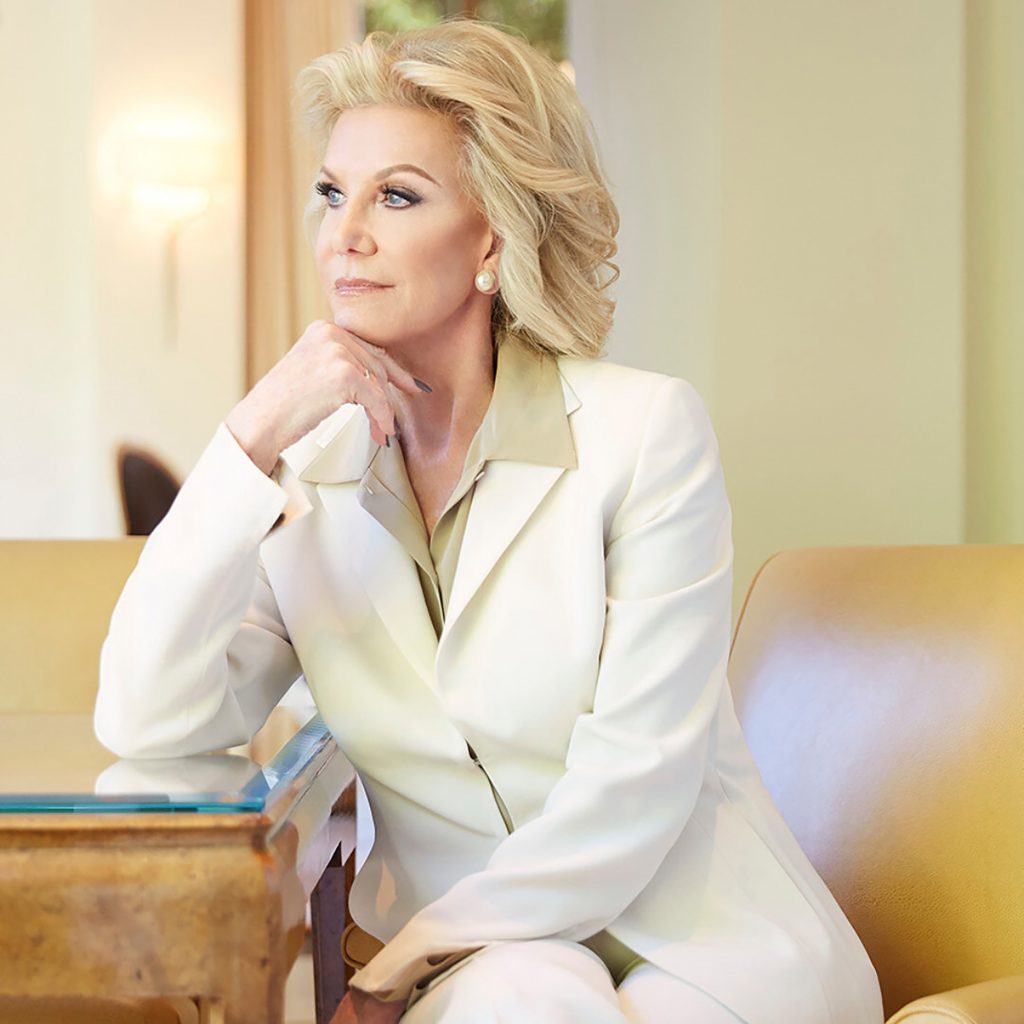
Elaine Wynn. Photo: Courtesy of Christie’s.
Co-founder of Wynn Resorts and Mirage resorts, which ultimately transformed the Las Vegas Strip, Wynn assembled a major art collection featuring Edouard Manet, Joan Mitchell, and Lucien Freud. In 2013, she purchased Francis Bacon’s Three Studies of Lucian Freud for $142.4 million, then the most expensive work ever sold at auction. A LACMA board member since 2011 and co-chair from 2015 until her death, the Elaine P. Wynn and Family Foundation directed contributions in Wynn’s memory to be made to the museum to support the building of its satellite Las Vegas Museum of Art, which is tentatively slated to open in 2028.
Shelly Zegart, quilt historian, advocate, and collector (1941–2025)
“Once called the ‘Queen of Quilts,’ Ms. Zegart wore stylish glasses, had an occasionally imperious personality and never stitched so much as a sweater in her life,” wrote the New York Times. “What she did make were connections: between quilters, art collectors, historians and museums. In doing so, she connected quilting to the American experience—from hollows in Appalachia to the stark plains of Nebraska.”